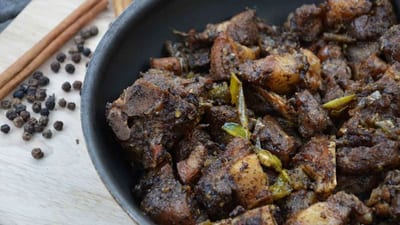
Malu ambul thiyal, usually called sour fish curry in English, is a dry fish preparation from the south coast of Sri Lanka. Chunks of firm tuna are coated in a paste of goraka and crushed black pepper, then cooked slowly, without stirring, until every drop of liquid has gone and the fish is dark, tangy and peppery. In Sinhala, malu means fish and ambul means sour, and the name is often rendered as "dry sour fish".
Unlike most Sri Lankan curries it contains no coconut milk and almost no gravy. It began as a way of keeping fish good for several days without ice, and it is still a favourite for packing for journeys and for eating with rice, a coconut sambol and a vegetable curry. Recipes range from the strict southern version of goraka, pepper and salt to fuller ones with garlic, chilli and whole spices; the card below sits in the middle.
How to make malu ambul thiyal
- Serves 4
- Prep: 15 minutes (+ 15 minutes resting)
- Cook: 50 minutes
- Difficulty: Moderate
Ingredients
- 500 g firm tuna (skipjack or yellowfin), cut into flat pieces about 5 cm wide and 2.5 cm thick
- 8 pieces goraka (dried Garcinia cambogia rind)
- 2 tbsp freshly crushed black pepper
- 1 tsp chilli powder (optional)
- 4 garlic cloves, peeled
- 1 1/2 tsp salt
- 2 sprigs curry leaves
- 5 cm piece Ceylon cinnamon stick
- 5 cm piece pandan (rampe) leaf (optional)
- 250 ml water
- 1 tsp coconut oil, for the pot
- 1 piece banana leaf, to line the pot (optional)
Method
- Soften the goraka. Rinse the goraka, put it in a small pan with 125 ml of the water and simmer over a medium heat for about 10 minutes, until the pieces are soft.
- Make the paste. Grind or pound the goraka with the pepper, chilli powder, garlic and salt, adding the goraka cooking water a little at a time, to a thick, dark paste. Taste it: it should be sharply sour, peppery and well salted.
- Coat the fish. Rub the paste over every piece of fish and leave to rest for 15 minutes.
- Layer the pot. Oil a clay pot or heavy-based pan and line the base with the banana leaf, if using. Scatter in half the curry leaves, lay the fish in a single layer, spread any remaining paste on top and add the rest of the curry leaves, the cinnamon and the pandan.
- Bring to the boil. Rinse the paste bowl with the remaining 125 ml water and pour it around the fish. Bring to the boil over a medium heat, then shake the pot gently so the pieces do not stick. Do not stir.
- Simmer until dry. Turn the heat to low and cook uncovered for 30 to 35 minutes, shaking the pot now and then and turning the pieces once with a spoon, until almost all the liquid has gone.
- Dry off. Keep the pot on the lowest heat for a further 5 to 10 minutes, until the paste clings to the fish and the pieces are dark grey to black at the edges. Take care not to scorch the base.
- Cool. Take the pot off the heat and let the fish cool completely in the pot before serving or storing.
What is goraka and can it be replaced?
Goraka is the fruit of Garcinia cambogia (also listed as Garcinia gummi-gutta). The segments are sun-dried until they turn black and shrivelled, and they keep for months. Soaked and ground, they give a deep, rounded sourness that is quite different from lime or vinegar, and in this dish they also give the fish its dark colour. Tamarind is the usual substitute outside Sri Lanka, but the result is lighter in colour and fruitier in taste; dried goraka is sold in most South Asian grocers and is worth finding.
Why so much black pepper?
Pepper, not chilli, is the heat in ambul thiyal. Ceylon black pepper, crushed fresh, gives a warm, lingering bite that stands up to the sourness of the goraka. Quantities vary widely between households: some southern cooks use several times the amount given here. Start with 2 tablespoons and increase next time if you like it hotter.
Which fish should you use?
Tuna is the traditional choice. Skipjack (balaya) and yellowfin (kelawalla) are the everyday catch of the offshore boats around the island, the same fish that anglers target on deep sea fishing trips. Any firm, meaty fish that holds its shape through a long, slow cook will work, such as seer fish or swordfish. Avoid delicate white fish, which breaks up before the liquid has cooked away.
What do you serve it with?
Ambul thiyal is strongly seasoned, so a piece or two goes a long way. Serve it with plain rice, a dhal curry and a coconut sambol made from freshly grated coconut, or with string hoppers and coconut roti. Leftover pieces can be flaked into sandwiches or a quick fried rice.
How do you store it?
The low moisture and the sourness of the goraka are why the dish was traditionally kept for days without refrigeration. At home today, cool it completely, keep it covered in the fridge and eat it within 4 days, always taking pieces out with a clean, dry spoon. It also freezes well for up to a month in an airtight container. Reheat gently in a covered pan with a spoonful of water.
Tips for the best result
- Arrange the fish in one layer. Stacked pieces steam instead of drying and cook unevenly.
- Shake, do not stir. Stirring breaks the fish; a gentle shake of the pot is enough.
- A clay pot holds a low, even heat and is the traditional vessel, but any heavy-based pan works.
- Taste the paste before it goes on the fish. Adjust the salt and pepper then, because it is hard to correct once the fish is cooked.
Related reading
3 pages on closely related subjects.