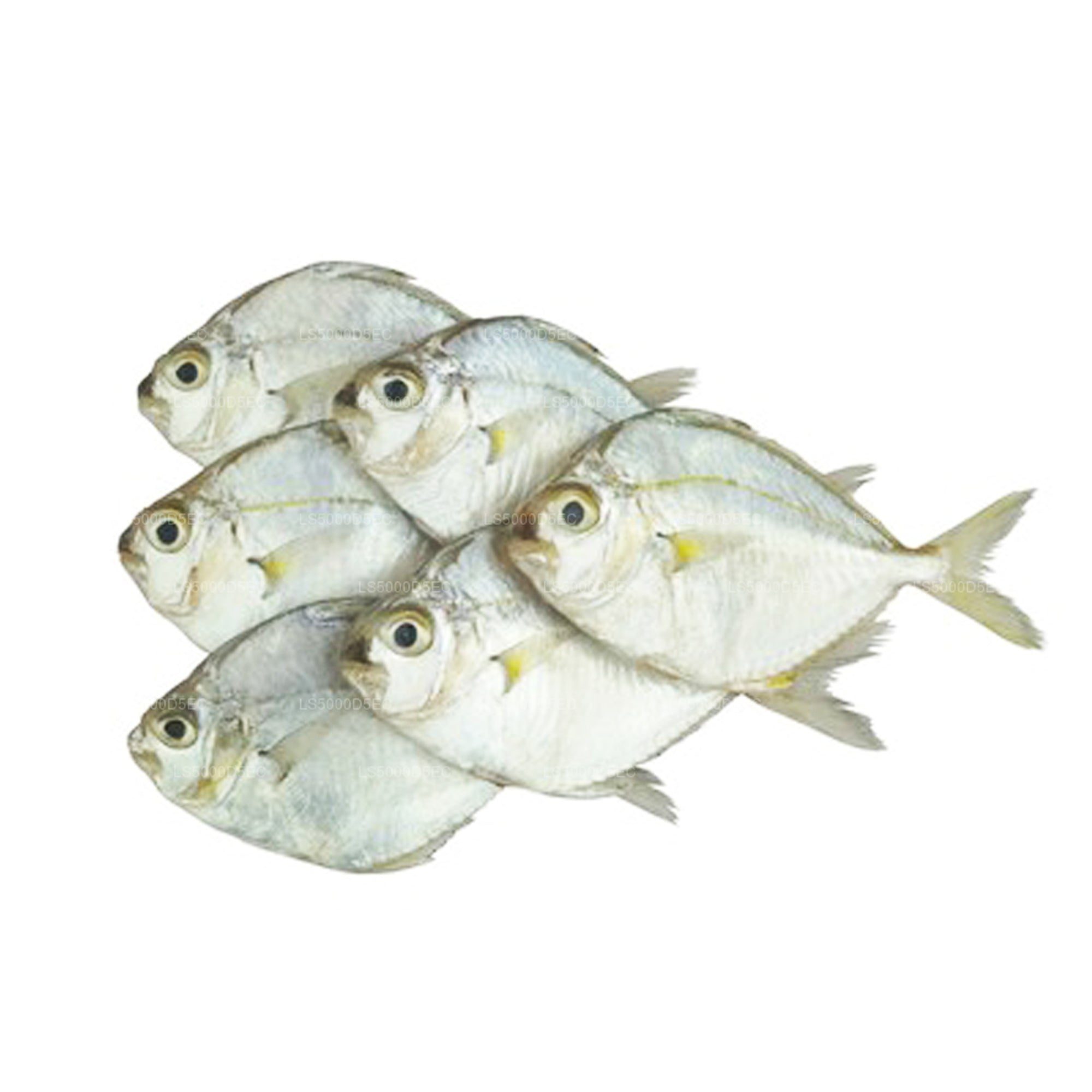
Goatfishes belong to the family Mullidae, a group of perciform fish found across tropical and subtropical seas worldwide. They are best known for the pair of fleshy chin barbels that give them their common name — a feature that doubles as a highly sensitive foraging tool. Around eighty-six described species are spread across six genera, making Mullidae one of the more diverse reef-fish families in the Indo-Pacific region.
What makes goatfishes different from other reef fish?
The defining feature of every goatfish is a pair of chemosensory barbels tucked beneath the chin. When the fish is resting or swimming, these barbels fold back against the throat; when foraging, they extend downward to probe sandy substrates or crevices in coral reef for invertebrates, small crustaceans, and worms. No other widely encountered reef fish uses quite this mechanism.
Their bodies are moderately deep and elongated, tapering to a clearly forked tail. Two dorsal fins sit well apart from each other — the first carries six to eight stiff spines, while the second has a single spine and eight to nine soft rays. The anal fin is comparably short, bearing one or two spines and five to eight soft rays. Internally, goatfishes are distinguished by a consistent vertebral count of twenty-four.
How large do goatfishes grow?
Size varies considerably across species. The largest member of the family is the dash-and-dot goatfish (Parupeneus barberinus), which can reach around 60 cm in length. The majority of species, however, stay well under 30 cm, making them mid-sized reef residents rather than large pelagic targets. Despite modest dimensions, many species are commercially important in artisanal fisheries throughout the Indo-Pacific.
What colours do goatfishes display?
Colouration across the family ranges from pale cream and yellow to vivid reds, pinks, and striped patterns. Many species can alter their colour rapidly — a trait linked to social signalling and camouflage rather than any fixed pigmentation. The genus Mullus, the red mullets of the Mediterranean and eastern Atlantic, gives the family its alternative name: red mullets. In English, however, the word "mullet" more commonly refers to the entirely unrelated grey mullets of the family Mugilidae, so the name goatfish — or its family name, Mullidae — is generally preferred to avoid confusion.
Where do goatfishes live and feed?
Most species favour sandy or rubble patches adjacent to coral reefs, typically in relatively shallow water down to around 100 m. They are active, diurnal foragers, working the seafloor methodically with their barbels while the body tilts to near-vertical. Schools are common, and mixed-species aggregations are often seen in areas with abundant soft substrate. At night, many goatfishes adopt a blotchy resting colour pattern and become largely inactive.
Their diet is primarily carnivorous: small crustaceans, polychaete worms, molluscs, and foraminifera make up the bulk of what the barbels unearth. This bottom-feeding role gives goatfishes an ecological function similar to that of larger burrowing invertebrates — turning over sediment and recycling nutrients in reef systems.
Which goatfish species are found in Sri Lankan waters?
Sri Lanka's coastal reefs and sandy lagoons support several species from the genus Parupeneus and Mulloidichthys, among others. The yellowfin goatfish (Mulloidichthys vanicolensis) and the manybar goatfish (Parupeneus multifasciatus) are regularly recorded by divers around reef sites on the south and west coasts. The dash-and-dot goatfish appears in deeper reef zones. Locally, goatfishes are sometimes grouped with other small reef fish sold fresh at coastal markets, though they are not among the country's principal commercial species.
Are goatfishes related to the red mullet served in European cuisine?
Yes, in a direct taxonomic sense. The European red mullet (Mullus surmuletus) and the striped red mullet (Mullus barbatus) are full members of the family Mullidae and share the characteristic barbels of all goatfishes. Both the family name Mullidae and the Latin word mullus trace back to the same root. Red mullets have been a prized table fish since Roman times, valued for their firm, mildly sweet flesh. Tropical goatfishes are eaten across the Indo-Pacific in much the same way — grilled, curried, or dried — though they rarely command the same prestige in Western markets.
How do goatfishes fit into Sri Lankan coastal cuisine?
Smaller goatfishes caught incidentally in artisanal nets are sometimes dried and salted in the traditional Sri Lankan karawala style alongside other reef species. Dried fish remains a cornerstone of Sri Lankan home cooking: it is pounded into sambols, fried with onion and chilli, or used as a flavour base in rice-and-curry meals. While goatfish is not the most prominent species in this tradition, the broader culture of preserving and cooking small reef fish is deeply embedded in coastal communities from Negombo to Mirissa.
Related reading
4 pages on closely related subjects.