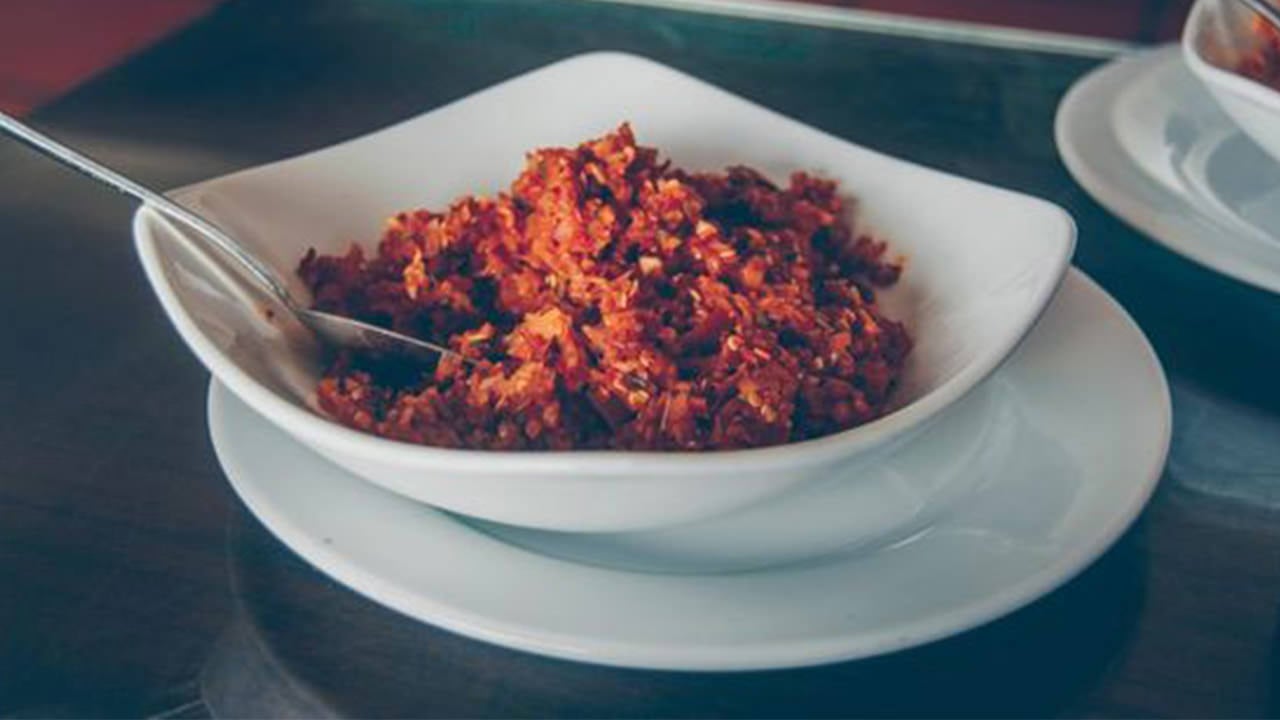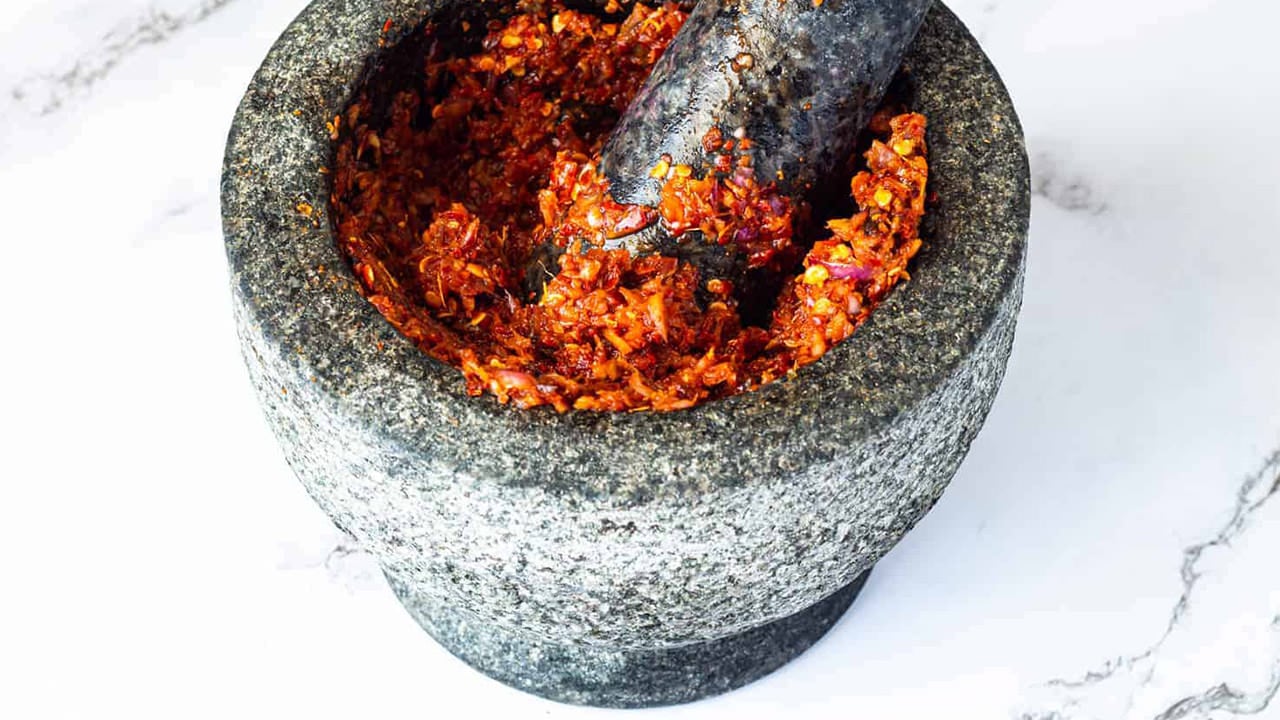


Lunu miris (ලුණු මිරිස්) means "salt and chilli" in Sinhala, and that is the heart of it: dried red chilli pounded with salt, red onion or shallots and a squeeze of lime into a rough, fiery, wet paste. Many cooks also pound in a spoonful of Maldive fish for a savoury depth. Nothing is cooked, and a small bowl takes about ten minutes to make.
Its most famous partner is kiribath, the coconut milk rice served at the Sinhala and Tamil New Year and on other special mornings, where the sharp heat of the sambol offsets the mild, creamy rice. It is just as common with hoppers, coconut roti, pittu, bread and rice.
How to make lunu miris
- Serves 4
- Prep: 10 minutes
- Cook: none (pounded raw)
- Difficulty: Easy
Ingredients
- 120 g (about 1 cup) shallots or 1 medium red onion, peeled and sliced
- 1 tbsp dried red chilli flakes
- 1/2 tsp chilli powder (optional, for extra heat and colour)
- 1/2 tsp salt
- 1 tbsp Maldive fish (umbalakada) chips (optional)
- 2 tsp lime juice (about half a lime)
Method
- Grind the dry ingredients. Put the chilli flakes, chilli powder, salt and Maldive fish, if using, in a mortar and pound for 1 to 2 minutes, until the fish is shredded and no large pieces remain.
- Pound in the onion. Add the shallots or onion a handful at a time and pound for 2 to 3 minutes, until they break down into a rough, juicy paste with a few small pieces left for crunch.
- Add the lime. Add the lime juice and pound or stir briefly until evenly mixed.
- Taste and adjust. Taste and add more salt, lime or chilli until it is hot, salty and sharp in balance. Serve at room temperature.
Is lunu miris the same as katta sambol?
Often, yes. Many Sri Lankan cooks and recipe writers use the two names for the same chilli, onion and Maldive fish paste. Where people do draw a line, it is usually the Maldive fish: plain lunu miris is chilli, salt, onion and lime, and the fish-rich version is called katta sambol or umbalakada sambol. Some cooks also make katta sambol a little drier and more concentrated. The oldest, simplest form of lunu miris is sometimes described as nothing more than chilli powder, salt and lime.
So the recipe above, made without Maldive fish, is lunu miris in the narrow sense; add the fish and many households would call it katta sambol. Everything else stays the same.
How is it different from other Sri Lankan sambols?
- Pol sambol starts from the same chilli, onion and lime but is bulked out with freshly grated coconut, which makes it milder and softer.
- Seeni sambol is cooked: onions are fried slowly with chilli and spices and sweetened with a little sugar until jammy.
- Other dried-chilli sambols. Our guide to dried red chilli sambols compares lunu miris, katta sambol and the cooked chilli pastes side by side.
- Lunu dehi sounds similar but is something else entirely: limes cured in salt as a pickle.
What do you need to make it?
Traditionally lunu miris is ground on a miris gala, the flat granite grinding stone with a stone roller, or pounded in a mortar. Both crush the onion so that its juice binds the chilli, giving the wet, slightly crunchy texture people expect. A small food processor works if you pulse in short bursts and add the lime at the end; blend too long and the paste turns smooth and watery. Mixing chopped onion and chilli by hand is quicker still, but the flavours do not meld in the same way.
How hot is it, and how can you change the heat?
Lunu miris is one of the hottest things on a Sri Lankan table, and it is meant to be eaten in small amounts. For a milder version, use the chilli flakes only and leave out the chilli powder, or use a mild dried chilli. For more heat, some cooks pound in a fresh chilli; our guide to nai miris and kochchi compares two of the island's hottest fresh chillies. Other common additions are a few black peppercorns, a clove of garlic, a sprig of curry leaves or a little chopped tomato.
How do you store it?
Lunu miris tastes best freshly made, while the onion still has its bite. Leftovers can be covered and refrigerated for a day or two; the onion softens and the lime fades as it stands, so refresh it with a little lime and salt before serving. It is vegan and gluten-free when made without Maldive fish.
Related reading
1 pages on closely related subjects.