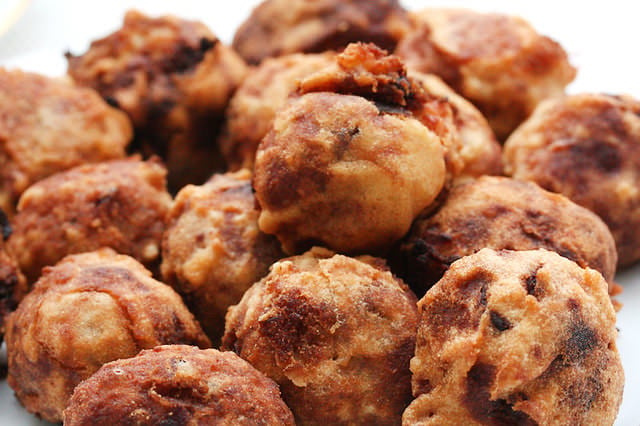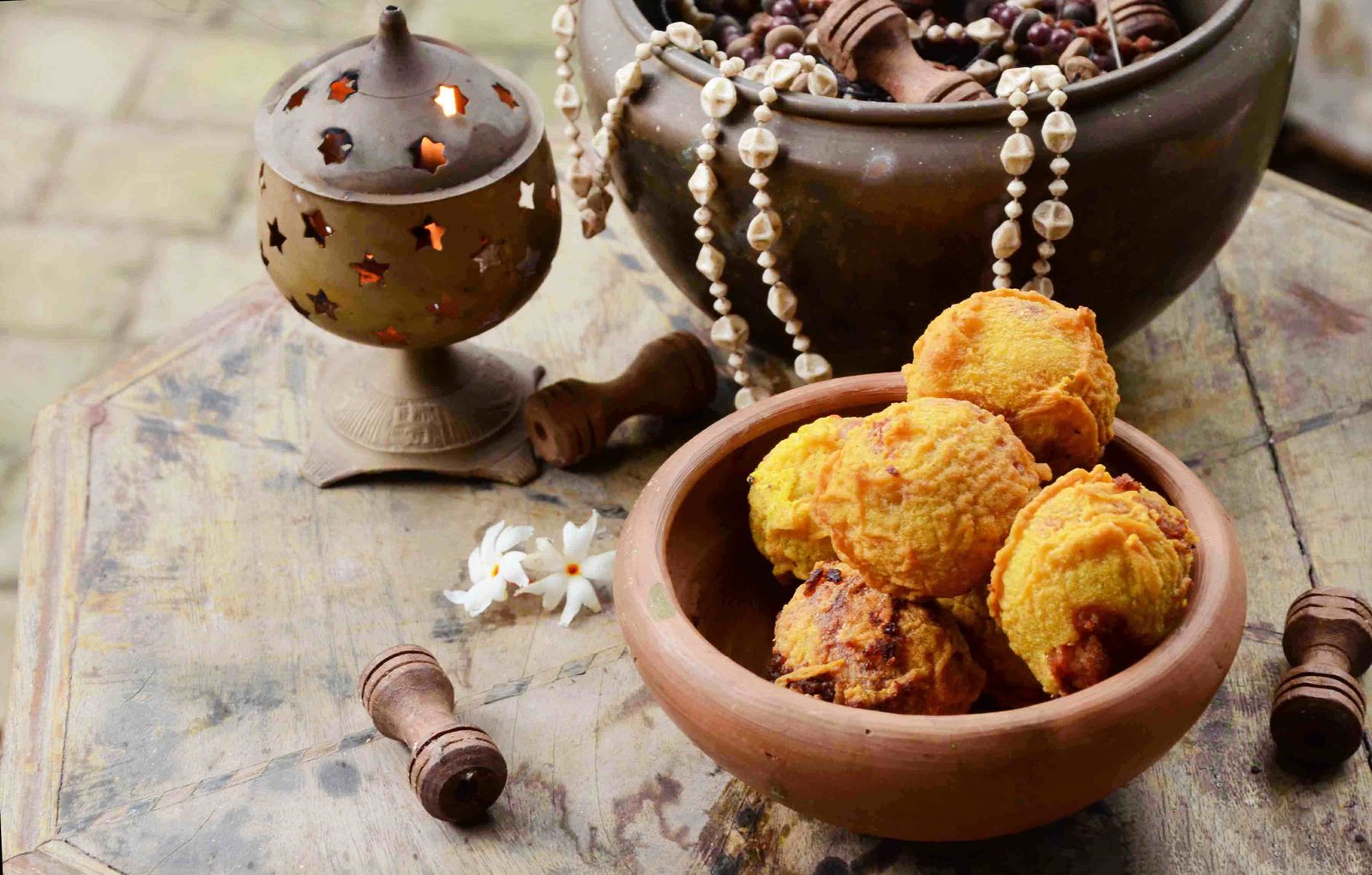
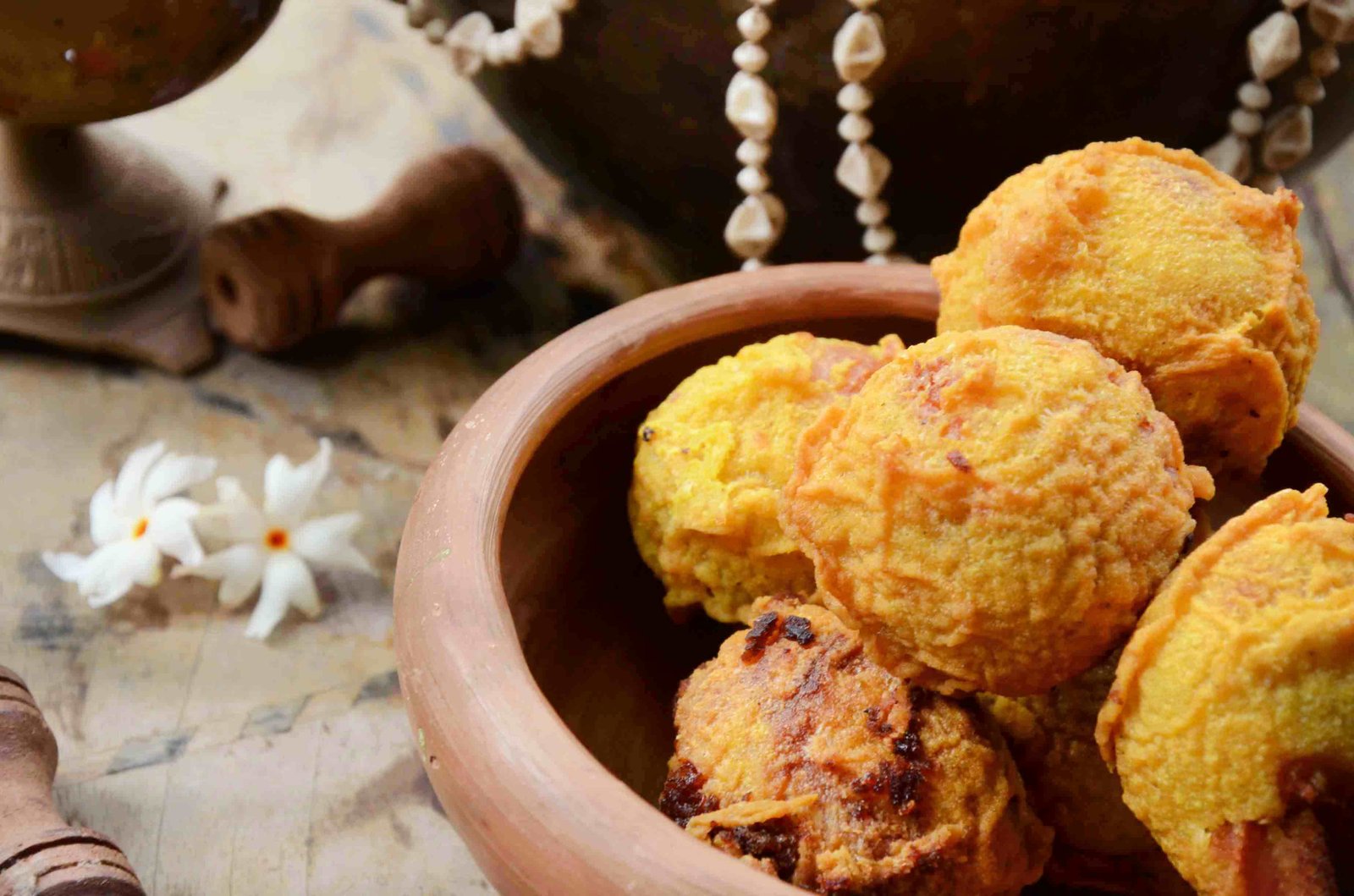


Naaran kavum (නාරං කැවුම්), also spelt naran or narang kavum, is a round Sri Lankan sweet with a filling of fresh coconut cooked in treacle or jaggery and spiced with cardamom. The filling is rolled into balls, dipped in a yellow batter of rice flour, turmeric and coconut milk, and deep-fried until crisp. Naran is the Sinhala word for mandarin or orange, and the name comes from the finished sweet's round shape and golden-orange colour. Because of its coconut centre it is also called pol kavum, pol being coconut.
Like the other members of the kavum family, naaran kavum is made mainly for the Sinhala and Tamil New Year in April, and it is found especially in village households. It sits on the New Year table with konda kavum, mung kavum, kokis and aluwa.
How to make naaran kavum
- Makes about 12 pieces
- Prep: 20 minutes (+ 20 minutes cooling)
- Cook: 40 minutes
- Difficulty: Moderate
For the coconut filling
- 200 g freshly scraped coconut (from about 1 coconut)
- 150 ml kithul treacle, or 150 g kithul jaggery melted with 3 tbsp water
- 50 g sugar
- 50 g whole mung beans (green gram), dry-roasted and coarsely crushed (optional)
- 3 tbsp rice flour
- 1/2 tsp ground cardamom
- A pinch of ground Ceylon cinnamon
- A pinch of salt
For the batter
- 150 g fine white rice flour, plus a little extra for rolling
- 200 ml thick coconut milk, plus up to 50 ml extra to adjust
- 1/2 tsp ground turmeric
- A pinch of salt
- About 1 litre coconut oil or vegetable oil, for deep frying
Method
- Make the syrup. Put the treacle, sugar, cardamom, cinnamon and salt in a heavy pan over a medium heat and stir until the sugar dissolves. Let it bubble for 3 to 5 minutes until it thickens slightly.
- Cook the coconut. Add the scraped coconut and stir over a medium-low heat for 10 to 15 minutes, until the moisture has cooked off, the syrup has been absorbed and the coconut turns a deep brown.
- Bind the filling. Stir in the crushed mung, if using, and the 3 tbsp rice flour, and cook for 2 to 3 minutes more, until the mixture is sticky and holds together when pressed. Spread it on a plate and leave for about 20 minutes, until cool enough to handle.
- Roll the balls. With lightly oiled hands, press and roll the filling into firm balls about 4 cm across, squeezing them so they do not crumble in the oil.
- Make the batter. Whisk the rice flour, turmeric and salt with the coconut milk until smooth and about as thick as pancake batter, so it coats the back of a spoon. Adjust with the extra coconut milk.
- Heat the oil. Heat the oil in a deep pan or wok over a medium heat to about 170°C, until a drop of batter sizzles and rises at once.
- Coat. Roll each ball lightly in rice flour, then dip it in the batter so it is completely covered, and let the excess drip off.
- Fry. Lower 3 or 4 balls at a time into the oil and fry for 3 to 4 minutes, turning, until the coating is crisp and golden all over.
- Drain. Lift out onto kitchen paper and cool for a few minutes before eating, as the centre stays hot.
Why is it called naaran kavum?
Naran means mandarin or orange in Sinhala. A finished naaran kavum is round, about the size of a small mandarin, and the turmeric in the batter fries to a golden orange, so it looks rather like the fruit. The name describes its look, not its flavour: there is no citrus in the traditional recipe.
How is it different from other kavum?
Most kavum, including konda kavum, are made from a batter of rice flour and kithul treacle that is fried on its own. Naaran kavum is a filled sweet: a cooked coconut centre inside a separate coating of batter. In that it is closer to mung guli, which uses the same yellow batter around a mung bean and treacle dough instead of coconut.
What variations are there?
- Sweetener: kithul treacle, kithul jaggery or plain sugar all work. Sugar gives a paler filling; treacle and jaggery give a darker, deeper one.
- Mung: many cooks add roasted, crushed mung beans or mung flour to the coconut, which makes the centre firmer and nuttier. Others use coconut alone.
- Batter: some cooks add an egg, or a little plain flour, for a thicker, crisper shell. With plain flour the sweet is no longer gluten-free, and with egg it is no longer vegan.
- Steamed version: another method steams coconut with rice flour first, then cooks it in sugar syrup to make the filling.
How do you stop the balls breaking in the oil?
Cook the filling until it is sticky and dry enough to hold when pressed, and roll the balls firmly. A light dusting of rice flour before dipping helps the batter cling and seal the ball. Make sure the oil is hot before the first piece goes in; if it is too cool, the batter takes too long to set and the filling can escape.
How long does naaran kavum keep?
Because the filling is made from fresh coconut, naaran kavum is best eaten on the day it is fried. Kept in an airtight container in a cool place, it will last for up to 2 days, although the shell softens.
Related reading
2 pages on closely related subjects.