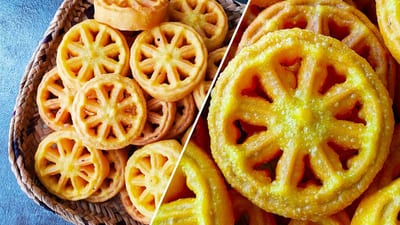
Aasmi (ආස්මී), also spelt asmi, is a lacy, crisp Sri Lankan sweet made from a rice flour and coconut milk batter that is poured into hot oil through a perforated ladle, so it sets as a fine net. The net is folded into a half-moon, fried, left to dry for a day or two, fried again until light and brittle, and finally drizzled with a thick sugar syrup, often tinted pink. It is one of the showpieces of the Sinhala and Tamil New Year in April and is also made for weddings and other celebrations.
What makes the batter work is the slippery sap of davul kurundu leaves (Neolitsea cassia), a small wild tree related to cinnamon that grows in Sri Lankan home gardens. The sap gives the batter the stretch it needs to fall in threads rather than blobs. Aasmi is slow, patient work, which is why many families now buy it; villages such as Opatha near Alawwa are known for making it in quantity before the New Year.
How to make aasmi
- Makes about 10 aasmi
- Prep: 30 minutes
- Cook: 1 hour 10 minutes (+ 1 to 2 days drying between fries)
- Difficulty: Hard
For the batter
- 225 g fine white rice flour, sifted
- 250 ml thick coconut milk
- 250 ml thin coconut milk, plus a little extra to adjust the batter
- A large handful of fresh davul kurundu leaves, or 8 to 10 okra (ladies' fingers) if the leaves are unavailable
- 1/2 tsp salt
- About 1.5 litres coconut oil or vegetable oil, for deep frying
For the syrup
- 225 g sugar
- 60 ml water
- 2 to 3 drops rose essence (optional)
- 1 to 2 drops pink or red food colouring (optional)
Method
- Extract the leaf sap. Wash the davul kurundu leaves, pound or crush them well, then squeeze and knead them in the thin coconut milk for a few minutes until it turns thick and slippery. Strain, pressing hard on the leaves. If using okra, chop it, simmer in 250 ml water for 10 minutes, strain off the slimy liquid and use it in place of the thin milk.
- Make the batter. Work the thick coconut milk into the rice flour a little at a time, kneading with your hand until smooth, and add the salt. Then beat in the strained sap. The batter should be thick, glossy and stretchy, and fall from a lifted spoon in a continuous ribbon. Thin it with a spoonful of coconut milk if it breaks into drops.
- Heat the oil. Fill a deep, round-bottomed pan about three-quarters full of oil and heat it over a medium-high heat until a drop of batter sizzles and floats at once, about 175°C.
- Pour the net. Put a ladleful of batter into an aasmi spoon (a coconut-shell ladle with a perforated base) and, holding it just above the oil, move it quickly round and across the pan so the threads fall in a close, even net about 15 cm across.
- Fold and first-fry. As soon as the net sets, about 30 seconds, loosen the edges with a slotted spoon, fold it into a half-moon and press the edges together. Turn it and fry for another 1 to 2 minutes, until firm but still pale. Drain on kitchen paper. Repeat with the rest of the batter, stirring it each time.
- Dry. Spread the fried pieces on a tray lined with paper, uncovered in a dry, airy place, and leave them for 1 to 2 days.
- Second fry. Reheat the oil to the same temperature and fry the dried pieces one or two at a time for about 1 minute, until they puff slightly and turn light, crisp and pale golden. Drain and cool.
- Make the syrup. Boil the sugar and water in a small pan over a medium heat for 5 to 7 minutes, until thick and a drop forms a soft thread between two fingers. Stir in the rose essence and colouring off the heat.
- Decorate. While the syrup is still hot and runny, trickle it over each aasmi in zigzag lines. Leave to set for about 15 minutes before serving or storing.
What are davul kurundu leaves, and what can replace them?
Davul kurundu is often translated as "cinnamon leaf", but it is a different tree from the Ceylon cinnamon sold as a spice; ordinary cinnamon leaves will not thicken the batter. The crushed leaves release a clear mucilage, and that slippery sap is the whole point: it holds the rice batter together as it streams through the holes of the ladle. Outside Sri Lanka, cooks use the slimy liquid from simmered okra instead.
Why is aasmi fried twice?
The first fry only sets the net and fixes its folded shape. Drying the pieces for a day or two lets moisture escape, and the second, short fry then makes them light and crisp. Because of this, aasmi has to be started at least a day or two before it is needed.
What if the batter will not form a net?
- Falls in blobs: the batter is too thick, or needs more sap. Beat in a little more leaf sap or coconut milk.
- Threads break or spread thinly: the batter is too thin. Work in a spoonful of rice flour.
- Net sinks and turns greasy: the oil is too cool. Let it come back to temperature between pieces.
- No aasmi spoon: a metal ladle with small holes works, and some cooks drip the batter from their fingertips in a moving circle.
What is aasmi topped with?
The classic finish is sugar syrup coloured pink, piped or trickled on in a zigzag so the pattern shows against the pale net. Some families use kithul treacle or a jaggery syrup instead, which gives a darker, more caramel-flavoured coating. Aasmi keeps for several days in an airtight tin at room temperature, somewhere cool and dry.
Where does aasmi fit on the New Year table?
Aasmi is one of the more elaborate items on the New Year table, set out at the auspicious time given in the Avurudu nakath beside kokis, kavum and aluwa.