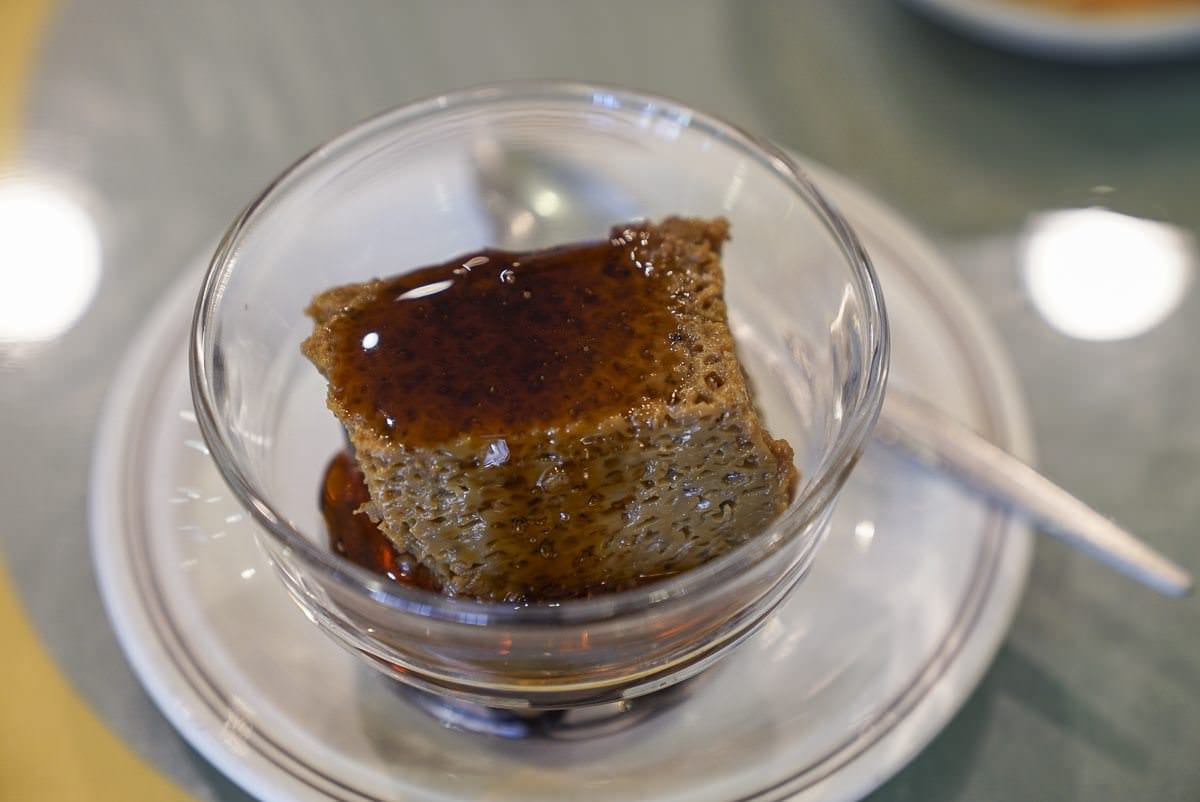
Watalappam (වටලප්පන්), also written watalappan, is a dark, spiced custard made from eggs, thick coconut milk and jaggery, the unrefined palm sugar that gives it its deep brown colour and faintly smoky sweetness. Cardamom is the defining spice, often joined by a little nutmeg and cloves, and the top is finished with cashew nuts. It is steamed until just set, then chilled, and cut in soft slices or spooned from small cups.
The dessert is strongly identified with Sri Lanka's Muslim community. It is a fixture of Eid al-Fitr at the end of Ramadan and appears at weddings and other celebrations, but today it is made in homes of every community and is one of the most familiar Sri Lankan sweets on restaurant and hotel menus.
How to make watalappam
- Serves 8
- Prep: 20 minutes (+ 20 minutes cooling, 3 hours chilling)
- Cook: 50 minutes
- Difficulty: Easy
Ingredients
- 400 g kithul or coconut palm jaggery, grated or finely chopped
- 100 ml water
- 400 ml thick coconut milk
- 8 eggs, at room temperature
- 8 cardamom pods, seeds ground (about 1 tsp)
- 1/4 tsp freshly grated nutmeg
- 1 pinch ground cloves (optional)
- 1 pinch salt
- 30 g cashew nuts, halved and lightly roasted
- 1 tsp butter or oil, for greasing the dish
Method
- Melt the jaggery. Put the jaggery and water in a pan over a low heat and stir for 3 to 5 minutes until it has completely dissolved into a smooth syrup. Do not let it boil hard.
- Add the coconut milk. Take the pan off the heat, stir in the coconut milk and leave the mixture to cool to room temperature, about 20 minutes. Hot syrup will scramble the eggs.
- Beat the eggs. In a large bowl, whisk the eggs by hand for 2 to 3 minutes, just until the whites and yolks are fully blended. Avoid an electric whisk: too much froth gives a spongy layer on top instead of a smooth custard.
- Combine and season. Pour the cooled jaggery mixture into the eggs, add the cardamom, nutmeg, cloves if using, and salt, and stir gently until evenly mixed.
- Strain. Grease a heatproof dish of about 1.5 litres (or 8 small cups) and pour the mixture through a fine sieve into it, to catch any egg threads and grit from the jaggery. Skim off any foam.
- Cover. Cover the dish with a lid or a sheet of foil. If your steamer lid drips, wrap it in a clean tea towel so condensation does not fall onto the custard.
- Steam. Set the dish on a rack over simmering water and steam over a low to medium heat for 45 to 55 minutes (15 to 20 minutes for small cups), until the edges are firm, the centre wobbles only slightly and a skewer comes out clean.
- Top and cool. Scatter the cashew nuts over the surface, then lift the dish out and let it cool to room temperature.
- Chill. Refrigerate for at least 3 hours, or overnight, until cold and fully set, then cut and serve.
Can you bake watalappam instead of steaming it?
Yes. Steaming is the traditional method, but the same mixture bakes well in a water bath. Stand the covered dish in a roasting tin, pour in hot water to come halfway up its sides and bake at 160°C for about 1 hour, until a skewer comes out almost clean. A pressure cooker is another shortcut some home cooks use. Whichever method you choose, a gentle heat gives the smoothest texture.
Why does watalappam have little holes?
A classic watalappam is not perfectly smooth like a crème caramel: its cut face often shows small pockets filled with dark syrup. These come from steaming at a fairly lively heat, and many cooks prize them. For a denser, silkier custard, keep the heat low and the water only gently simmering. A thick, pale, sponge-like layer on top is a different thing and usually means the eggs were beaten too hard.
Which jaggery should you use?
Kithul jaggery, made from the sap of the kithul palm (Caryota urens), is the traditional first choice for its dark colour and smoky, caramel flavour. Coconut palm jaggery is also used and gives a slightly lighter result. Outside Sri Lanka, palm sugar or dark muscovado sugar will work, although the flavour is less complex. Taste a piece first: jaggery varies in sweetness, so adjust by 50 g either way to suit.
Where does watalappam come from?
Watalappam is generally believed to have come to Sri Lanka with the Sri Lankan Malays, whose ancestors were brought to the island from the Indonesian archipelago during the Dutch colonial period. It closely resembles serikaya, a Malay steamed custard of eggs, coconut milk, palm sugar and pandan, and serikaya is still the name used for the dish in Sri Lankan Malay. From there it was taken up by the wider Muslim community and then by the whole island. The origin of the word itself is uncertain; one suggestion links it to the Tamil for cup (vattil) and cake (appam).
What variations are there?
- Condensed milk: some cooks replace part of the coconut milk with sweetened condensed milk for a richer, sweeter custard, reducing the jaggery to compensate.
- Extra spice: a little ground clove and nutmeg are common, and some families add a knotted pandan leaf to the syrup or a few drops of vanilla or rose water.
- Individual cups: small cups steam faster and are the usual way to serve watalappam at large gatherings.
How long does watalappam keep?
Covered in the fridge, watalappam keeps well for 2 to 3 days, and many cooks think it tastes better on the second day. Serve it cold or at cool room temperature, on its own or beside other festive sweets such as pani kadju and kokis.