Each January, the Kelaniya Rajamaha Viharaya becomes the focal point of one of Sri Lanka's most revered Buddhist festivals. The Duruthu Perahera commemorates the first visit of Lord Buddha to Sri Lanka, an event traditionally dated to the ninth month after his enlightenment. For devotees, the occasion carries deep religious significance; for visitors, it offers a rare glimpse into a living ceremonial tradition that has been observed continuously since 1927.
What is the Duruthu Perahera and why is it celebrated?
The festival takes its name from Duruthu, the Sinhala name for the month of January in the lunar Buddhist calendar. According to Buddhist belief, Lord Buddha made three visits to Sri Lanka, and the Duruthu Perahera marks the first of these — his arrival on the full-moon day of Duruthu. The ceremonies are held at the Kelaniya Rajamaha Viharaya, a temple of considerable antiquity situated on the banks of the Kelaniya River, close to Colombo. The event draws pilgrims from across the island as well as international visitors who attend for its cultural spectacle.
The festival is structured in three distinct stages. It opens with a series of religious sermons delivered each evening, followed by a week of Pirith Ceremonies — the chanting of Buddhist scriptures. The procession itself, the Perahera, then takes place over three consecutive nights.
How does the three-night procession unfold?
Each of the three procession nights has its own character and scale, building steadily toward a grand finale.
- Udamaluwa Perahera (Night One): The opening procession is held within the upper terrace of the Kelaniya Temple compound. Known as the Dathu Perahera, this first night is comparatively intimate — a modest assembly of elephants, whip-crackers, fire dancers, flag bearers, drummers, and dancers moves through the upper grounds.
- Pahatha Maluwa Perahera (Night Two): The second night expands considerably in scale and colour. The Dathu Perahera leads the procession, now joined by three Devala Peraheras representing the shrines associated with the temple. The route extends beyond the temple grounds, and the number of participants grows markedly.
- Randholi Perahera (Night Three): The final night is the centrepiece of the entire festival — an elaborate procession of elephants, performers, monks, and devotees that travels the full ceremonial route through Kelaniya. A cannon boom marks the formal close of the pageant as the procession returns to the temple.
What can you expect to see during the procession?
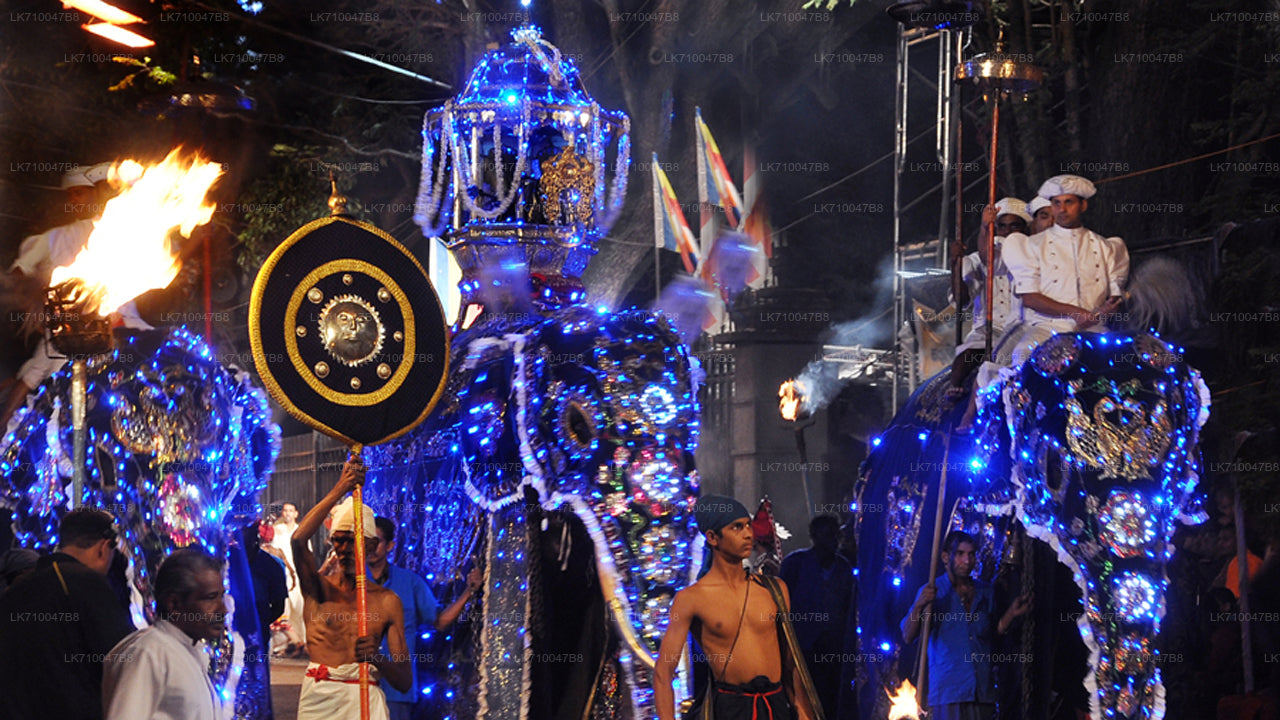
The Randholi Perahera, in particular, assembles a wide cast of performers and participants. Whip-crackers lead the procession, their sharp cracking sounds signalling the approach of the column. Fire-ball performers follow, tossing and catching lit torches in choreographed displays. Elaborately decorated elephants and tuskers carry sacred relic caskets, dressed in embroidered cloths and illuminated by strings of electric lights. Drummers maintain a constant ceremonial rhythm, while traditional dancers — Kandyan, low-country, and Sabaragamuwa styles — perform at intervals along the route.
Buddhist monks and the chief incumbents of the temple walk in formal procession, accompanied by attendants in historical dress. Flag bearers carry banners displaying the religious insignia of each temple and devala associated with the festival. The entire route is lit by torchbearers, and colourful flags and pennants decorate the roadside. Devotees lining the streets often join in by chanting pirit, the protective Buddhist verses, as the procession passes.
The atmosphere is one of collective devotion rather than theatrical performance — a distinction worth keeping in mind when attending. Dress modestly and arrive early to secure a good vantage point along the route.
What is the significance of Kelaniya Rajamaha Viharaya?
The temple itself warrants time beyond the festival. Its origins are traced to ancient Sri Lankan chronicles, and the current structure reflects centuries of construction and restoration. The entrance gateway features a Makara Thorana — an ornate archway carved in the form of a mythological creature that combines elements of several animals, symbolising protection and auspiciousness. Within the compound, visitors encounter a main shrine room, a dagoba, a moonstone at the threshold of the inner shrine, a reclining Buddha statue of considerable size, a sacred Bo tree, and numerous Buddha images in varying postures.
The interior walls of the shrine room are covered in frescoes that depict scenes from the Jataka tales — the stories of the Buddha's previous lives — as well as episodes from Sri Lankan history. The paintings are among the finest examples of 20th-century Sri Lankan temple art and reward close attention. The temple's proximity to Colombo, roughly 11 kilometres from the city centre, makes it accessible as a half-day excursion.
How does the Duruthu Perahera compare to other Sri Lankan peraheras?
Sri Lanka holds several major perahera festivals throughout the year. The Esala Perahera Festival in Kandy, held in July or August, is the largest and most internationally recognised. The Duruthu Perahera is smaller in overall scale but is considered by many devotees to carry equivalent religious importance, given its direct connection to the Buddha's first visit to the island. For travellers who cannot attend in July, the January festival offers a comparable ceremonial experience with somewhat smaller crowds.
The Nawam Maha Perahera at Gangaramaya Temple in Colombo, held in February, is another significant urban procession that forms part of this cycle of annual festivals.
When exactly does the Duruthu Perahera take place?
The festival is timed to the lunar calendar. The main Perahera processions fall on the three nights leading up to and including the Duruthu Poya (full-moon) day in January. The precise dates shift each year, so confirming the schedule in advance with the temple or a reliable source is advisable. The Poya day itself is a public holiday in Sri Lanka, and the days surrounding the festival see significant traffic around Kelaniya.
How do I get to Kelaniya from Colombo?
Kelaniya is approximately 11 kilometres northeast of Colombo city centre, accessible by road in under 30 minutes outside of peak traffic. A private car or taxi is the most comfortable option, particularly on festival nights when public transport becomes crowded. Trains on the Kandy main line stop at Kelaniya station, which is a short walk from the temple. On procession nights, road closures along the ceremonial route take effect in the evening, so arriving well before dusk is strongly recommended.
What should visitors know before attending?
- Remove footwear before entering the temple premises.
- Dress conservatively — shoulders and knees should be covered. Sarongs are available for hire near the entrance.
- Photography is generally permitted in the outer temple areas and along the procession route, but be respectful of devotees at prayer.
- The festival draws very large crowds on the final night. Arrive at least two hours before the procession begins to find a suitable viewing position.
- Street food vendors set up along the route; however, ensure food and water are sourced from reputable stalls.
Nearby places
8 places within about 25 km, nearest first.
- Kelaniya Temple Paintingsunder 1 km
- Kelaniya Raja Maha Vihara Stupaunder 1 km
- Kelaniya Railway Stationunder 1 km
- Wanawasala Railway Stationunder 1 km
- Kithsirimewan Rajamaha Viharaya, Kelaniyaunder 1 km
- Kelaniya City2 km
- Kiribathgoda2 km
- Kadawatha4 km
Related reading
7 pages on closely related subjects.