

Every year, in the weeks spanning the Esala full moon — typically late July or early August — the sacred town of Kataragama transforms. What is ordinarily a place of quiet devotion becomes one of the most intense pilgrimage gatherings in Asia. Hindus, Buddhists, Muslims, and followers of indigenous Vedda traditions converge on this small town in Sri Lanka's deep south, each seeking the favour of Skanda, the god of war and wisdom, whose principal shrine anchors the Maha Devale complex at the town's heart.
What is the Kataragama Esala Festival?
The Kataragama Esala Festival is a multi-week religious event centred on the Maha Devale shrine, dedicated to Kataragama Deviyo — identified with the Hindu deity Skanda (also known as Murugan), son of Shiva. Tradition holds that Skanda rested on the mountain at Kataragama after defeating a demonic army, and that the site has drawn pilgrims ever since.
The festival formally marks its high point on Esala Poya, the full-moon night of the month of Esala. In the days leading up to that night, and in the days that follow, processions wind through the temple grounds nightly. Decorated elephants carry sacred relics and regalia; drummers maintain a constant, driving rhythm; torchbearers light the path through the darkness. The atmosphere is one of collective fervour rather than spectacle — the processions are acts of worship, not performance.
The festival is closely linked in spirit to the Esala Perahera Festival in Kandy, which takes place during the same lunar month, though the two events differ markedly in character. Kandy's perahera is ordered and ceremonial; Kataragama is raw, personal, and unpredictable.
What rituals and acts of penance take place?
The festival is best known outside Sri Lanka for its acts of kavadi — extreme penances undertaken by devotees who have made vows to Skanda, usually in exchange for a blessing already received. These are not performances for tourists. They are deeply sincere expressions of faith, and observers are expected to treat them with corresponding respect.
Common acts of penance during the festival include:
- Fire-walking (Theemithi): Devotees who have fasted, meditated, and bathed in the Manik Ganga river walk barefoot across a bed of glowing embers. Before the walk, they worship at the Maha Devale. The act is called mal nethi gini piyaparama — treading the flowers — a name that reflects the belief that faith transforms the coals beneath the walker's feet.
- Hook-swinging: Some devotees are suspended from a frame by hooks that pierce the skin of their back or chest. The practice is understood as a demonstration of the depth of devotion, with the pain said to be transcended through concentrated prayer.
- Sand-rolling: Pilgrims roll their bodies across the hot sand near the temple precincts as a form of prostration along the pilgrimage route.
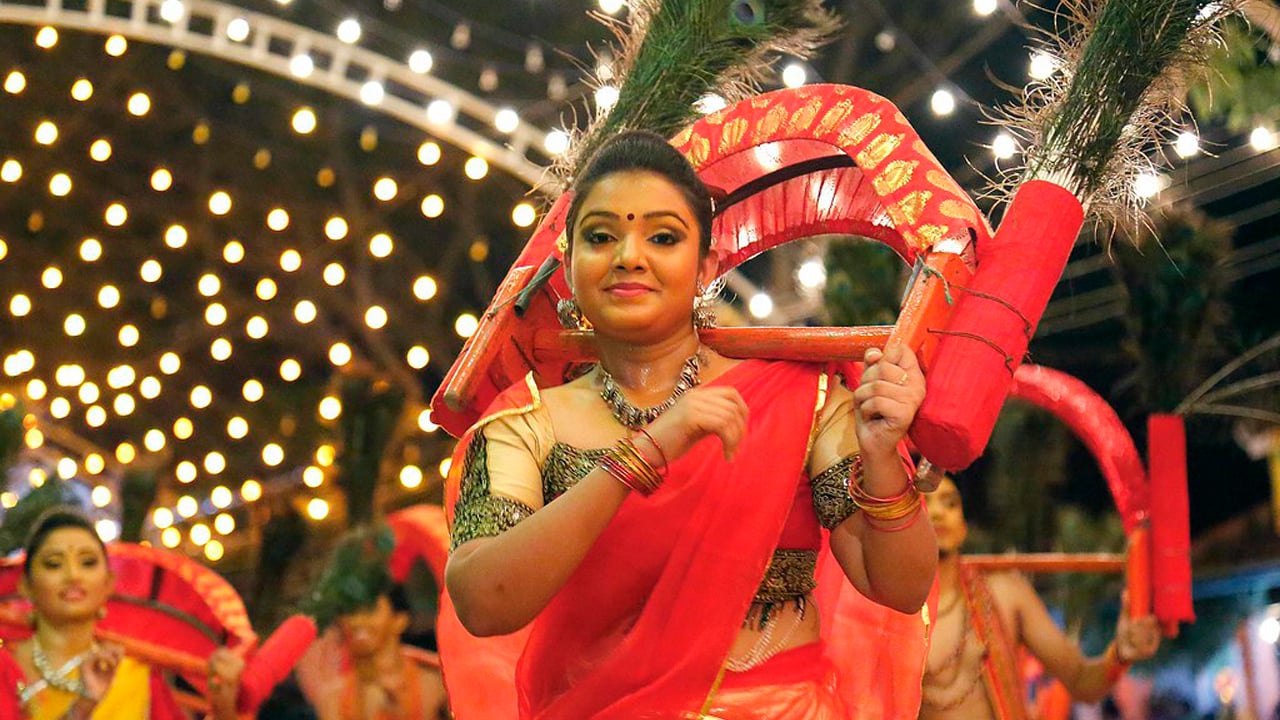
- Kavadi processions: Devotees carry elaborately decorated arched frames — often adorned with peacock feathers — that may be attached to their bodies by skewers through the skin, dancing in a distinctive rhythmic step toward the shrine.
The fire-walkers prepare with particular care. They fast for a prescribed period, observe strict ritual purity, bathe in the Manik Ganga, and offer worship at the Maha Devale before stepping onto the embers. After the walk, the festival officially concludes the following morning with the water-cutting ceremony (Diya Kepeema) in the Manik Ganga — a ritual said to invoke rain for the season's harvests.
What happens during a daily Pooja at Kataragama?
Outside the festival season, Kataragama observes three daily Poojas — ritual offerings at the Maha Devale and associated shrines. Devotees arrive barefoot, carrying plates piled with fruit, flowers, and the red garlands associated specifically with Skanda. The queue moves patiently around the inner shrine walls as worshippers await their turn at the doors.
One of the most quietly memorable sights at Kataragama is the temple elephant making its rounds of the three principal shrines. Holding a single lotus flower aloft in its trunk, it kneels before each shrine in turn — first the Buddhist stupa, then the shrine of Ganesh, and finally the Maha Devale — placing the lotus as an offering before moving on. The Elephant Transit Home at nearby Udawalawe gives context to the role elephants play in Sri Lankan religious and cultural life more broadly.
How old is the Kataragama shrine?
The Maha Devale is ancient by any measure. Tradition attributes its formal construction to King Dutugemunu in the 2nd century BC, though the site's sanctity almost certainly predates the building. The Vedda people — Sri Lanka's indigenous community — venerated Kataragama long before the arrival of Buddhism or formal Hinduism on the island, and the site retains that layered, multi-faith character today.
An ancient pilgrimage route to Kataragama begins in Jaffna and follows the east coast southward, passing through the wilderness of what is now Yala. Pilgrims who walk this route — some of them barefoot for the entire journey — arrive at Kataragama having undertaken weeks of travel. On clear evenings, the lights from the shrine on the hill are visible from within the town's temple precincts.
When is the best time to visit the Kataragama Esala Festival?
The festival runs for roughly two to four weeks, with the most intense activity concentrated in the final days before and on the night of Esala Poya itself. The exact date shifts each year according to the lunar calendar; it typically falls between mid-July and mid-August. Accommodation in and around Kataragama fills quickly, and roads into town become congested in the days immediately preceding the full moon. Visitors who plan to attend should arrange transport and lodging well in advance.
The town of Kataragama sits near the boundary of Yala National Park in Sri Lanka's Southern Province, roughly 250 km from Colombo by road. The journey by private car takes around four to five hours depending on the route. Travelling to the Esala Festival via Udawalawe National Park is a natural pairing — the park lies roughly halfway along the route from the hill country, and a morning game drive before continuing south adds considerably to a southern Sri Lanka itinerary.
What should visitors know before attending?
Kataragama is an active place of worship, not a cultural venue. A few practical considerations help visitors engage with the festival respectfully:
- Dress modestly. Shoulders and knees should be covered within the temple precincts. Remove footwear before entering.
- Photography of acts of penance requires sensitivity. Some devotees and their families prefer not to be photographed during kavadi. Read the situation before raising a camera.
- The Manik Ganga river, which flows through the temple grounds, is a sacred space. Bathing is permitted in designated areas; general swimming is not appropriate.
- The main shrine complex is open to all faiths. There is no entry fee to enter the temple grounds, though offerings are customary.
- Parking and access roads into Kataragama are severely congested during festival nights. Arriving early in the day is strongly advisable.
How does Kataragama compare with other Sri Lankan festivals?
Sri Lanka's festival calendar is dense with events that combine religious observance, procession, and communal gathering. The Esala month alone contains some of the island's most significant occasions. Where the Kandy Esala Perahera is structured around the relic of the Buddha's tooth and follows an elaborately choreographed ceremonial order, Kataragama is participatory and intense — the festival exists as much for the devotee in the crowd as for any audience.
Visitors who want to understand the full context of Esala observance in Sri Lanka often pair both events in the same trip, since they overlap on the calendar and the contrast between the two reveals a great deal about the island's plural religious traditions.
Nearby places
12 places within about 25 km, nearest first.
- Ruhunu Katharagama Devalayaunder 1 km
- Kataragama Esala Peraheraunder 1 km
- Kirivehera Stupaunder 1 km
- Maha katharagama devalayaunder 1 km
- Lord Muruganunder 1 km
- Menik Gangaunder 1 km
- Kataragamaunder 1 km
- Maha Vishnu Devalayaunder 1 km
- Kataragama Templeunder 1 km
- Sella Kataragama3 km
- South Entrance6 km
- Lunugamvehera City11 km
Related reading
2 pages on closely related subjects.