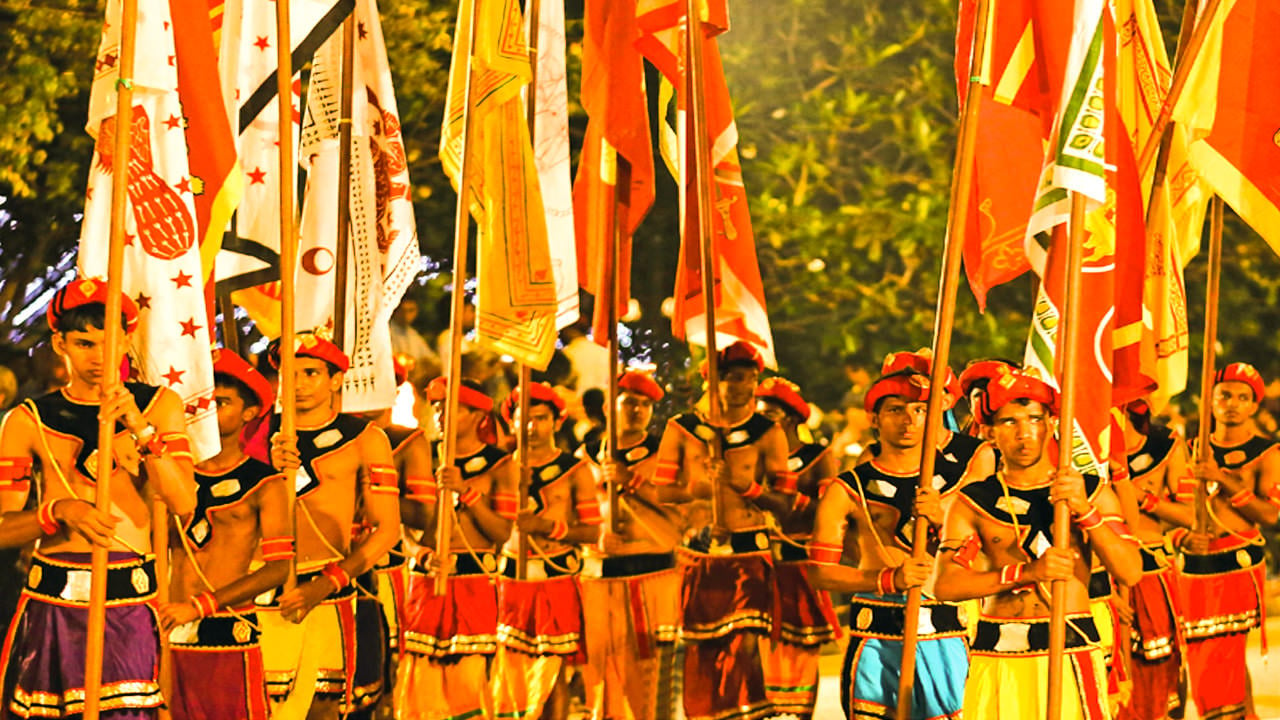


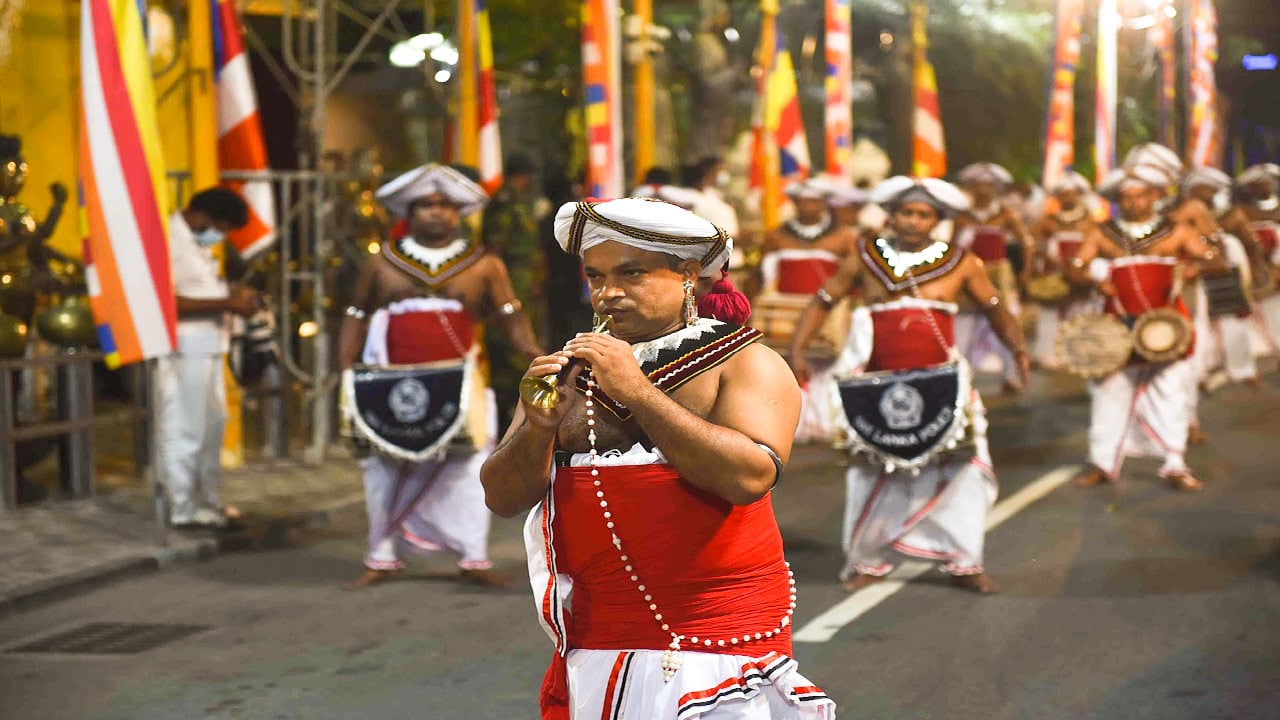
Every February, on the Navam Full Moon Poya Day, the streets around Beira Lake in central Colombo transform into one of Sri Lanka's most spectacular ceremonial processions. The Gangaramaya Navam Maha Perahera draws hundreds of thousands of spectators — local families, devotees, and international visitors — to witness a two-night parade that blends deep Buddhist tradition with the pageantry of Kandyan performing arts.
What is the Gangaramaya Navam Maha Perahera?
A perahera is a ceremonial procession, and the Navam Maha Perahera is the annual festival held by Gangaramaya Temple — one of the most revered Buddhist temples in Sri Lanka. Established more than 120 years ago on reclaimed swamp land at the edge of Beira Lake, Gangaramaya grew from a modest place of learning and worship into an institution of global cultural significance, holding one of the finest collections of Buddhist artefacts and texts in the world.
The festival was inaugurated in 1979 and has been held every year since, coinciding with the Navam Poya Day in February. Unlike many temple festivals that remain confined to their immediate community, the Navam Maha Perahera is openly inclusive — people of all faiths and backgrounds line the route, making it as much a celebration of Sri Lankan civic life as it is a Buddhist religious event.
What happens during the Navam Maha Perahera parade?
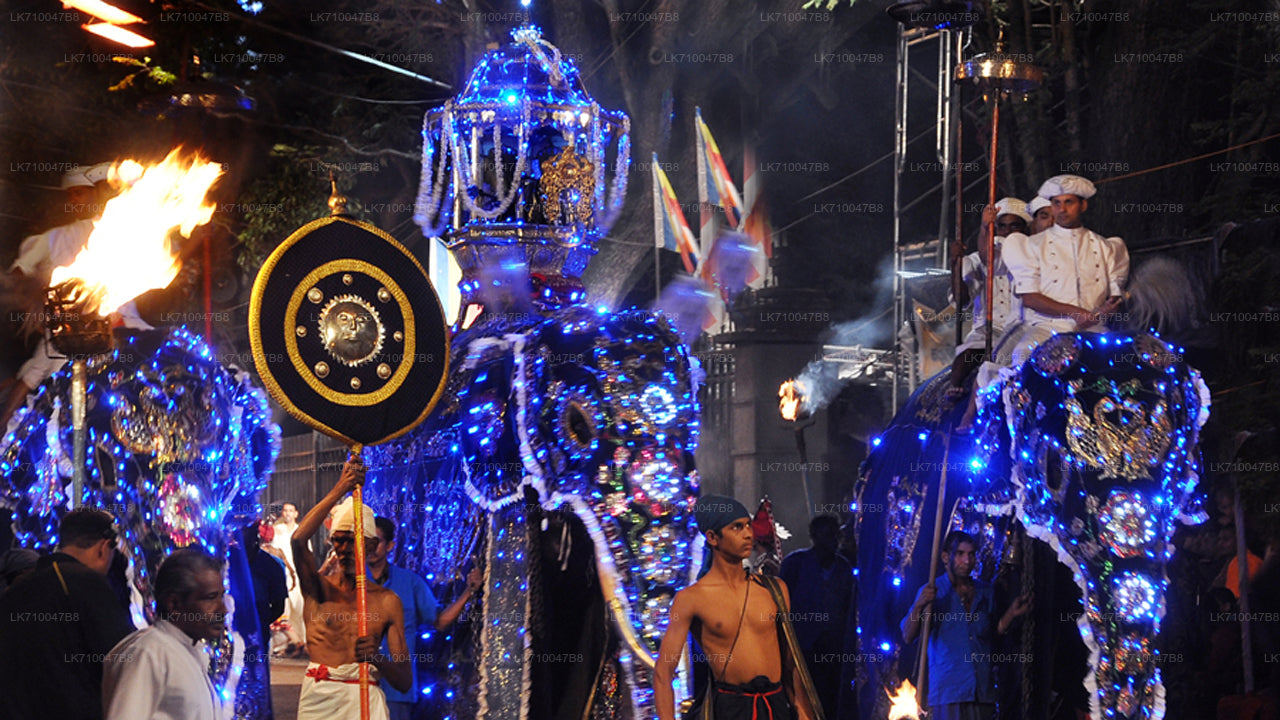
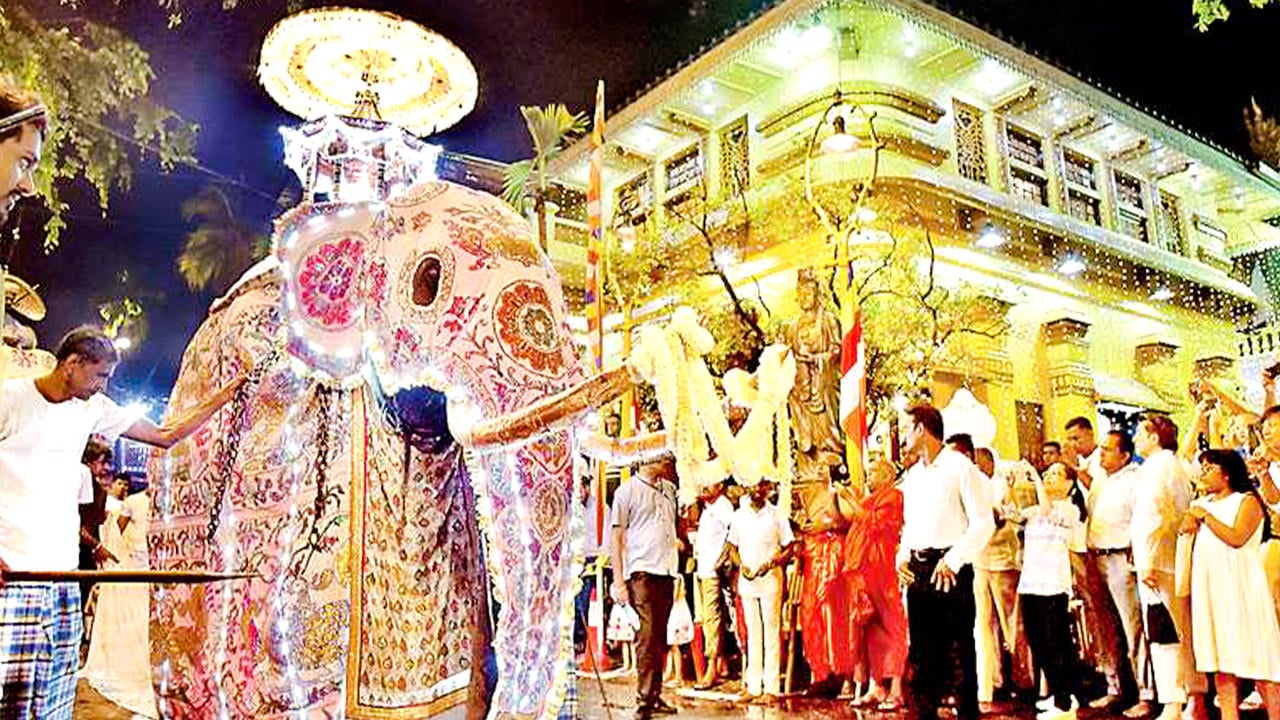
The procession runs for two consecutive nights. At its heart is the ceremonial carrying of a Sacred Relic Casket mounted on the temple's elaborately adorned chief tusker elephant, whose caparison is embroidered with gold thread and studded with lights. Dozens of other traditionally dressed elephants — accompanied by their mahouts — follow in formation, flanked by torch bearers whose flames cast dramatic shadows across the lakeside boulevard.
Surrounding the elephants is a procession of performers that showcases the breadth of Sri Lanka's classical arts:
- Kandyan dancers in layered white-and-silver costumes perform the intricate footwork of the Udarata tradition
- Mask dancers representing folk characters from ancient Sinhalese ritual theatre
- Drummers playing the geta beraya and davul — the percussive heartbeat of the parade
- Sword dancers and stilt walkers adding visual drama to the column
- Buddhist monks in saffron robes, walking in silence alongside flag bearers carrying the Buddhist colours
The entire parade circuit is lit by flaming torches rather than electric lighting, preserving an atmospheric quality that photographs alone cannot fully convey.
How does the Navam Perahera compare with other Sri Lankan festivals?
Sri Lanka hosts several major peraheras throughout the year. The most internationally recognised is the Esala Perahera Festival in Kandy, held in July or August and centred on the Sacred Tooth Relic at the Dalada Maligawa. The Navam Maha Perahera shares a similar format — sacred relics, elephants, classical dancers — but its urban Colombo setting gives it a different character. The Beira Lake forms a natural amphitheatre, and the route through Viharamahadevi Park and the surrounding streets is easily accessible from most city hotels, making it a particularly convenient experience for short-stay visitors.
When does the Navam Maha Perahera take place?
The festival falls on the Navam Poya Day, which corresponds to the full moon of February under the Sinhalese lunar calendar. The exact Gregorian date shifts by a few days each year. The main procession takes place over two nights — typically the night before Poya and Poya night itself. Crowds begin gathering along the route from early evening; the parade usually commences after nightfall and continues for several hours.
Where does the Navam Maha Perahera take place?
Gangaramaya Temple stands on Sri Jinarathana Road in the Slave Island district of Colombo 2, at the southern edge of Beira Lake. The procession departs from the temple and follows a circuit through Viharamahadevi Park and the surrounding streets before returning. The area is served by multiple bus routes and is a short tuk-tuk or taxi ride from Colombo Fort and the hotel district along Galle Road. During the festival, expect road closures in the immediate area from mid-afternoon onwards.
Tips for attending the Navam Maha Perahera
- Arrive early. Good vantage points along the parade route fill up quickly. Aim to be in position at least 90 minutes before the procession begins.
- Book ticketed grandstand seating. Organised seating offers an elevated view of the elephants and performers without navigating the street crowds. Lakpura arranges tickets and transfers for guests who want a comfortable, well-positioned experience.
- Dress appropriately. The event takes place near an active temple. Modest clothing is respectful — shoulders and knees covered, especially if you plan to visit Gangaramaya Temple before or after the parade.
- Photography. Handheld cameras and smartphones are generally permitted along the open street sections. Flash photography directed at the elephants is strongly discouraged.
- Transport after the event. Colombo's main roads can be congested for an hour or more after the parade ends. Pre-booking a return vehicle is advisable.
Visiting Gangaramaya Temple before the festival
The temple complex is well worth a visit in its own right, regardless of the festival calendar. Its museum houses an eclectic collection of gifts presented to the temple over more than a century — antique Buddha images, rare manuscripts, ceremonial objects, and donated vehicles. The complex also contains a Dhamma School and a library, reflecting the temple's longstanding role as a centre of Buddhist education. Entry to the temple is open most days; visitors are expected to remove shoes before entering.
How to get to Gangaramaya Temple from Colombo city hotels
Most hotels in Colombo 3 (Kollupitiya) and Colombo 7 (Cinnamon Gardens) are within 10–15 minutes by tuk-tuk or taxi under normal traffic conditions. The temple is roughly 20–30 minutes from Bandaranaike International Airport depending on traffic. During the festival, road closures mean the final approach on foot is often necessary — factor this into your timing. A Colombo city tour on the day of the festival can be a practical way to see key sights before settling in at the parade route in the evening.
Nearby places
9 places within about 25 km, nearest first.
- Colombo City Centerunder 1 km
- Beira Lakeunder 1 km
- Gangaramaya Templeunder 1 km
- Seema Malakaunder 1 km
- Shri Ponnambalawaneswaram Kovilunder 1 km
- Slave Islandunder 1 km
- 7 Degrees Restaurants & Bar, Colombounder 1 km
- Kollupitiyaunder 1 km
- Origins of Kollupitiya (Colpitty)under 1 km
Related reading
2 pages on closely related subjects.