


Seema Malaka sits on three floating platforms anchored to the bed of Beira Lake, in the middle of Colombo's urban sprawl. It is a satellite shrine of the Gangarama Buddhist Temple, and one of the most photographed religious buildings in the country — not because of grandeur, but because of the quiet contrast it strikes between still water, colonial-era parkland, and a design that feels simultaneously ancient and modern.
What is the history of Seema Malaka?
The Gangarama Temple was established in the late 19th century to serve the growing Buddhist community in Colombo. Seema Malaka — the name refers to a boundary hall used for ordination ceremonies — was built as one of its outer structures, with foundations sunk into the floor of Beira Lake. The marshy substrate proved hostile, and by 1970 the original structure had sunk entirely beneath the water.
In 1976, the temple commissioned Geoffrey Bawa to design a replacement. Bawa was already the most celebrated architect in Sri Lanka and would go on to be recognised internationally as the founder of Tropical Modernism — an approach that works with the local climate and landscape rather than imposing external forms upon them. His solution was three separate platforms connected by pontoon walkways and secured to the lakebed by stone pillars, light enough to float without repeating the subsidence that had claimed the earlier building. A pontoon bridge then links the whole complex to the southern shore.
The result draws consciously on the monastic architecture of Polonnaruwa and Anuradhapura — low rooflines, open lattice-work walls, dwarf guardian figures — while the deep-blue clay roof tiles and the overall logic of the structure are unmistakably Bawa's own. The building is listed as one of the finest examples of Tropical Modernism in Asia.
What can you see inside Seema Malaka?
The complex divides into three main areas, each on its own platform.
- The Courtyard Platform — The largest and most active section. A sacred Bo tree, propagated from the original Jaya Sri Maha Bodhi in Anuradhapura, grows from a raised platform draped in prayer flags and flanked by Buddha statues of varying sizes, the largest standing beside a small stupa. At the four corners of the courtyard, small rooms with carved wooden doors contain representations of Hindu devas that Sri Lankan Buddhists venerate alongside the Buddha. Behind the courtyard stands a tier of gilded Buddha images brought from Thailand, and — in one of the temple's more unexpected details — a collection of vintage cars donated by lay supporters over the decades.
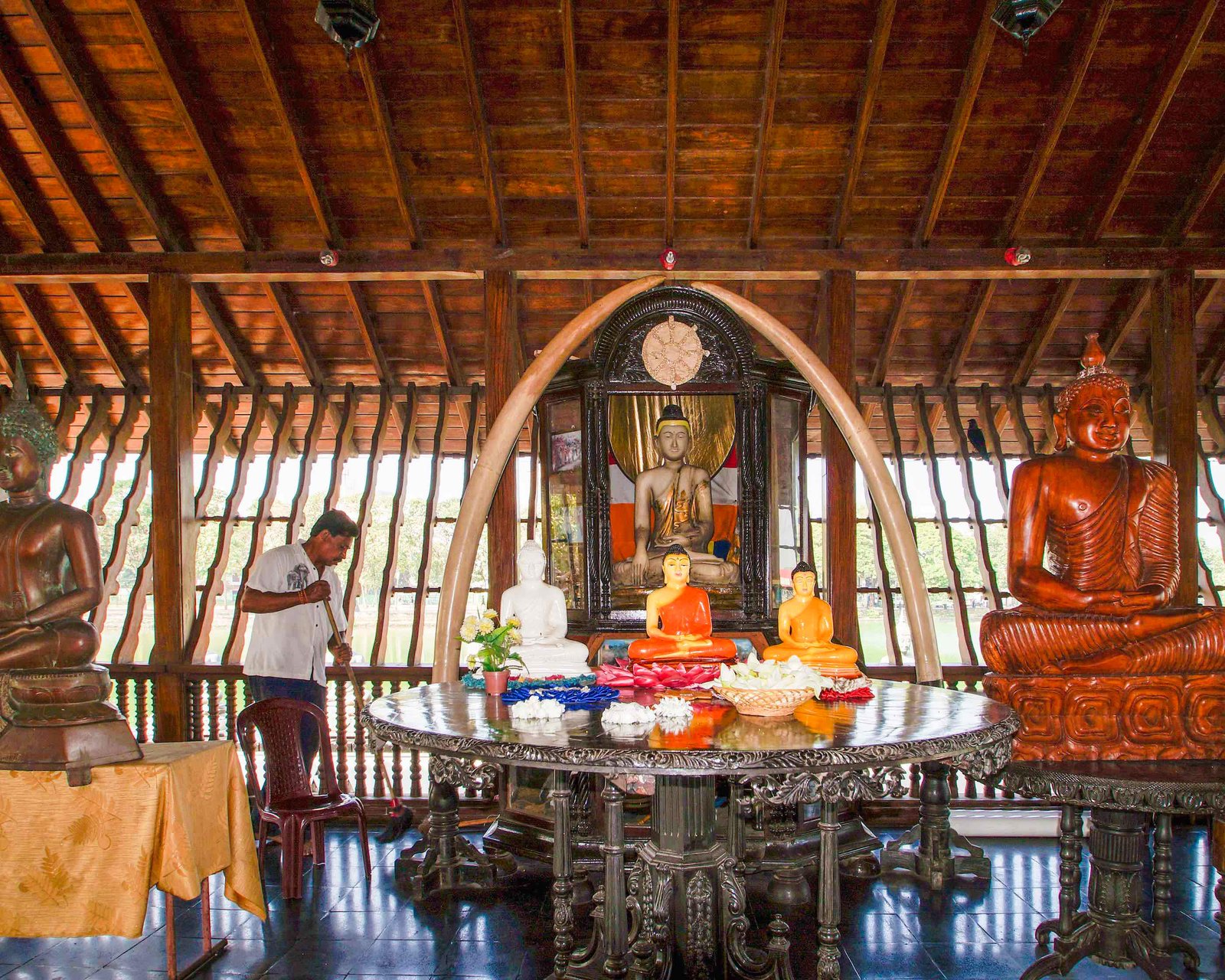
- The Central Platform — A meditation hall enclosed by slatted wooden walls that allow air and filtered lake-light to pass through freely. Stone Buddha figures in an Asiatic seated style line the perimeter. The entrance is flanked by dwarf guardian statues in the Anuradhapura idiom. Inside, a large seated Buddha is flanked by two elephant tusks. The space is used daily for meditation by both monastics and visitors.
- The Northern Platform — This sealed platform is not open to general visitors. It houses the temple's library of Buddhist canonical texts and is accessible to monks only.
On the way back toward the entrance, a small museum contains two rooms of religious art, antique objects, and donations received by the Gangarama Temple — an eclectic collection that reflects the temple's wide network of lay supporters across Asia.
How does Seema Malaka relate to the Gangarama Temple?
Seema Malaka is administratively and spiritually part of the Gangarama Temple complex, which occupies a larger site on Jinarathana Road nearby. The main Gangarama buildings include a viharaya, a museum, and a college for novice monks. Seema Malaka functions as the sīmā — the formally defined boundary within which ordination ceremonies are conducted — which explains why the hall takes on special significance in Buddhist monastic life beyond its role as a place of worship open to the public. The Colombo city tour operated by Lakpura typically includes both sites together.
When is the best time to visit Seema Malaka?
The temple is open daily and draws visitors throughout the year. Early morning, between roughly 6 am and 9 am, is the quietest period; the light across the lake at that hour is also the most photogenic. Poya days (full-moon days in the Buddhist calendar) bring significantly larger numbers of devotees, which makes for an atmospheric visit but means crowds around the meditation hall and courtyard. The annual Navam Perahera procession, held on the full moon of February, departs from the Gangarama Temple and is one of the larger festival processions in Colombo; arriving a day or two before or after avoids the peak congestion around the lakeshore.
How do I get to Seema Malaka from central Colombo?
The entrance to Seema Malaka is on Sir James Peiris Mawatha (also known as Sir James Pieris Mawatha), on the southern bank of Beira Lake in Slave Island — a neighbourhood more formally called Kompanna Veediya. It sits roughly 2 km from Colombo Fort railway station and around 3 km from the Galle Face Hotel end of Galle Road. Taxis and rideshare apps reach it easily from anywhere in central Colombo, and three-wheelers are plentiful along the lakeshore road.
There is no dedicated car park at the temple; visitors generally set down on the roadside or use informal spaces nearby. The Colombo Lotus Tower is visible from the lake and serves as a useful orientation landmark.
What should visitors know before going?
- Remove footwear before entering any of the platforms — shoe-minding services operate at the entrance.
- Dress modestly: shoulders and knees should be covered. Sarongs are sometimes available for hire if needed.
- Photography is permitted throughout most of the complex; be mindful of worshippers during meditation sessions in the central hall.
- The pontoon walkways can feel slightly unsteady underfoot — this is normal, given the floating construction.
- A small donation is customary rather than a fixed entrance fee, though this may be subject to change for foreign visitors; verify locally before your visit.
Why is Geoffrey Bawa's design significant?
Bawa (1919–2003) is widely credited with establishing Tropical Modernism as a coherent architectural philosophy. Rather than importing European Modernist forms wholesale into the tropics, he developed a design language rooted in open-air circulation, local materials, and sensitivity to landscape. Seema Malaka is a clear illustration of these principles: the deep-blue clay tiles regulate heat, the lattice walls eliminate the need for mechanical ventilation, and the positioning on water insulates the platforms from the noise and temperature of the surrounding city. The design sits comfortably alongside the surrounding Beira Lake parkland without dominating it.
Bawa also designed several landmark hotels in Sri Lanka, and his influence is visible in much of the higher-end architecture built in the country since the 1980s.
Nearby places
8 places within about 25 km, nearest first.
- Gangaramaya Templeunder 1 km
- Colombo City Centerunder 1 km
- Gangaramaya Navam Maha Peraheraunder 1 km
- Beira Lakeunder 1 km
- Colombo Public Libraryunder 1 km
- Colombo Town Hallunder 1 km
- Shri Ponnambalawaneswaram Kovilunder 1 km
- Nelum Pokunaunder 1 km