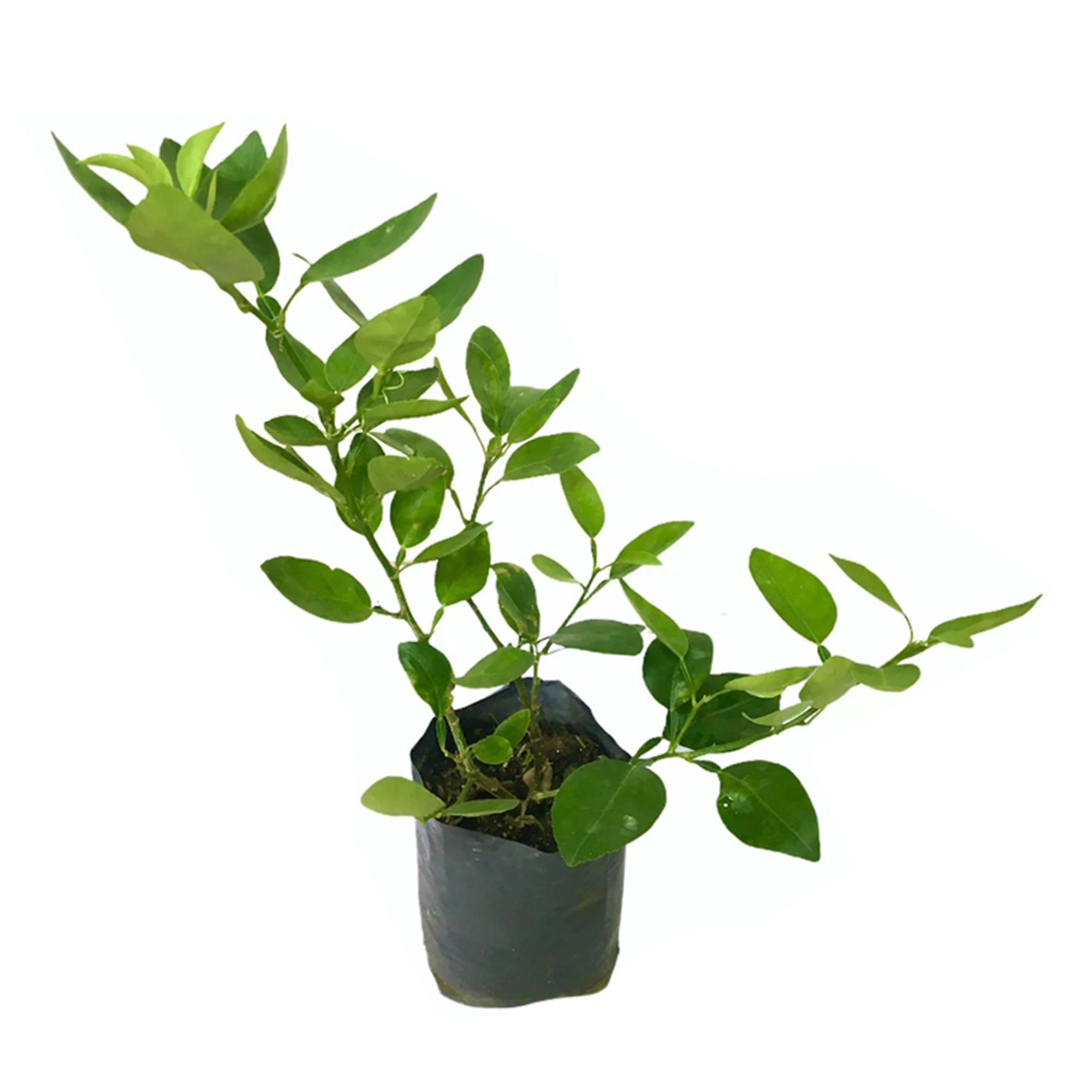
The makrut lime — also widely known as kaffir lime, kieffer lime, or Thai lime — is one of the most distinctive citrus plants in Southeast Asian horticulture and cookery. Its scientific name, Citrus hystrix, nods to the Greek word for hedgehog, a reference to the thorny, spiny stems that characterise the species. This grafted specimen is sold as a young, actively growing plant ready to establish itself in a garden bed, a large pot, or a container on a sunny terrace.
What sets this plant apart from other citrus is the leaf, and specifically its shape. Each leaf is composed of two parts — a true leaf blade and a broadly winged petiole below it — joined end to end so that the whole thing reads as a single, figure-of-eight form. The leaves are dark green and glossy on the upper surface, strongly aromatic when bruised, and release an intense citrus fragrance from the oils within. It is these leaves, used fresh, dried, or frozen, that appear in Thai, Indonesian, Laotian, Cambodian, and Vietnamese cooking: in curry pastes, coconut-milk soups, stir-fries, and sauces. The fruit itself is small, dark green, and covered in a rough, verrucose rind; the rind carries aromatic oils used in perfumery and cosmetic preparations, while the juice is highly acidic and rarely used in the kitchen.
Citrus hystrix is native to tropical Southeast Asia and southern China, and has been cultivated across the region, including Sri Lanka, for centuries. As a mature plant it is a small, bushy, evergreen tree with dense branching and small white flowers that appear intermittently and carry their own faint fragrance. It is well suited to tropical and subtropical gardens and adapts readily to container growing, which makes it practical for growers outside its native range who want to manage it in a sheltered spot.
Grafted plants are favoured over seedling-grown stock because grafting produces a specimen that comes into flower and fruit considerably sooner than a plant raised from seed. This young plant arrives in a small black polythene nursery grow bag, with two branching shoots already bearing its characteristic double-lobed leaves. The grow bag keeps the root system intact and the growing medium moist during transit, so the plant can move into its permanent home with minimal disturbance.
Because Citrus hystrix is not frost-tolerant, growers in cooler climates should plan for a sheltered position or bring the container indoors during cold months. In suitable tropical or subtropical conditions it will settle and grow with straightforward care — good light, regular watering, and a free-draining growing medium. This is a long-lived plant; given the right conditions, it will supply leaves for the kitchen and rind for the kitchen or workshop season after season.