
Ridee Viharaya, also spelled Ridi Viharaya and known in English as the Silver Temple, is an old Buddhist cave temple at Ridigama in Kurunegala District. Tradition links it to the silver said to have helped King Dutugemunu finish Ruwanwelisaya in the 2nd century BC. What you see today spans many periods: cave shrines under a huge rock, a stone image house with Hindu-style carving, Dutch tiles under a reclining Buddha, and a well-known ivory carving.
| Quick facts | Details |
|---|---|
| Location | Ridee Vihara Road, Ridigama, Kurunegala District, North Western Province |
| Traditional date | 2nd century BC, with major later work in the Kandyan period |
| Main places | Maha Viharaya, Uda Viharaya, Waraka Welandu Viharaya, Serasum Gala, Pahangala |
| Hours | The temple says it is open 24 hours all year; plan to visit in daylight |
| Entrance | No official fee found; a 2023 listing gives free entry with donations welcome |
| Temple contact | 077 505 0670, or the temple's contact page |
What is the history of Ridee Viharaya?
The story comes from the Mahavamsa, the great chronicle of Sri Lanka. When King Dutugemunu was planning Ruwanwelisaya at Anuradhapura, silver is said to have appeared in a cave called Ambatthakola, eight yojanas from the city. A merchant travelling to the hills stopped nearby, found a huge jackfruit, and offered it to passing monks. One of them, remembered in local tradition as the arahant Indragupta, led him to the cave. The merchant took a lump of silver to the king.
In the popular version, the grateful king built a temple on the spot, sent more than 300 stone craftsmen, and brought a gold-plated Buddha image from India.
The record is less tidy than the legend. The chronicle itself credits the building of the Rajatalena monastery at Ambatthakola to King Amandagamani Abhaya, who ruled about the 1st century AD. A much later section of the chronicle credits Dutugemunu. So Dutugemunu may be the temple's traditional founder rather than a certain one. Brahmi inscriptions and about 25 caves in the area also point to monks living here very early on.
Later rulers kept the temple going. Parakramabahu I and Nissankamalla are both named as patrons in the Polonnaruwa period. The biggest later change came under King Kirti Sri Rajasinha of Kandy (1747 to 1782), who gave the temple to the novice Siddhattha, revived it, and added the upper temple. Most of the paintings and statues you see today date from the Kandyan period. The temple now belongs to the Malwatte chapter.
What can you see at Ridee Viharaya?
The complex is spread around a rock outcrop about 60 m high. The silver itself is not on show, so come for the shrines, the art and the setting.
Maha Viharaya, the great temple
This is the oldest part and the first main shrine you reach. Also called the Pahala Viharaya, or lower temple, it fills the Rajata Lena, the Silver Cave, beneath a rock said to look like a cobra's head.
- Reclining Buddha: a 9 m image lying along one side of the cave.
- Gold-plated Buddha: a seated image traditionally said to be the one given by Dutugemunu, now kept in a glass case.
- Dutch "Bible tiles": about 200 blue and white tiles on the platform below the reclining Buddha, showing Bible scenes and Dutch village life. Tradition says a Dutch envoy gave them to Kirti Sri Rajasinha. Their jumbled order suggests whoever laid them did not know the stories they show.
- Other images: a line of standing Buddhas, the bodhisattva Avalokitesvara, and a figure believed to represent Dutugemunu.
- Paintings: scenes from the Buddha's life on the plastered rock, some unfinished and some badly weathered.
- Hevisi Mandapaya: the drummers' pavilion in front of the cave, with an old palanquin in its roof and a very large bowl.
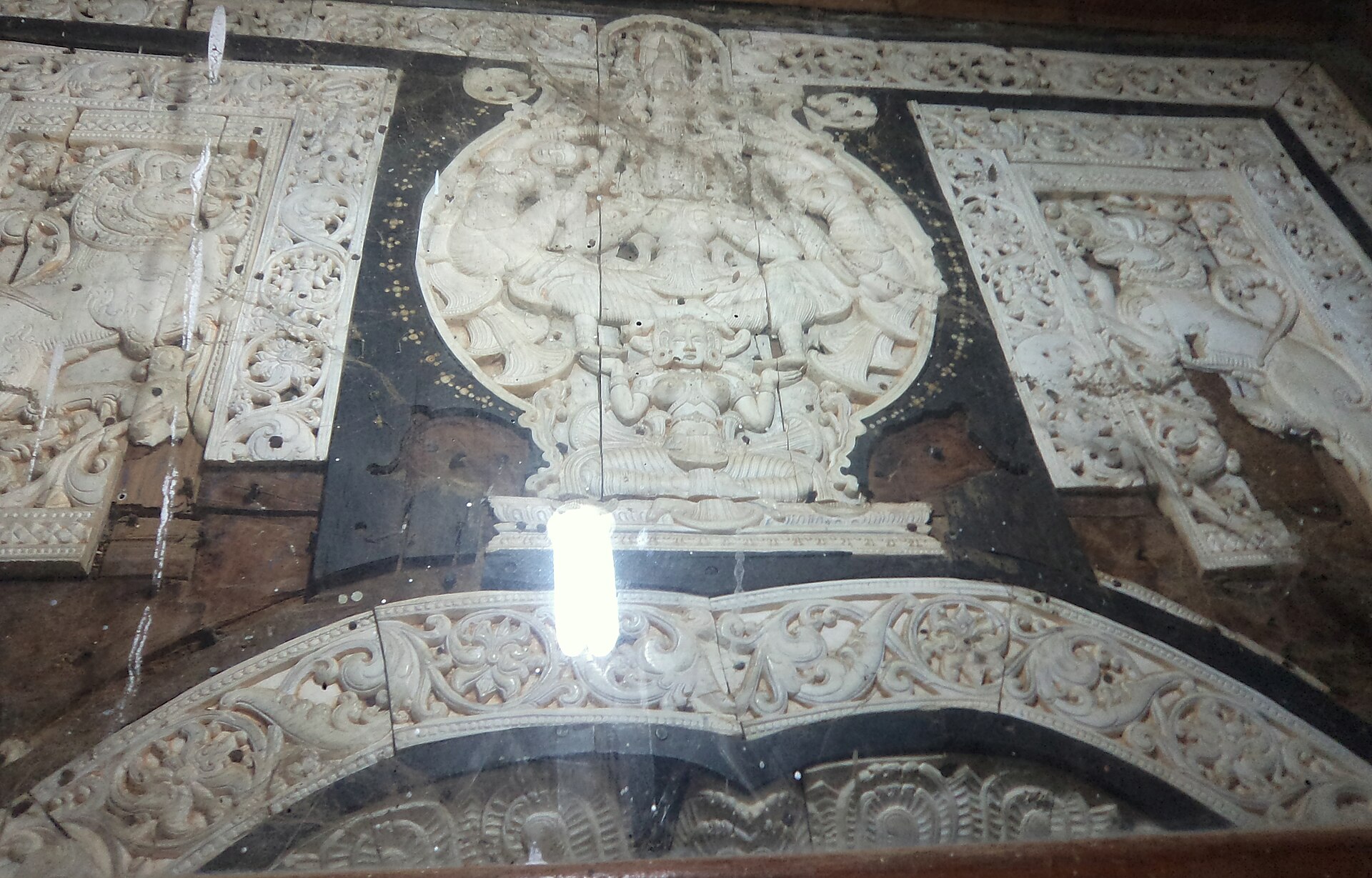
The Pancha Nari Ghataya ivory carving
On the doorway between the lower and upper temples is the carving most visitors ask for. From a distance, the Pancha Nari Ghataya looks like a vase. Up close, it becomes five women whose bodies twist together to make the shape. It sits among lions and floral creepers, and is now behind glass after an act of vandalism.
Uda Viharaya, the upper temple
Kirti Sri Rajasinha's upper temple is built against the rock, with connected chambers and a corridor. One chamber honours Kumara Bandara, the guardian deity of the mountain.
- The entrance: a semi-circular sandakada pahana, or moonstone, with bands of animals and flowers, and carved wing stones beside the steps.
- The seated Buddha: under a makara torana, a dragon arch. The temple says its dragon arch is unlike any other in Sri Lanka.
- Puzzle images: look for Tri Singha, three lions sharing one head; Vrushaba Kunjaraya, a bull and an elephant sharing one head; and Navanari Kunjaraya, nine women arranged to form an elephant.
- Paintings: Kandyan-period work by the painter Devaragampala Silvath Thena and artists of the Nilagama line.

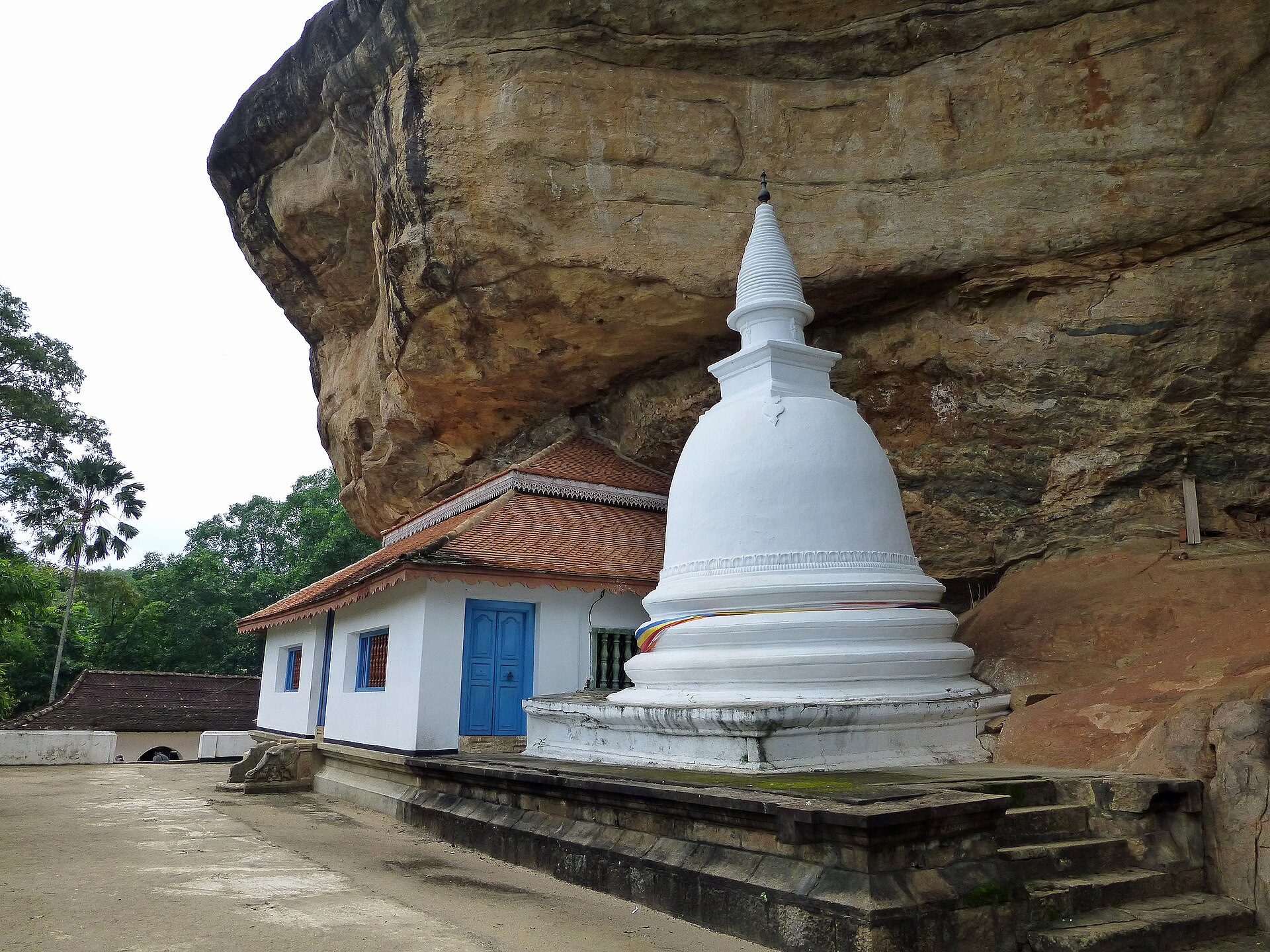
Waraka Welandu Viharaya
This small stone building looks quite different from the rest. Its name is usually explained as the place where the monks ate the jackfruit. Its open hall has eight stone pillars carved with female dancers, in a style close to Hindu temples of the Polonnaruwa period. The dating is not settled: the temple places it in the 12th century, while the Daily FT says it began as a Hindu shrine and became Buddhist around the 11th century. Its Buddha image and paintings are from the Kandyan period.

Serasum Gala
Stone steps to the right of the entrance climb to this rock and its small stupa. Tradition says Dutugemunu changed his clothes here before worship, and some accounts suggest the first temple stood here. The temple also points out rock-cut ponds made for forest monks and old royal inscriptions in the area. On a clear day you can look out toward Dolukanda and Ritigala.
Pahangala
The temple describes Pahangala as about a two-hour walk through forest near Serasum Gala, with views over hills and Bathalagoda Lake. Local legend says lamps were lit here for Kumara Bandara while the temple was being built. We found no mapped route or independent trail description, so ask at the temple for a local companion and start early.
The temple elephant
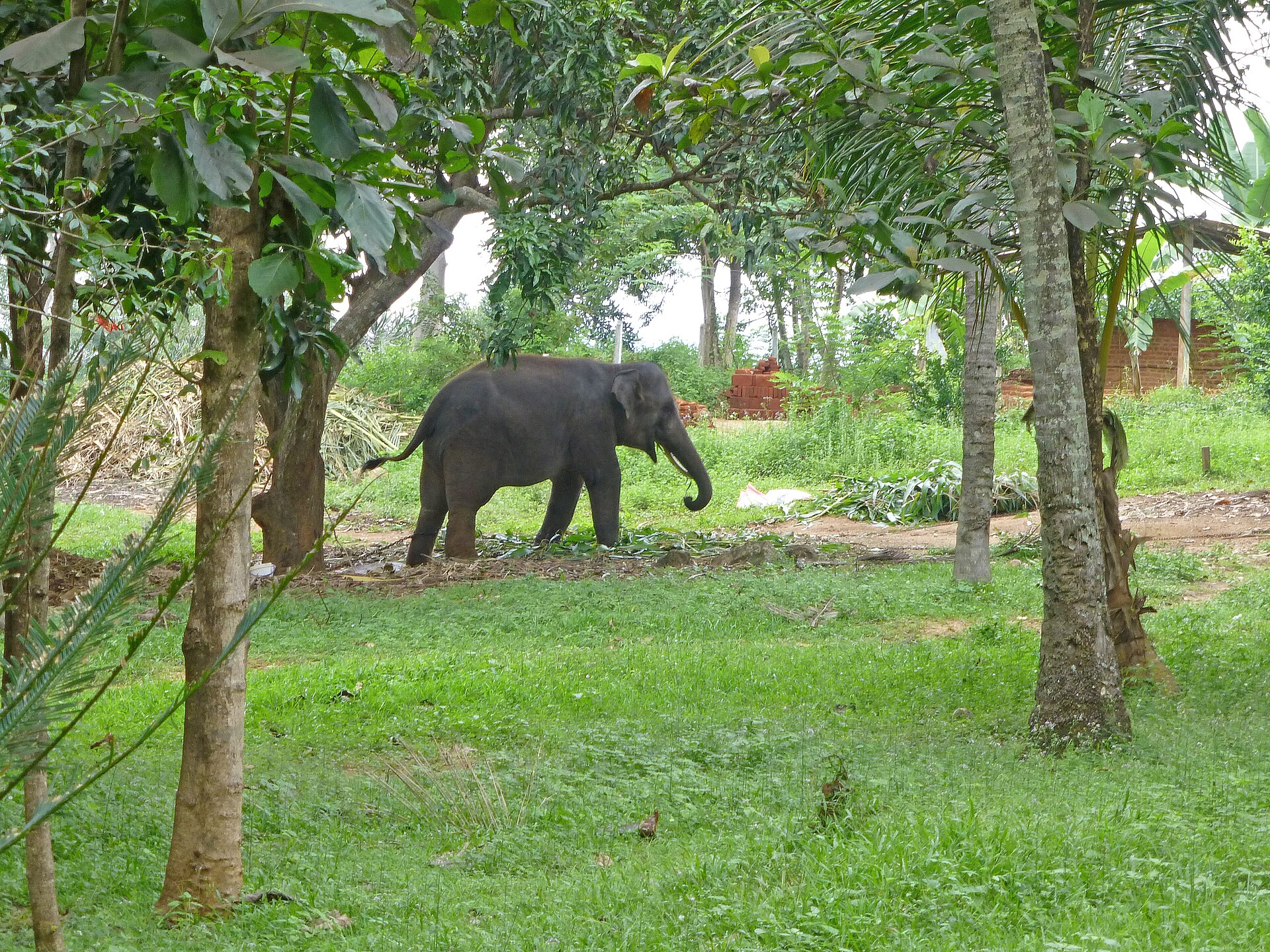
The temple also has a tusker, Sindu, who takes part in its processions and carries sacred relics. If you meet an elephant in the grounds, keep your distance and ask before you approach or feed it.
Which festivals are held at Ridee Viharaya?
This is a living temple, so busy days can be the most rewarding and the most crowded. Dates follow the lunar calendar, so check them with the temple.
- Vesak: the main festival, marking the Buddha's birth, enlightenment and passing, with lanterns, Dhamma talks and almsgiving.
- Poson: marks the arrival of Buddhism in Sri Lanka with Mahinda Thero.
- Esala perahera: the Daily FT and other accounts describe an annual Ridi Vihara procession, with that of the Kumara Bandara Devalaya, passing through Ridigama. The temple's own festival page is less firm, so confirm before you travel for it.
- Kathina: robes and other needs are offered to the monks after the rainy season retreat.
- Poya days: each full moon brings more devotees, most of them dressed in white.
Can you stay at Ridee Viharaya?
Yes, according to the temple, which offers free accommodation and meals to pilgrims and travellers. Lodging is simple. Its reservation page lists these options:
- A/C room: with an attached washroom.
- Non-A/C room: with a shared washroom.
- Scenery room: needs special permission from the head monk.
- Dhana Shala: a hall for groups of up to 500 people.
Send a request through the temple's room reservation page and ask for a confirmation. No prices, check-in times or length-of-stay limits are published. This is a monastery rather than a hotel, so please dress and behave accordingly, and consider leaving a donation.
The temple's site also describes guided cave walks, village tours and craft workshops. We could not confirm that these run regularly, so ask first.
How do you get to Ridee Viharaya?
From Kurunegala, follow the Kandy road to the Mallawapitiya junction, then turn onto the road toward Ridigama. Continue for about 13 to 15 km and take the signposted road uphill for the last 1.5 to 2 km.
| From | Distance | Time by road |
|---|---|---|
| Kurunegala | About 20 km | About 30 minutes |
| Kandy | About 50 km | About 1 to 1.5 hours |
| Dambulla | About 50 km | About 1 to 1.5 hours |
| Colombo | About 115 km | About 2 to 2.5 hours |
These are map estimates, so allow for traffic. Without a car, travel to Kurunegala by bus or train, then continue by local bus or three-wheeler.
What should you know before you visit?
- Dress: cover your shoulders and knees. Remove your shoes and hat before entering shrines.
- Photos: photography is reported to be allowed, but ask inside shrines and during worship, and never pose with your back to a Buddha image.
- Footing: expect stone steps and bare rock, which is hot at midday and slippery in rain. One listing rates the site as not accessible for visitors with reduced mobility.
- Timing: go in the morning for cooler rock and fewer people. Poya days are busier.
- Guides: a listing describes visits as self-guided, so ask locally if you would like someone to explain the shrines.
What else is near Ridee Viharaya?
- Rambadagalla: a huge granite seated Buddha at Rambadagalla Viharaya, about 5 km past the Ridi Viharaya turn-off.
- Kurunegala: the former royal capital and nearest large town.
- Yapahuwa: a rock fortress and short-lived capital further north.
- Dambulla Cave Temple: a natural pairing if you are interested in cave shrines and Kandyan painting.
Top photo: Maha Viharaya, by Ji-Elle, CC BY-SA 3.0, via Wikimedia Commons. Visitor details are drawn from the temple's website and other published sources, and can change. Please confirm them with the temple before you travel.
Nearby places
8 places within about 25 km, nearest first.


