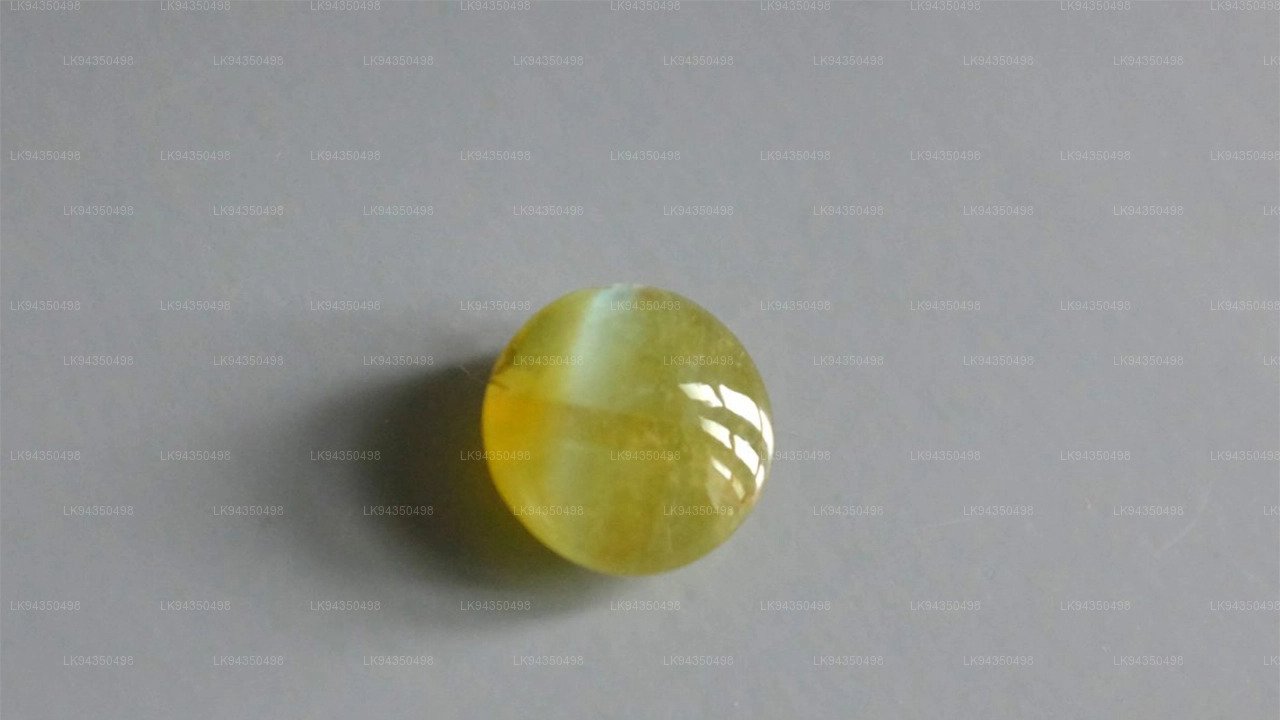
Moonstone is one of the most poetic gemstones in the world — not because of hyperbole, but because of physics. Its signature glow, a soft billowing light that seems to float just beneath the surface, is a natural optical phenomenon that no treatment can fully replicate. Sri Lanka has been producing some of the finest moonstones on earth for centuries, and the island remains the primary source for the prized blue-sheen variety.
What gives moonstone its glow?
The effect is called adularescence, and it arises from the stone's internal structure. Moonstone belongs to the feldspar mineral group and is composed of alternating layers of two feldspar species — orthoclase and albite. When light enters the stone, it scatters between these microscopic layers and reflects back as a soft, diffused luminescence that appears to move as the viewing angle changes.
The finest adularescence is distinctly bluish and appears to float in three dimensions within a semi-transparent stone. Lower-quality specimens tend to be more translucent and show a whiter, flatter glow with less depth.
Where does moonstone come from?
Sri Lanka is the world's leading source of blue-sheen moonstone, the variety most prized by collectors and jewellers. Other sources include Myanmar (Burma), Switzerland (where early specimens were found near the Adula mountain range, giving adularescence its name), Madagascar, Tanzania, and the United States. Each source tends to produce stones with slightly different character: Sri Lankan moonstones typically offer the strongest blue flash and the greatest transparency.
What varieties of moonstone exist?
- Blue moonstone — The classic variety, semi-transparent with a vivid blue adularescence. Sri Lanka is the primary source.
- White or colourless moonstone — More common, typically translucent, with a white or silver sheen.
- Peach or rainbow moonstone — Often labradorite marketed under the moonstone name; exhibits a multicolour flash rather than a single-direction glow.
- Cat's eye moonstone — A rarer variety displaying chatoyancy (a focused beam of light) in addition to adularescence. The two effects together in a single stone are uncommon.
How is moonstone quality assessed?
Gemologists evaluate moonstone on four main criteria: the strength and colour of adularescence, transparency, colour of the body, and freedom from visible inclusions. The ideal stone is near-colourless, highly transparent, and shows a strong blue flash centred over the dome of a well-cut cabochon.
One characteristic flaw to know about is the centipede — tiny tension cracks that resemble the body of a centipede when viewed under magnification. Their presence does not necessarily disqualify a stone, but heavy centipede inclusions reduce value. The majority of commercial-grade moonstones are eye-clean, meaning these cracks are not visible to the naked eye.
Moonstone is almost never treated. Unlike many coloured gemstones, it reaches the market in its natural state. Its adularescence cannot be enhanced by heat or irradiation, so what you see is what the earth produced.
What are moonstone's physical properties?
| Property | Details |
|---|---|
| Mineral group | Feldspar (orthoclase) |
| Optical phenomenon | Adularescence; occasionally cat's eye |
| Transparency | Semi-transparent to translucent |
| Typical colour | Colourless to white; blue adularescence |
| Toughness | Poor — vulnerable to knocks and pressure |
| Treatments | Typically none |
The poor toughness rating is worth noting for buyers. Moonstone has two cleavage directions that intersect, making it prone to chipping or cracking if knocked hard. Rings set with moonstone should be worn with care; pendants, earrings, and brooches are safer choices for everyday wear.
What is the history of moonstone?
Both ancient Rome and Greece associated moonstone with their lunar deities — Selene, Diana, and Luna. The Roman natural historian Pliny the Elder coined the name in the first century AD, writing that the stone's shimmering appearance shifted with the phases of the moon. This belief persisted well into the sixteenth century and gave the gem an enduring mystique that modern gemology has since explained through optics rather than mythology.
In India, moonstone has long been considered a sacred stone. Merchants traditionally displayed it on a yellow cloth — yellow being a sacred colour — and it was believed to bring good fortune. During the Art Nouveau period in Europe, from the 1890s through the early 1900s, moonstone enjoyed a significant revival among jewellers who prized its organic, otherworldly glow as a counterpoint to the era's industrial aesthetic. René Lalique and other masters of the period used it extensively.
Sri Lanka's gem trade has been intertwined with moonstone for millennia. The island's gem-bearing gravels — known as illam — are concentrated in the Sabaragamuwa and Uva provinces, and the trade route that carried Sri Lankan gems to Rome and Arabia passed through ports that have been active since antiquity.
How is moonstone used in jewellery?
Moonstone is almost exclusively cut as a cabochon — a smooth, domed shape with a flat base — because this cut best focuses and displays the adularescence across the crown of the stone. Faceted moonstones exist but are uncommon; facets break up the glow rather than concentrating it.
The gem is set in rings, pendants, earrings, and brooches. Because of its poor toughness, protective settings such as bezel mounts (which surround the stone's edge with metal) are preferred over prong settings for rings. Sterling silver and white gold are the most popular metal pairings, as they complement the stone's cool luminescence without competing with it.
What role does moonstone play in traditional beliefs?
Across several traditions, moonstone is associated with feminine energy, intuition, and cyclical change. It has been used in Ayurvedic and crystal-healing contexts for purposes relating to hormonal balance and emotional clarity. These associations are rooted in cultural and spiritual tradition rather than clinical evidence, but they have contributed to the stone's enduring popularity as a meaningful gift — particularly for new beginnings, travel, and milestones.
How should you care for a moonstone?
Clean moonstone with warm water and mild soap, using a soft cloth or brush. Avoid ultrasonic cleaners, steam cleaning, and any abrasive materials — all of which can exploit the stone's cleavage planes and cause fracturing. Store moonstone jewellery separately from harder gemstones (sapphires, diamonds, rubies) that could scratch its surface. Prolonged exposure to strong sunlight is unlikely to cause damage, but extreme temperature changes should be avoided.