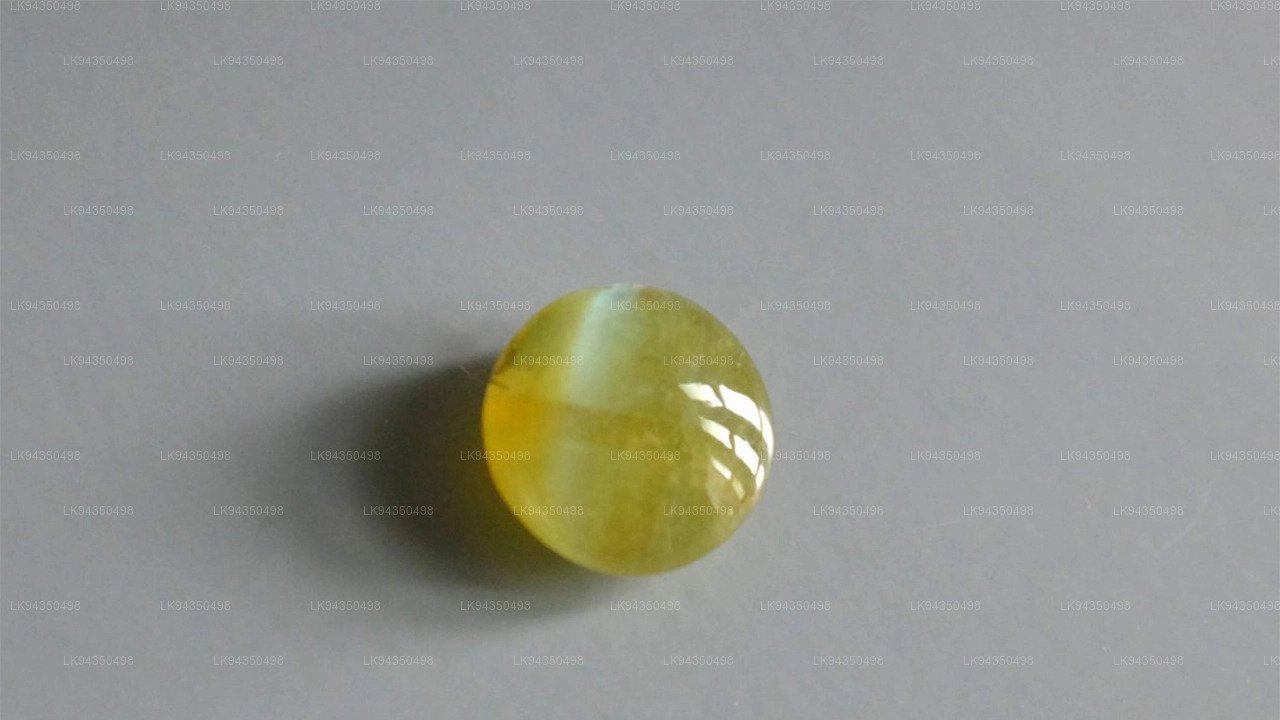
Cymophane, more widely recognised by its trade name cat's eye, is one of Sri Lanka's most distinctive gemstones and among the rarest varieties of chrysoberyl found anywhere in the world. Its name derives from the Greek words for wave and appearance — a fitting description for the silvery light that seems to glide across the surface of the stone when it is moved beneath a light source.
What Makes Cymophane Unique?
The defining characteristic of cymophane is chatoyancy — an optical phenomenon in which a narrow band of reflected light moves across the surface of the gem, closely resembling the slit pupil of a cat's eye. This effect is produced by the presence of microscopic inclusions within the crystal: tightly packed, parallel needles of rutile or hollow tubular cavities align themselves during the growth of the stone. When the gem is cut as a cabochon — a smooth, dome-shaped cut rather than a faceted one — and oriented correctly, these inclusions concentrate incident light into a single, crisp luminous band.
No two specimens produce exactly the same band. The sharpness and brightness of the eye depends on the uniformity and density of the inclusions. Stones displaying a strong, well-centred eye that opens and closes distinctly as the light angle changes are considered exceptional and command significant collector interest.
What Colours Does Cymophane Come In?
Chrysoberyl as a mineral family occurs across a wide spectrum of transparencies — from fully transparent and water-clear to cloudy and nearly opaque. Cymophane specifically tends toward the translucent-to-opaque end of this range, which is precisely what makes chatoyancy visible. In terms of colour, most cymophane from Sri Lanka ranges through:
- Semi-transparent golden-yellow, often described as honey-coloured
- Slightly greenish-yellow, sometimes called mint or pistachio
- Brownish-yellow to olive tones
The most sought-after stones display a warm honey or greenish-yellow body colour combined with a sharp, centred, bright eye. A phenomenon called the milk-and-honey effect — where one half of the cabochon appears milky white and the other a warmer golden tone — is considered especially desirable among gem collectors.
Where Is Cymophane Found in Sri Lanka?
Sri Lanka has been a significant source of chrysoberyl cat's eye for centuries, and the gem appears within several distinct geological zones across the island's central and southwestern regions. The main gem-bearing areas include Ratnapura, widely regarded as Sri Lanka's gem capital, along with surrounding localities such as Rakwana, Bulutota, Deniyaya, and Morawaka in the Sabaragamuwa and Southern provinces.
Additional productive zones extend through Elahera in the North Central Province and a band of southwestern lowland localities including Avissawella, Pelawatte, Horana, Matugama, Panadura, Aluthgama, Ambalantota, Agalawaththa, Bulathsinghala, Kalapugama, and Mestiya. These areas share similar geological conditions — alluvial gem gravels known locally as illam — deposited over millennia through the weathering and erosion of the island's ancient Precambrian metamorphic rocks.
The Sinharaja Forest Reserve region in the south-west sits adjacent to some of these productive gem-bearing deposits, a reminder of how Sri Lanka's biodiversity and geological wealth are intertwined in this part of the island.
How Is Cymophane Distinguished from Other Cat's Eye Stones?
In the gem trade, the term cat's eye without any qualifier conventionally refers exclusively to chrysoberyl cat's eye. Other minerals — quartz, tourmaline, aquamarine, and others — can also display chatoyancy, but they are always identified by their mineral name (for example, quartz cat's eye or tourmaline cat's eye). This convention reflects the historical pre-eminence of cymophane as the finest and most valued chatoyant gem.
The key distinguishing factors when evaluating cymophane are:
- Hardness: Chrysoberyl rates 8.5 on the Mohs scale, making cymophane harder than most other chatoyant gems and suitable for everyday jewellery use.
- Refractive index: Cymophane has a relatively high refractive index, which contributes to the brightness and sharpness of the eye.
- Eye quality: A fine cat's eye should show a single, well-defined, silvery-white band precisely centred on the cabochon.
- Body colour: Colour saturation and tone affect value significantly alongside eye quality.
What Is the Cultural Significance of Cat's Eye in Sri Lanka?
Sri Lanka's relationship with its gemstones extends well beyond commerce. The island — historically known as Serendib and later Ceylon — has supplied gemstones to courts across Asia, the Middle East, and Europe for over two thousand years. Marco Polo's accounts of Ceylon's gems helped establish the island's enduring reputation as a stone of exceptional quality in global gem lore.
In Vedic astrology, which remains widely practiced across South Asia, chrysoberyl cat's eye is associated with the planet Ketu and is traditionally worn as a protective talisman. It is believed to bring clarity of thought, guard against the unknown, and offset certain astrological influences. While these claims belong to cultural tradition rather than gemological science, they reflect the deep symbolic weight that cat's eye has carried in this part of the world for generations.
How Is Cymophane Mined and Processed?
In Sri Lanka, cymophane is typically recovered through artisanal and small-scale gem mining. Miners excavate alluvial gravels by hand or with simple mechanical equipment, then sieve and wash the material to separate heavier gem-bearing fractions. The process is labour-intensive and requires considerable skill in reading the land for productive gem pockets.
Once rough cymophane is recovered, it is assessed for the orientation of its inclusion structure before cutting. Because the chatoyant band only appears when the inclusions run parallel to the base of the cabochon, the lapidary must orient the rough carefully before shaping begins. Misjudging this orientation even slightly results in a weak or off-centre eye — a costly error in a rare and valuable material.
Where Can You Buy Cymophane in Sri Lanka?
Ratnapura — whose name in Sinhala literally means City of Gems — is the natural starting point for anyone interested in purchasing cymophane. The city hosts both wholesale gem dealers and retail jewellers, and the National Gem and Jewellery Authority of Sri Lanka operates certification services that provide independent verification of a stone's identity, origin, and quality. Purchasing a certified stone from a reputable dealer is strongly advisable, particularly for high-value specimens where synthetic or misrepresented material occasionally appears in general markets.
Colombo's dedicated gem districts and several hotel-based gem retailers also offer cymophane, typically with higher price points but the convenience of easier access for visitors arriving from overseas.