
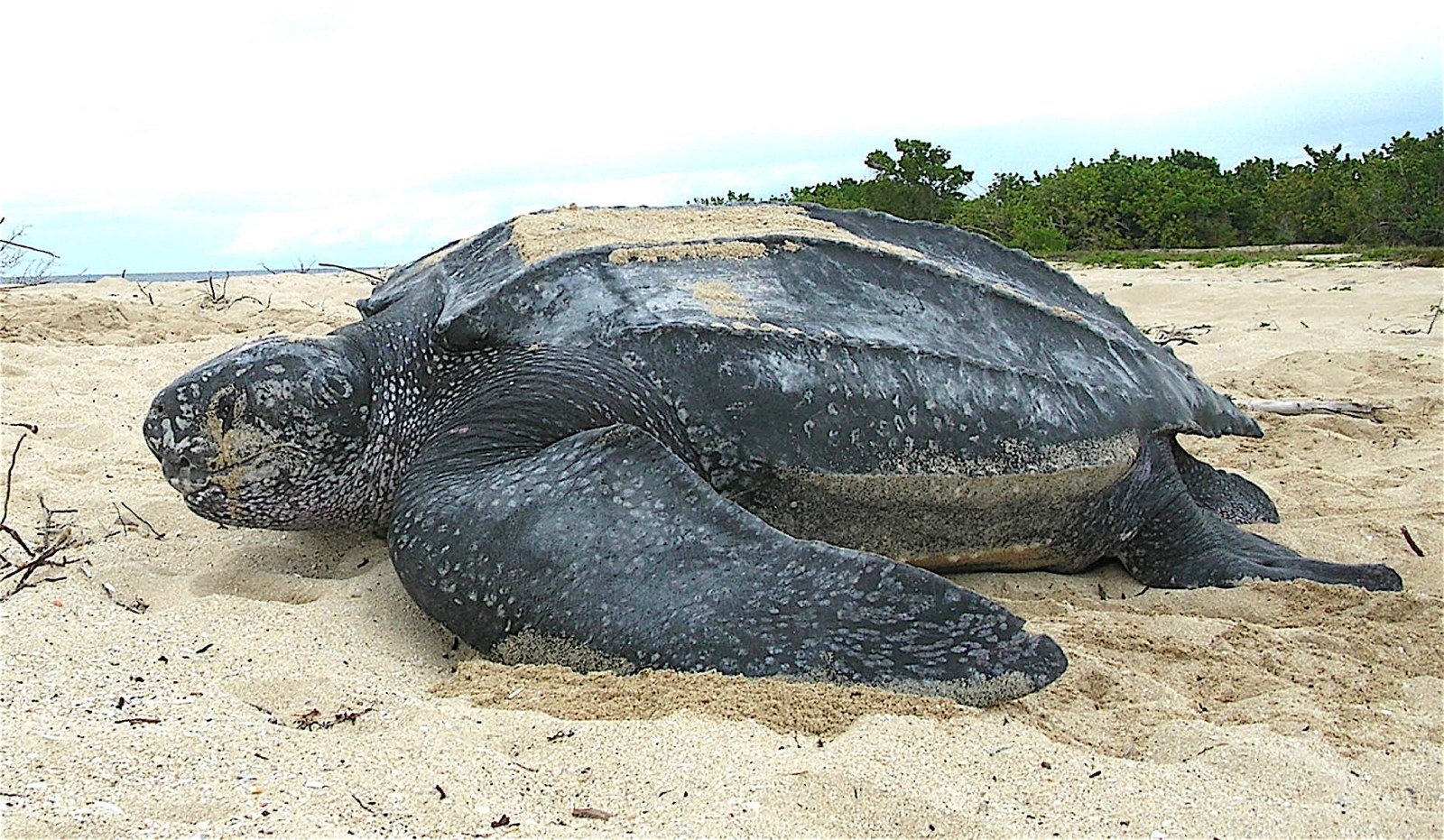
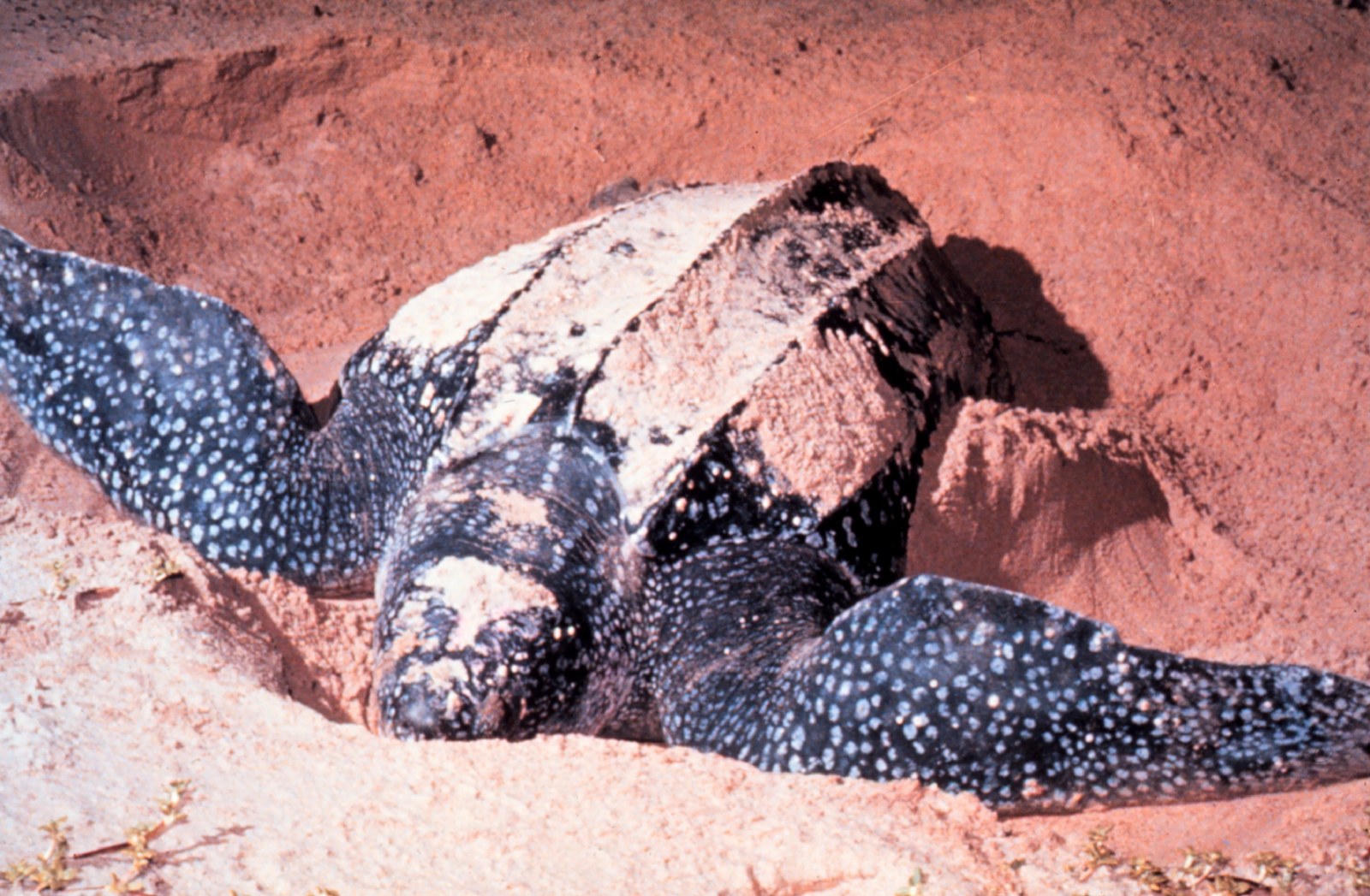
The Leatherback Turtle (Dermochelys coriacea) is the largest sea turtle in the world, and the only one without a hard shell. It spends most of its life in the open ocean, feeding on jellyfish and diving far deeper than other turtles. Leatherbacks do nest in Sri Lanka, but only occasionally, so a sighting here is rare.
How do you identify a Leatherback Turtle?
No other turtle looks like it. Its size and ridged, rubbery back are unmistakable.
- Size: adults have a shell of about 1 to 1.75 m and weigh about 250 to 700 kg.
- Shell: flexible skin over a layer of tiny bones, instead of hard plates, with seven ridges running along the back.
- Colour: dark grey to black with white or pink speckles, and paler underneath.
- Flippers: very long front flippers with no claws, which drive it across whole oceans.
What does the Leatherback Turtle eat?
Adults eat almost nothing but jellyfish and other soft-bodied animals such as salps and squid. Because this food holds so little energy, they must eat a great deal of it, up to about 73% of their body weight in a day. Plastic bags look like jellyfish in the water, and about a third of adults have been found to have swallowed plastic.
How deep can a Leatherback Turtle dive?
The deepest recorded dive is about 1,280 m, though most dives are short and last only a few minutes. Leatherbacks can also forage in very cold water. Their fat, their circulation and their constant swimming keep the body warm, and adults have been recorded at 18 °C above the water around them, which is remarkable for a reptile.
How do Leatherback Turtles nest?
A female can nest up to nine times in a season, about nine days apart, which is the shortest gap of any sea turtle. Each clutch holds about 110 eggs, and the eggs hatch after about 60 to 70 days.
Where can you see Leatherback Turtles in Sri Lanka?
You cannot plan on seeing one. Leatherbacks have been recorded on beaches at Kosgoda, Induruwa, Rekawa and Bundala, but they nest far less often than the Green Turtle and the Olive Ridley Turtle. Scientists have proposed that the turtles nesting in Sri Lanka and the Nicobar Islands form their own Indian Ocean population, though little research has been done on them.
To plan a visit, see our guides to turtle watching and the baby turtle release, or read about all the sea turtles of Sri Lanka.
Is the Leatherback Turtle endangered?
The IUCN Red List classes the species as Vulnerable worldwide, but this hides large differences. Several populations are Critically Endangered, including those of the East and West Pacific and the Southwest Indian Ocean, while the Northeast Indian Ocean population is listed as Data Deficient because too little is known about it. The main threats are egg collecting, capture in fishing gear, boat strikes, plastic waste and artificial lights on beaches. It is on CITES Appendix I, and all sea turtles are protected by law in Sri Lanka.
What should you do if you see a Leatherback Turtle?
- Keep your distance. A nesting female is easily disturbed, so stay well back and out of her path.
- Keep lights off. Use no flash or white torch on the beach.
- Report it. Records of this species in Sri Lanka are valuable, so tell your guide or a local conservation project.
Sri Lanka's other sea turtles are the Green Turtle, the Loggerhead Turtle, the Olive Ridley Turtle and the Hawksbill Turtle.
Related reading
2 pages on closely related subjects.

