

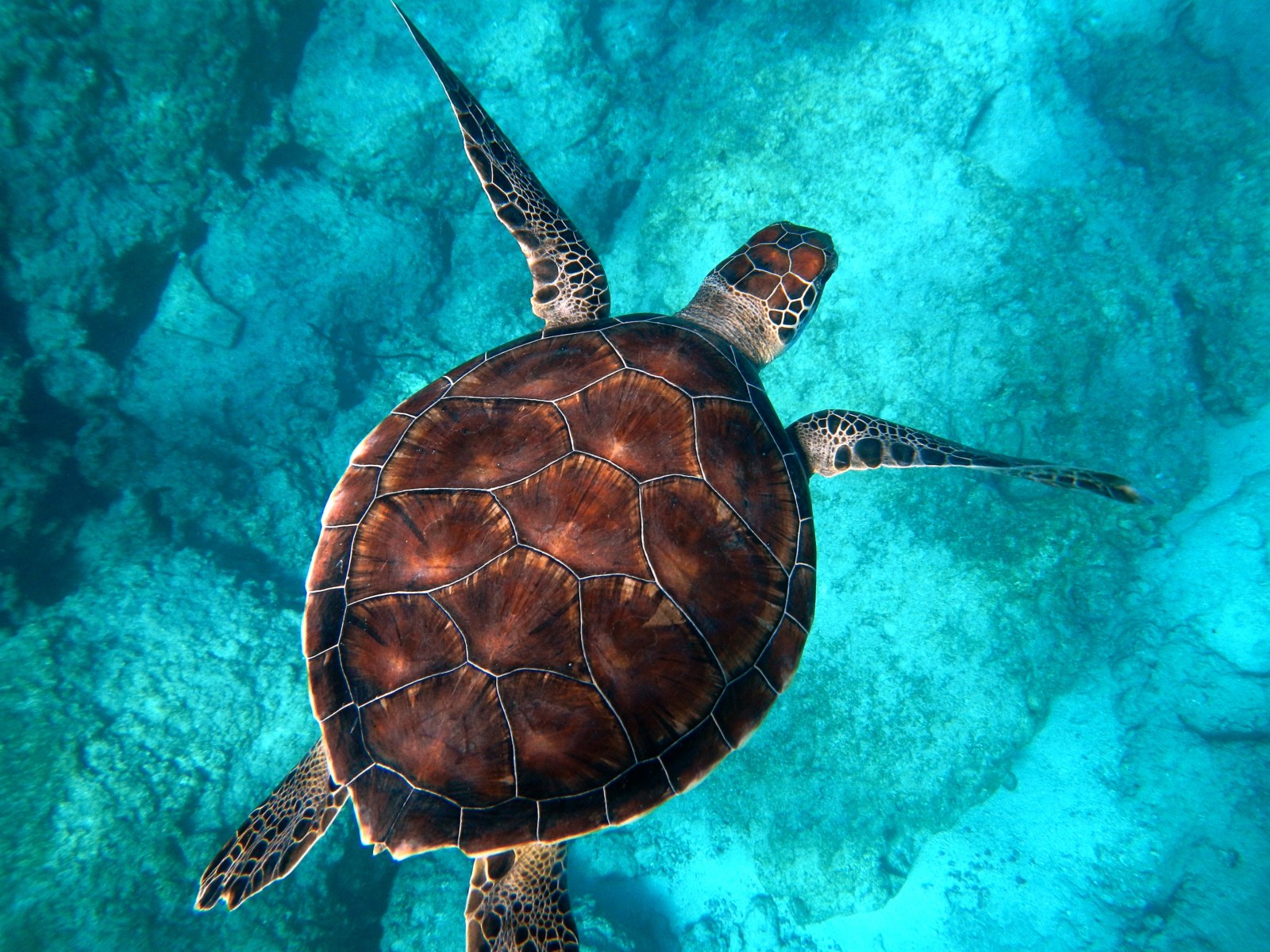
The Green Turtle (Chelonia mydas) is the sea turtle you are most likely to meet in Sri Lanka, both on the nesting beaches of the south and southwest and over the island's shallow reefs. It is a large, calm animal that grazes on seagrass and algae, and it is the only sea turtle that lives mainly on plants as an adult. Its name has nothing to do with the colour of its shell, which is olive to brown.
How do you identify a Green Turtle?
Look at the head first. The Green Turtle has a short, rounded snout and a beak with no hook, which separates it from the sharp-beaked Hawksbill Turtle.
- Size: adults have a shell of about 78 to 112 cm and usually weigh 68 to 190 kg. The largest on record weighed 395 kg.
- Shell: smooth and oval, olive to brown and often marbled or spotted, with five central plates and four pairs along the sides.
- Head: small for the body, with one pair of scales between the eyes.
- Flippers: adults have a single visible claw on each front flipper.
Why is it called the Green Turtle?
The name comes from the greenish fat under its shell, which is coloured by its seagrass diet. That fat was once prized for turtle soup, a trade that drove heavy hunting around the world.
What does the Green Turtle eat?
Young Green Turtles are carnivores, eating jellyfish, fish eggs and small invertebrates. As they grow they move to shallow lagoons and bays, and adults live largely on seagrass and algae, cropping them with finely serrated jaws.
How do Green Turtles nest?
Females come ashore at night and return to the region where they hatched. They mate every two to four years and nest three to five times in a season, laying about 85 to 200 eggs in each clutch. The eggs hatch after about 50 to 70 days, and warmer nests produce more females. A hatchling that survives may need 20 to 50 years to reach maturity.
Where can you see Green Turtles in Sri Lanka?
This is the island's main nesting species. One review put it at about 68% of nesting turtles, with the Olive Ridley Turtle at about 30%.
- Rekawa: the largest Green Turtle nesting site on the south coast, where you can watch wild females at night.
- Kosgoda: a study from 2003 to 2008 recorded about 298 Green Turtle nests a year. Nesting went on all year, with about two thirds of it from February to June.
- Hikkaduwa: snorkellers often see Green Turtles feeding over the reef.
- Pigeon Island: turtles feed around this east coast reef, which is best visited from about May to September.
To plan a visit, see our guides to turtle watching and the baby turtle release, or read about all the sea turtles of Sri Lanka.
Is the Green Turtle endangered?
Not any more on the global list, though it still needs protection. In October 2025 the IUCN Red List moved it from Endangered to Least Concern, after decades of beach protection and limits on hunting allowed nesting to recover in several regions. The recovery is uneven, and some populations remain a concern. The species is on CITES Appendix I, which bans international commercial trade, and all sea turtles are protected by law in Sri Lanka. The main threats here are capture in fishing gear, coastal development and lights on nesting beaches.
How should you behave around Green Turtles?
- In the water, keep your distance. Never chase, touch or ride a turtle, and let it come up to breathe without being crowded.
- On a nesting beach, stay dark and quiet. Use no flash or white torch, and follow your guide's instructions.
- Take your plastic home. Sea turtles can swallow plastic, which can block the gut.
Sri Lanka's other sea turtles are the Loggerhead Turtle, the Olive Ridley Turtle, the Leatherback Turtle and the Hawksbill Turtle.
Related reading
8 pages on closely related subjects.


