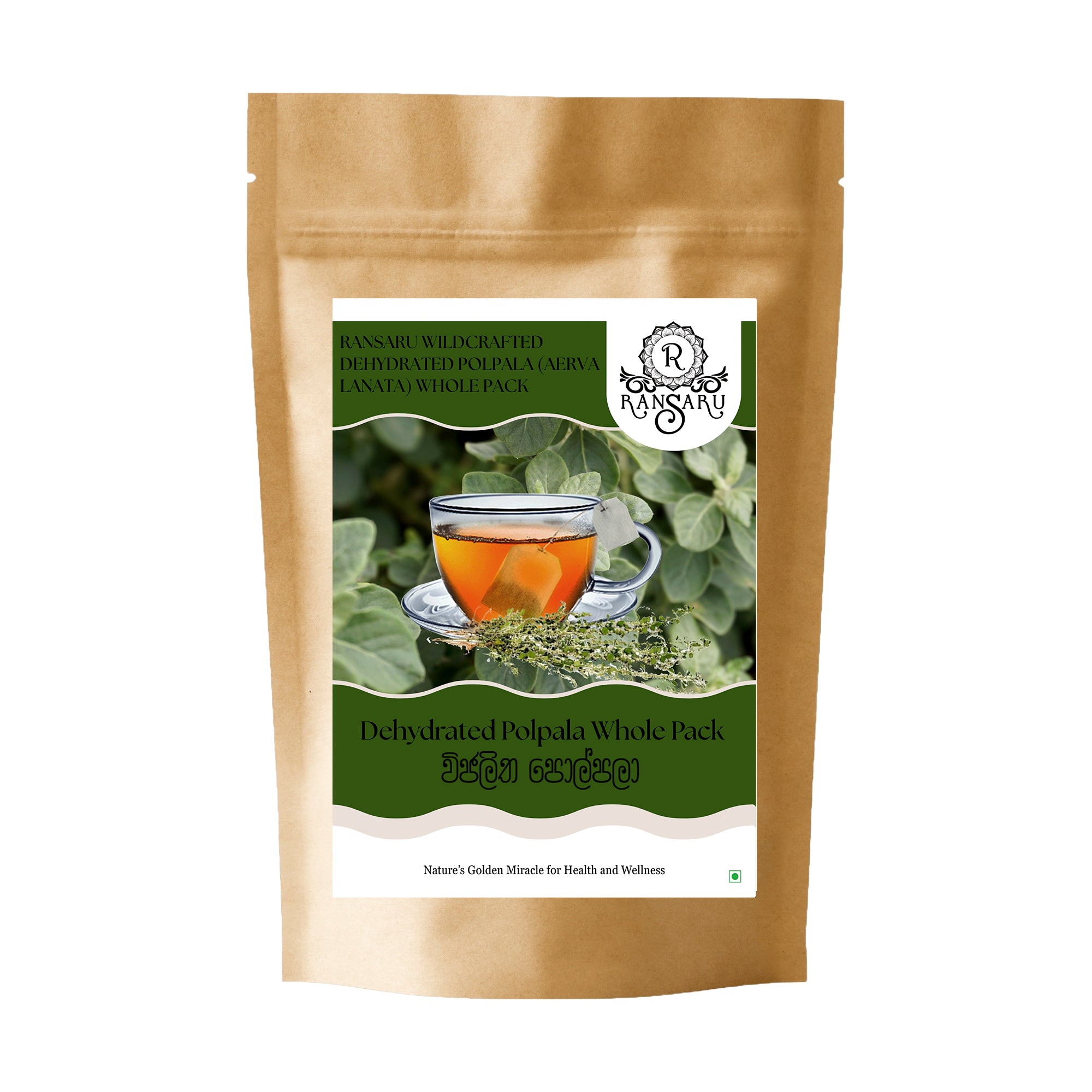
Polpala is a woody, succulent perennial herb — known botanically as Aerva lanata and belonging to the Amaranthaceae family — that grows across the drier tropics of Africa and Asia, and is well established as a native plant of Sri Lanka. Lakpura sources the whole herb and dehydrates it to produce a shelf-stable product that retains the taste, aroma and nutritional character of the freshly picked plant. The packaging states the single ingredient as 100% Pure Organic Aerva lanata, and the product carries both GMP and EDB certifications.
The herb has a long presence in Ayurvedic tradition and in everyday Sri Lankan kitchens. The leaves and young stems are edible: they are stirred into porridge (kola kanda), added to soups, or eaten simply as a leafy green. Polpala also has a place in traditional herbal preparations, where the dried plant is steeped in hot water to produce an infusion that has been consumed in parts of Asia for generations. The Lakpura range offers the dehydrated herb in three forms — leaves, powder and tea bags — so the preparation method can suit how you intend to use it.
Dehydration is a technique that removes moisture while leaving the structure of the plant largely intact. To return the leaves to something close to their fresh state, the packaging and preparation guidance both describe immersing the dehydrated product in lukewarm water for around twenty minutes. The powder and tea bag variants can be prepared directly with hot water. Each pack travels freshly picked, packed and shipped from Sri Lanka, which is noted on the packaging alongside Lakpura's 'Small Island, Big Surprise' mark.
Packs are available in three sizes — 50 g, 100 g and 200 g — making it practical to try the product before committing to a larger quantity, or to stock up if Polpala is already a regular part of your kitchen. The nutrition facts on the 50 g pack record 14 calories per 2 g serving, with 0.52 g carbohydrates and 0.17 g protein per serving, and no measurable fat.
A note on use: Polpala has a long history as a traditional herb, but it is not a food to consume in large or sustained quantities without guidance. Peer-reviewed research has raised questions about the effects of long-term, high-volume ingestion, and the herb is not conventionally prescribed for extended use in traditional Ayurveda. Used in the measured, culinary and infusion-based ways it has historically been prepared, it is a distinctive Sri Lankan ingredient with a genuine depth of heritage behind it.