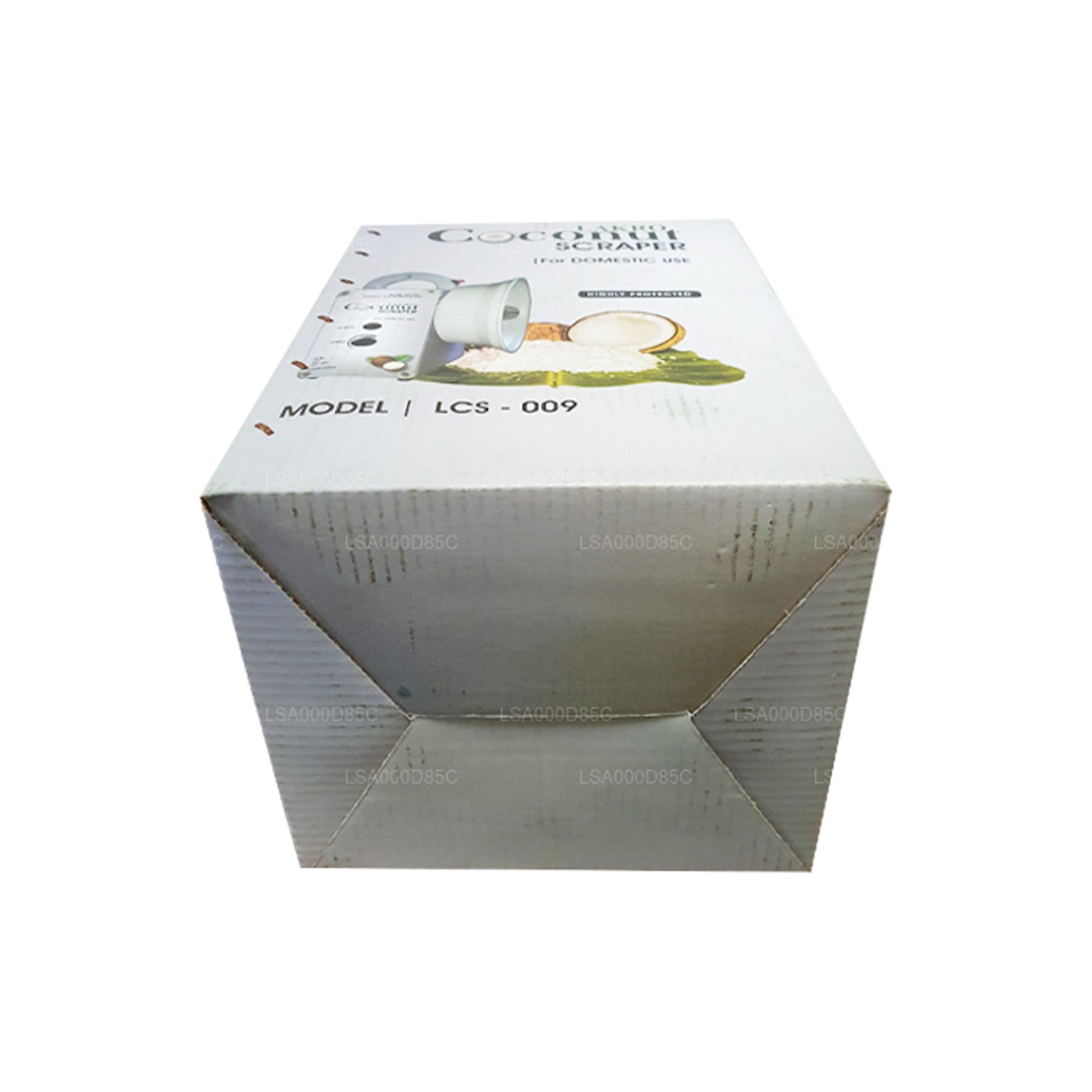
The Lakro Domestic Electric Coconut Scraper is a small Sri Lankan kitchen machine built for the one job that holds up cooking with fresh coconut: getting the white flesh out of the shell. You hold half a nut against a spinning stainless steel head and it comes back as a bowl of fine, even shreds — around a coconut a minute, where a hand scraper wants several and a sore wrist.
It is made in Sri Lanka and built for home kitchens rather than commercial ones: a 150 W motor, a body small enough to live on a worktop, and a handle on top so it can be lifted back into a cupboard between meals. If you cook Sri Lankan, South Indian, Thai or Malay food often enough that a tin of desiccated coconut has stopped being good enough, this is the machine that makes fresh scraped coconut — and the first-press milk you squeeze from it — an ordinary weeknight thing.
What is on the machine. A deep moulded bowl catches the shreds as they come off, so nothing sprays across the counter. Inside it, a serrated stainless steel scraping head turns on the motor shaft. On the front panel sit a red power indicator lamp and a speed dial, so you can run the blade slower for a soft young nut and faster for a hard mature one, and there is a safety control switch on the body. The cable is long enough to reach a worktop socket, and rubber feet keep the machine planted while it works.
Two voltages — please pick the right one. This machine is sold in two electrical builds, and you choose between them on this page:
- 220 / 230 V, 50–60 Hz — the standard build. Right for Sri Lanka, the United Kingdom and Europe, most of Asia and Africa, Australia and New Zealand.
- 110 V — the North American build. Right for the United States, Canada and anywhere else on a nominal 110–120 V supply.
Match the build to the mains voltage where the machine will actually live, not to where the parcel is posted. This matters more than it looks: a travel plug adapter changes the shape of the pins and does nothing at all to the voltage. A 220 V machine on a 110 V supply will labour and scrape badly; a 110 V machine on a 220 V supply will be damaged. The machine ships with a Sri Lankan square-pin plug, so you will most likely want a plug adapter for your own sockets whichever build you order — but the adapter is for the socket, and the voltage choice is the one you make here.
Two model builds. The scraper is offered as the LCS-009 and the ACS-01, and each is available in both voltages. They are the same class of machine at the same 150 W and differ in the housing and the shape of the collecting bowl. If a specific model is being matched to one you already own, or to a blade or motor you already have, tell us before you order and we will confirm what is in stock.
What the machine is good for:
- Coconut milk — fine, even shreds release more milk under the squeeze than a coarse hand-scraped pile, which is the whole argument for scraping fresh at all.
- Everyday Sri Lankan cooking — pol sambol, mallung, kiri hodi and coconut roti all want scraped coconut, and all of them are quicker to make than they are to scrape by hand.
- Curries and rice — South Indian, Thai, Malay and Caribbean cooking that leans on fresh coconut rather than the tinned kind.
- Baking and sweets — fresh shreds for cakes, puddings, wattalappam and coconut toffee.
- Cooking in quantity — a machine that clears several nuts in a few minutes changes what is realistic for a family lunch or a party.
- Hands that have had enough — the usual reason people buy one: hand scraping is hard work, and harder every year.
Technical data
- Power: 150 W motor
- Voltage: 220 / 230 V, 50–60 Hz, or a 110 V build — selected on this page
- Blade: serrated stainless steel scraping head
- Controls: variable speed dial, safety control switch, power indicator lamp
- Body: moulded housing with a collecting bowl, carry handle and rubber feet
- Packed size: approximately 33 × 25 × 22 cm
- Packed weight: approximately 5 kg
- Plug: Sri Lankan square pin — a plug adapter is likely to be needed abroad
- Made in Sri Lanka
Using it. Stand the machine on a flat, steady surface and hold the half nut squarely against the blade. Start at the outer edge of the flesh and work gradually towards the middle rather than pressing hard at the centre — you get a cleaner shell and a finer shred. Switch off at the socket and let the blade stop before you go anywhere near it, and wipe the bowl and head down while the coconut is still moist rather than after it has dried on. Hand-wash the removable parts; do not put the motor body in water.
The motor is sold separately as a replacement part should it ever be needed. For hotels, restaurants and catering kitchens, the heavier Lakro Heavy Duty Coconut Scraper (LCS-02) is built for the same job at a commercial duty cycle.