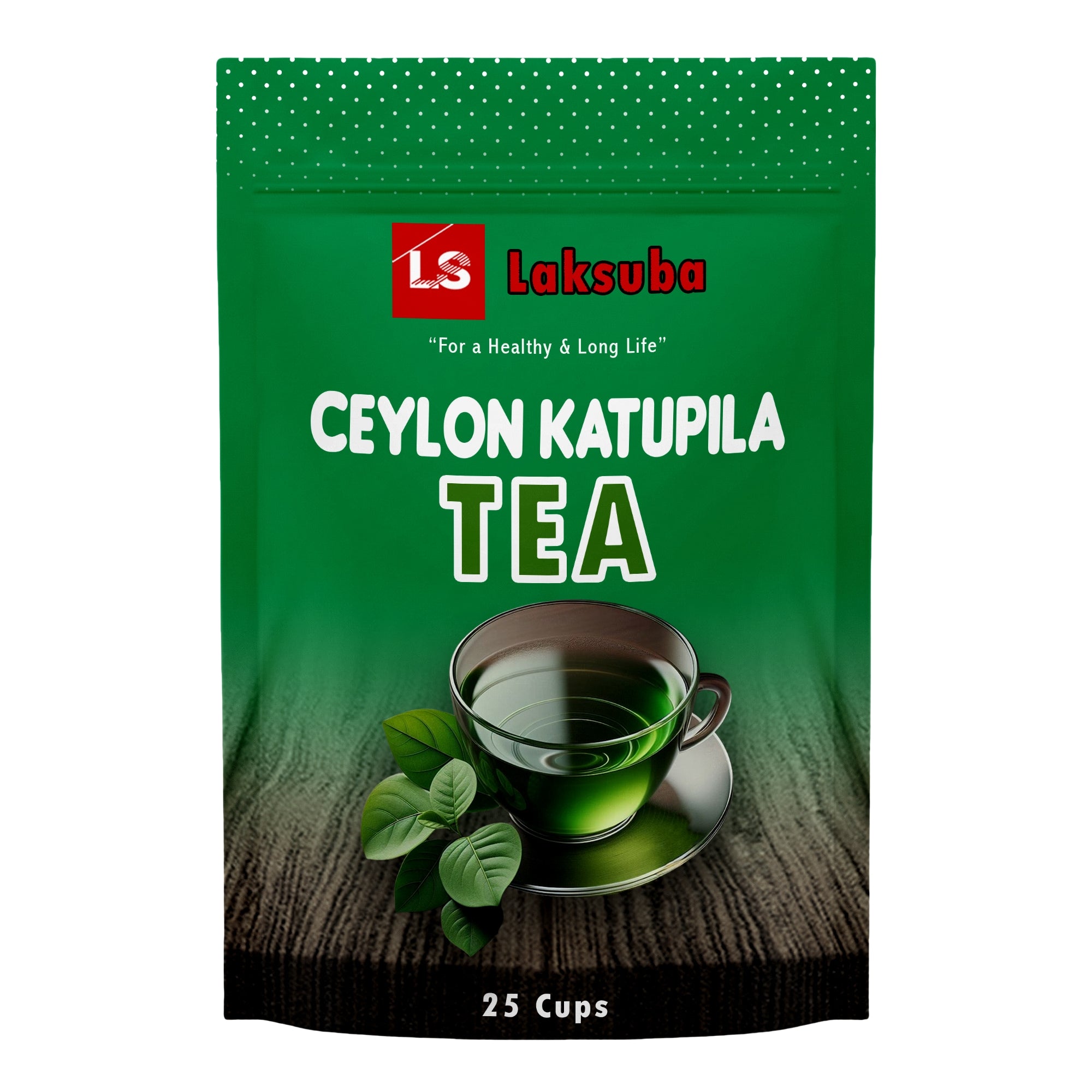
Katupila tea (කටුපිල තේ) is a herbal tea made from the dried leaves of Katupila, Flueggea leucopyrus, a spiny shrub of the dry zone of Sri Lanka. The plant has a long history in Sinhala traditional medicine, where its leaves are boiled into decoctions and cooked into porridge, and in recent decades it has become widely known across the island as a herb that people turn to during cancer treatment. Katupila tea is the convenient modern form of that tradition: the same leaves, dried and packed into tea bags or sold as a powder to stir into hot water. This page explains what is in it, how to brew it, how it is traditionally used, what the research does and does not show, and how to drink it sensibly.
What Katupila Is
Katupila is an erect, much-branched shrub of the family Phyllanthaceae that can grow to about 5 metres tall. Its angular branchlets end in sharp spines, which is where the Sinhala name comes from: katu means thorn. It has small, rounded green leaves, tiny greenish flowers, and round berries that turn white when ripe, which is why it is called Indian snowberry or white honey shrub in English. In Sri Lanka it grows wild in scrub and on sandy ground in dry districts such as Mannar, Puttalam, Hambantota and Ampara, and it is also found in India, other parts of South and Southeast Asia, and East Africa. The plant itself is described in detail on the Flueggea leucopyrus page.
Some sellers give Katupila's Ayurvedic name as Sharapunkha, or call it "purple tephrosia". Both names belong to a different plant, Tephrosia purpurea (wild indigo). If you are buying Katupila tea, look for Flueggea leucopyrus on the label.
How Katupila Tea Is Made and Sold
The tea is made from the leaves, which are picked, washed, dried and cut or ground. In Sri Lanka you will find it in three main forms:
- Pure Katupila tea bags. Only dried Katupila leaf, with nothing added. Laksuba Ceylon Katupila Tea, for example, contains 100% dehydrated Katupila leaves in 25 tea bags (37.5 g) and is caffeine-free.
- Blends with green tea. Some makers mix Katupila with green tea (Camellia sinensis) for a milder, more familiar flavour. Beam Katupila Tea is a blend of this kind, in 10 tea bags (20 g). Because green tea is real tea, a blend contains caffeine; a pure Katupila tea does not.
- Katupila powder. Dried, ground leaf sold loose in pouches, such as Lakpura® Katupila Powder, which comes in pack sizes from 50 g to 500 g. The powder is stirred into hot water as a tea, or added to porridge. Katupila is also sold in capsules.
How to Brew It
Katupila tea is brewed like any other herbal tea. For a tea bag, pour a cup of hot water over one bag and leave it to steep for 3 to 5 minutes, then remove the bag. For powder, stir the amount given on the pack into a cup of hot water, leave it for a few minutes to settle, and drink it. One maker suggests 1 to 2 cups a day. The taste is herbal and bitter, and many people add a little honey or sugar.
The traditional decoction is much stronger than a cup of tea. In Sinhala medicine the leaves, and sometimes other parts of the plant, are boiled for a long time until the water is greatly reduced. In one laboratory study, researchers reproduced this by boiling 60 g of the plant in 1.6 litres of water for about three hours, down to 200 ml. A decoction of that kind should only be taken on the advice of a qualified practitioner.
Traditional Use
Katupila leaves have long been part of village life in Sri Lanka's dry zone, eaten as a salad or cooked into a green leaf porridge, and used in traditional medicine for boils, sores, ulcers and wounds. Its best-known use today is as a complementary remedy for cancer. A survey of traditional Ayurveda practitioners in Sri Lanka found Katupila to be the plant they used most often among the 120 plants they named for cancer, and researchers report that many cancer patients drink Katupila decoction or tea alongside their hospital treatment. Makers' labels also list uses for digestion, haemorrhoids, urinary complaints and general well-being.
These are traditional and commercial claims. They reflect how the plant is used, not proof that it works.
What the Research Shows
Sri Lankan and Indian researchers have studied Katupila in some detail, but so far only in the laboratory and in animals. Water extracts and decoctions of the leaves have shown strong antioxidant activity. In laboratory studies they killed several kinds of human cancer cells, including laryngeal cancer cells (2014) and three types of breast cancer cells (2015), and further studies have looked at cervical and ovarian cancer cells. A 2024 study in rats found that leaf and root extracts reduced inflammation. Analysis of the leaves has found alkaloids, flavonoids, tannins and other plant compounds.
No clinical trial has tested Katupila tea, or any Katupila preparation, as a treatment for cancer or any other disease in people. Laboratory results on cells in a dish often do not carry over to the human body, and the concentrations used in those studies are far higher than anything in a cup of tea. Katupila tea is best treated as a traditional herbal drink, not as a medicine.
Safety
- Do not use it instead of cancer treatment. If you are being treated for cancer, tell your doctor or oncologist before drinking Katupila tea or taking any Katupila product, because herbal preparations can interact with other treatments.
- Pregnancy, breastfeeding and children. There is no safety information for these groups. Makers advise asking a healthcare provider first.
- Medicines and medical conditions. If you take regular medication or have a medical condition, ask a doctor or qualified practitioner before using it regularly.
- Caffeine. Blends with green tea contain caffeine; choose a pure Katupila tea if you avoid it.
- Moderation. Keep to about 1 to 2 cups a day, as one maker suggests, and stop if you notice any side effects.
Choosing a Katupila Tea
Check the ingredient list: a pure tea should list only Katupila leaves, Flueggea leucopyrus. Choose a sealed or resealable pack, and store it in a cool, dry place away from light. Lakpura ships these Katupila teas and products worldwide:
- Laksuba Ceylon Katupila Tea, 25 tea bags of pure Katupila leaf.
- Beam Katupila Tea, 10 tea bags of Katupila blended with green tea.
- Lakpura® Katupila Powder, loose ground leaf for tea or porridge.
- Lakpura® Katupila Plant, a live plant for growing your own in a warm, dry garden.
Katupila tea sits among Sri Lanka's many herbal teas and alongside the island's famous Ceylon tea, and it belongs to a wider tradition of plant medicine that includes Ayurveda and the island's own Hela Wedakama.
Related reading
1 pages on closely related subjects.