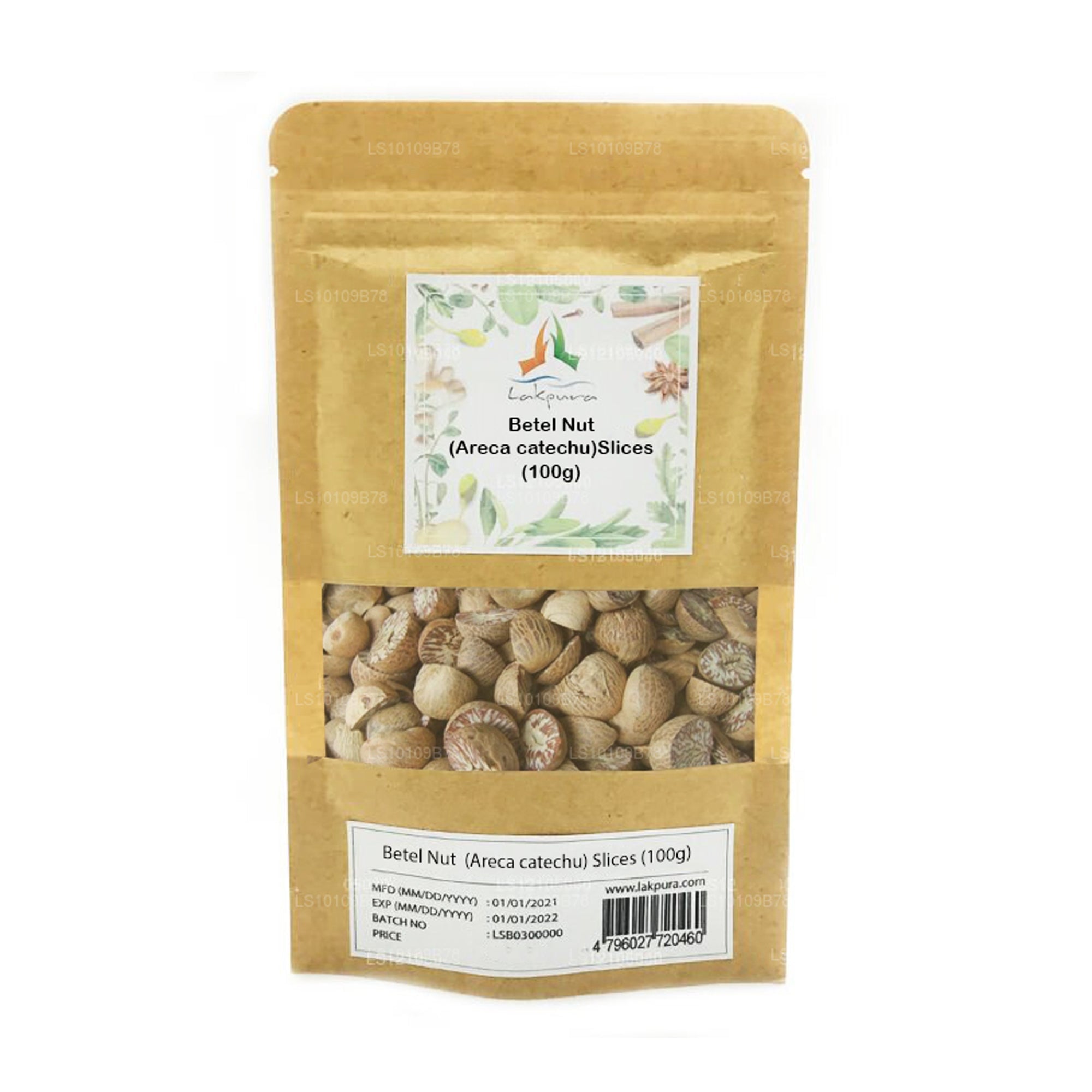
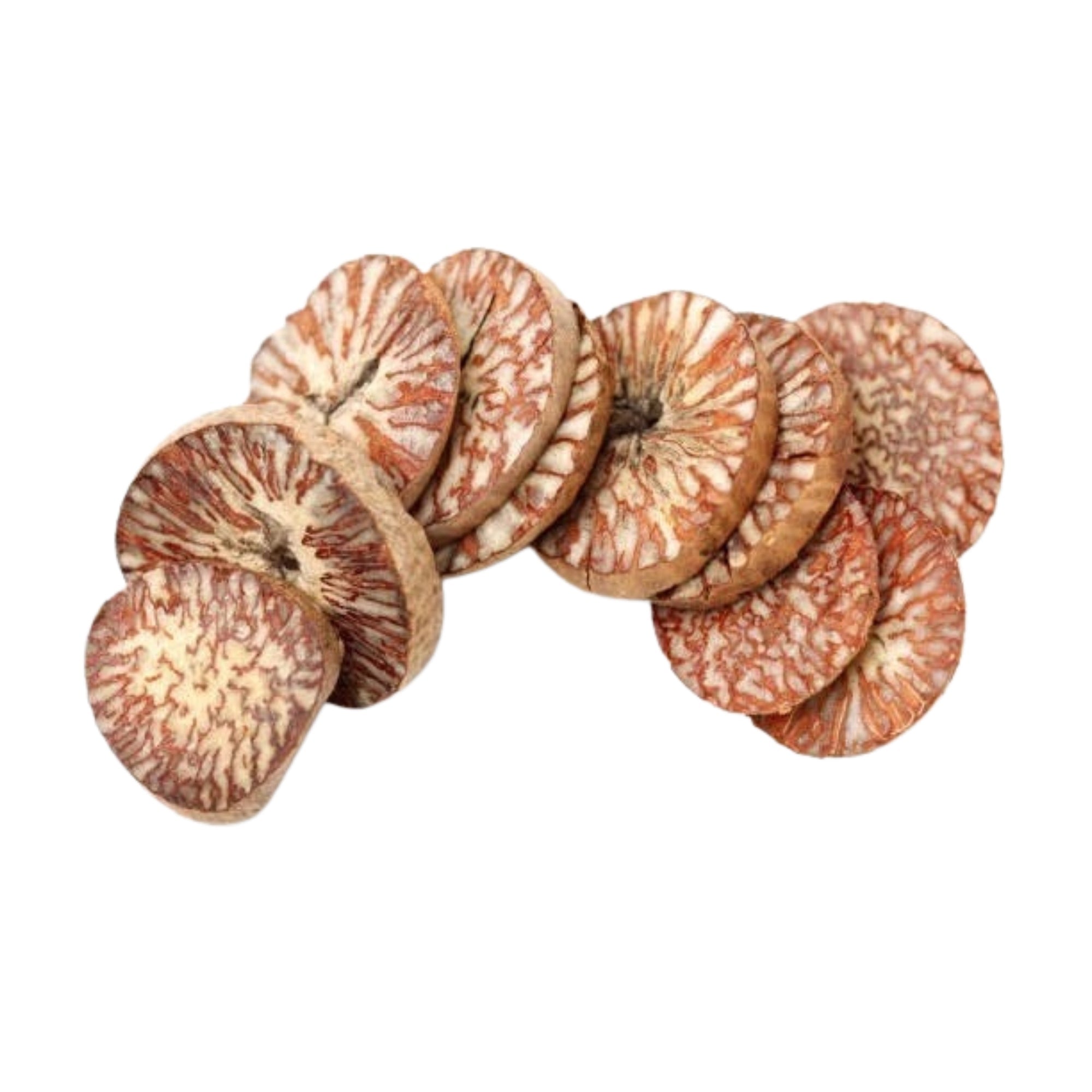
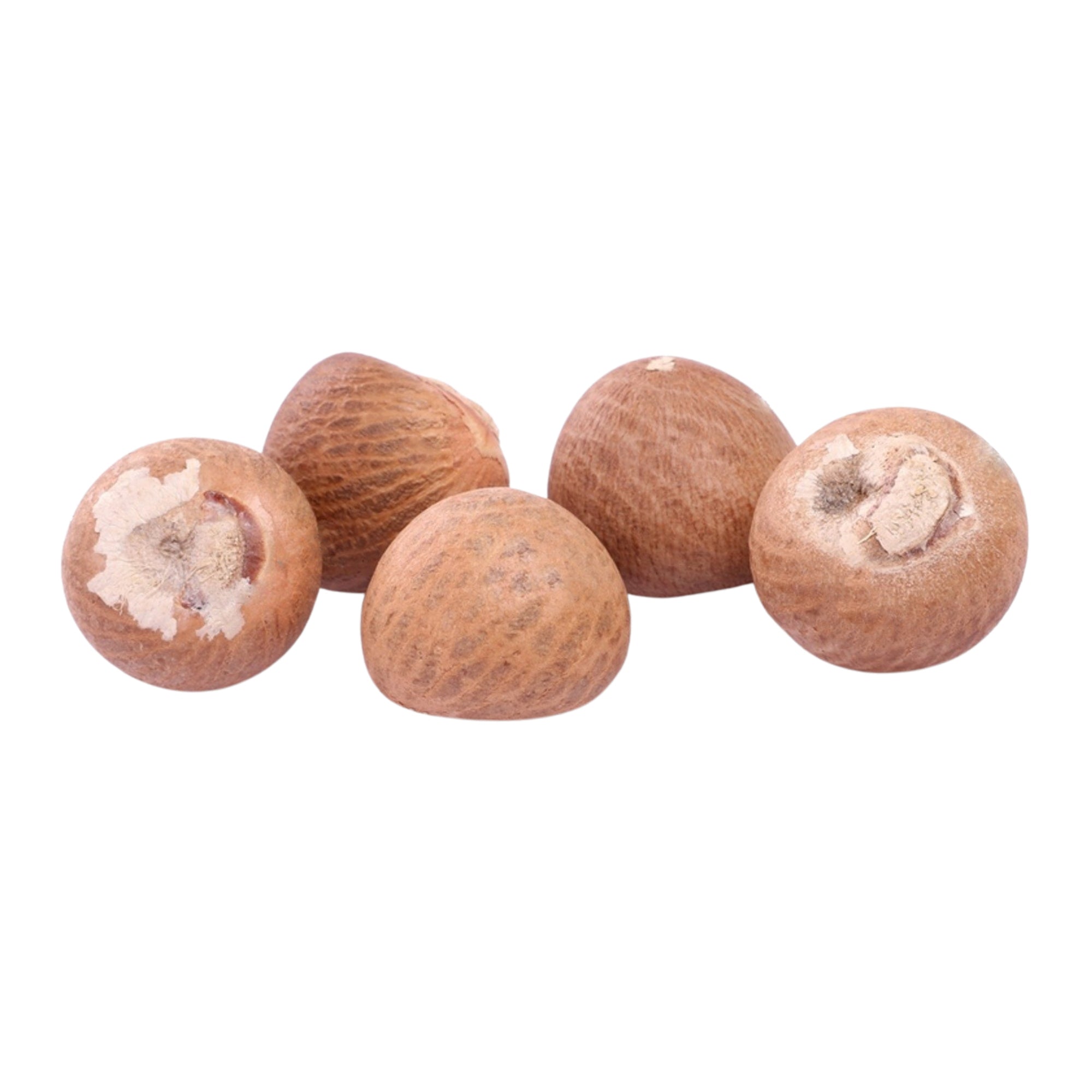
Lakpura® Betel Nut Slices are dried areca nut — the seed of the areca palm, Areca catechu, known in Sinhala as puwak — cut crosswise into thin discs. Each slice shows the seed's characteristic marbling, russet-brown veining radiating outward through a pale cream ground, with a thin band of tan husk left around the rim. The slices are hard, dry and brittle rather than soft, and carry the astringent, faintly woody smell of the cured nut. Nothing is added: no sweeteners, no flavourings, no tobacco. Packed in Sri Lanka in two sizes, 100 g (3.5 oz) and 250 g (8.8 oz).
How it is used in Sri Lanka. Sliced areca is one half of bulath vita, the Sri Lankan betel quid: a sliver of nut is placed on a fresh betel leaf brushed with slaked lime and the leaf folded into a small parcel. The same pairing is what fills the ceremonial betel tray offered to elders, monks, teachers and guests at weddings, almsgivings, astrological consultations and formal visits, where the offering itself carries the meaning and the tray is very often received as a courtesy rather than chewed. Dried areca also appears as an ingredient in traditional Ayurvedic and Sri Lankan herbal formulations, and the slices are used decoratively in ritual arrangements.
Sourcing and preparation. The nuts are collected from home gardens and smallholdings in Sri Lanka's wet zone, where areca palms are grown intercropped with pepper, banana and coconut rather than in monoculture. Bunches are cut by hand from the crown of the palm, then dehusked, sliced and sun-dried. Drying is what makes the difference between this and the fresh nut: it hardens the slice, darkens the veining, and concentrates the alkaloids relative to a fresh, softer nut.
Health information — please read before ordering. Areca nut is classified by the International Agency for Research on Cancer (IARC), the World Health Organization's cancer agency, as a Group 1 carcinogen, meaning it is carcinogenic to humans. That classification applies to the plain nut on its own, with no tobacco involved. Betel quid without tobacco carries the same Group 1 classification on the basis of sufficient evidence for oral cancer, and where tobacco is added the evidence extends to cancers of the pharynx and oesophagus as well. Habitual chewing is the principal cause of oral submucous fibrosis, a progressive and irreversible stiffening of the lining of the mouth, and arecoline, the nut's main alkaloid, is dependence-forming. No safe level of consumption has been established.
We list this product because it is a real and continuing part of Sri Lankan ceremonial life and is legally traded here, and because customers ask for it by name. We do not present it as a health food, and nothing on this page is a recommendation to chew areca nut or a substitute for medical advice. It is not suitable for children and should not be used in pregnancy. If you already chew and want to stop, your doctor or dentist can help.
Import restrictions. Areca nut is restricted or prohibited as a food in a number of countries, and it is your responsibility to check the rules that apply where you live before ordering. In the United States, the FDA detains imported areca nut offered as food, as a dietary supplement or as a bulk dietary ingredient under Import Alert 23-15, so we cannot reliably deliver it there. Import and sale are also banned in the United Arab Emirates. Several other jurisdictions apply their own limits.