Every April, Sri Lanka pauses for its most deeply felt celebration: the Sinhala and Tamil New Year, known as Sinhala Avurudu. While the occasion is marked by rituals, food, and family, it is the traditional games — avurudu krida — that animate neighbourhoods from the paddy-field villages of the interior to the coastal towns of the south. These games are not nostalgia. They are still played competitively, judged by village elders, and accompanied by the beat of the rabaana drum. Understanding them is a way into the living texture of Sinhalese culture.
What are the most popular Sinhala New Year games?
The canon of Avurudu games is broad — some test physical skill, others rely on strategy or sheer luck — but a core set appears at almost every village-level celebration.
Kotta Pora (Pillow Fight)
Two players straddle a horizontal pole, each with one hand tied behind the back, and attempt to knock each other off using a pillow. When the game is played over a pond or a paddy channel, a fall is not just defeat — it is a soaking, to the delight of everyone watching. The constraint of one tied hand demands balance as much as force.
Lissana Gaha Nageema (Climbing the Greased Pole)
A tall wooden pole is coated with grease and a small prize — a flag, a coin, or a packet of sweets — is tied at the top. Contestants take turns attempting to scale it. Most slide back down within seconds. The game rewards a combination of raw grip strength, body control, and the knack of reading where the previous climber left traces of bare wood.
Kana Mutti Bindeema (Breaking the Pot)
A row of clay pots is suspended at head height. Each pot is filled with water, sand, or sometimes a prize. Blindfolded participants are spun around and handed a stick, then left to find and break the right pot. The pots filled only with water make for a wet audience, which is, of course, part of the appeal.
Banis Kaema (Bun Eating Contest)
Buns are hung from a rope at face height. Competitors, with their hands tied behind their backs, race to eat an entire bun without using their hands. Speed and technique matter, but composure under the laughter of onlookers matters just as much.
Kamba Adeema (Tug of War)
The most straightforward test of collective strength on the roster. Two teams grip opposite ends of a rope and pull. Victory goes to the team that drags the opposing anchor past a centre marker. Tug of war at Avurudu is often inter-village, carrying a seriousness that a casual description might not convey.
Porapol Gaseema (Coconut Throwing)
Teams take turns hurling coconuts at each other across an open space. Players defend using their own coconuts as blockers. The team that retains the most intact coconuts at the end wins. It requires good aim and a certain bravado. The coconut, central to Sri Lankan daily life, appears in the Cocos nucifera traditions of the island in more contexts than most visitors realise.
Onchili Pedeema (Swinging)
Rope swings are strung between trees or erected on bamboo frames for the occasion. The activity is enjoyed by all ages and is traditionally accompanied by folk songs — particularly the onchili padam — sung by the women present. It carries a contemplative quality that sets it apart from the more competitive games.
Aliyata Asa Thabeema (Placing the Eye on the Elephant)
A large outline of an elephant is drawn or painted on a board. A blindfolded player must walk forward and place a marker precisely on the elephant's eye. It sounds simple. It is not. This game is a crowd favourite because even near-misses are wildly entertaining.
Which Avurudu games involve strategy rather than physical skill?
Not all New Year games are athletic. Two board games anchor the quieter end of the Avurudu programme.
Olinda Keliya
A traditional mancala-style game played on a wooden board with two rows of nine holes. Players distribute olinda seeds around the board, with the objective of accumulating more seeds than the opponent by the end of the game. The rules reward forward planning over improvisation, and experienced players can read several moves ahead. Olinda boards, often beautifully carved, are a characteristic piece of Sri Lankan craft.
Pancha Keliya (Pancha Dameema)
Played with five small cowrie shells, a game chart, and a coconut shell as a throwing cup, Pancha Keliya is part strategy and part chance. The face-up pattern of the five shells after each throw determines a player's moves on the chart. The player who collects the most seeds wins. It is one of the older games in the Avurudu tradition and remains popular with adults.
What role do music and ritual play in Avurudu games?
Two activities sit at the boundary between game and ceremony.
Raban Geseema (Playing the Rabaana)
The rabaana is a flat, hand-held drum played primarily by women during the New Year season. Groups gather to play in rhythmic call-and-response patterns, sometimes incorporating improvised songs. Skill is measured in precision of rhythm and the ability to maintain tempo through complex sequences. It is competitive in the way folk music is competitive — less about winning than demonstrating mastery.
Ankeliya (Tugging the Horn)
Ankeliya occupies a different register from the other games. Two teams — traditionally named Udupila and Yatipila — are each attached to one of two interlocked sambar-deer horns that are fixed to a tree. Both teams pull simultaneously. The team whose horn breaks loses. The game has ritual roots connected to Goddess Paththini and is treated with a solemnity absent from the purely recreational games. It is less common today but still observed in some village communities during the New Year period.
Are there Avurudu competitions for women?
Several games are traditionally associated with women participants, though this is a cultural pattern rather than a strict rule.
- Pol Girasima (Coconut Grating Competition): Participants race to grate a coconut as efficiently as possible. Speed and the fineness of the resulting gratings are both judged. It is a skill that was once entirely domestic but is now celebrated as a competitive art in its own right.
- Raban Geseema: While anyone may play, rabaana drumming at Avurudu is predominantly a women's tradition, practised in neighbourhood groups that form weeks before the New Year.
- Onchili Pedeema: Swinging is enjoyed across genders, but the accompanying songs are part of a women's oral tradition.
What is the Avurudu Kumariya and Kumaraya pageant?
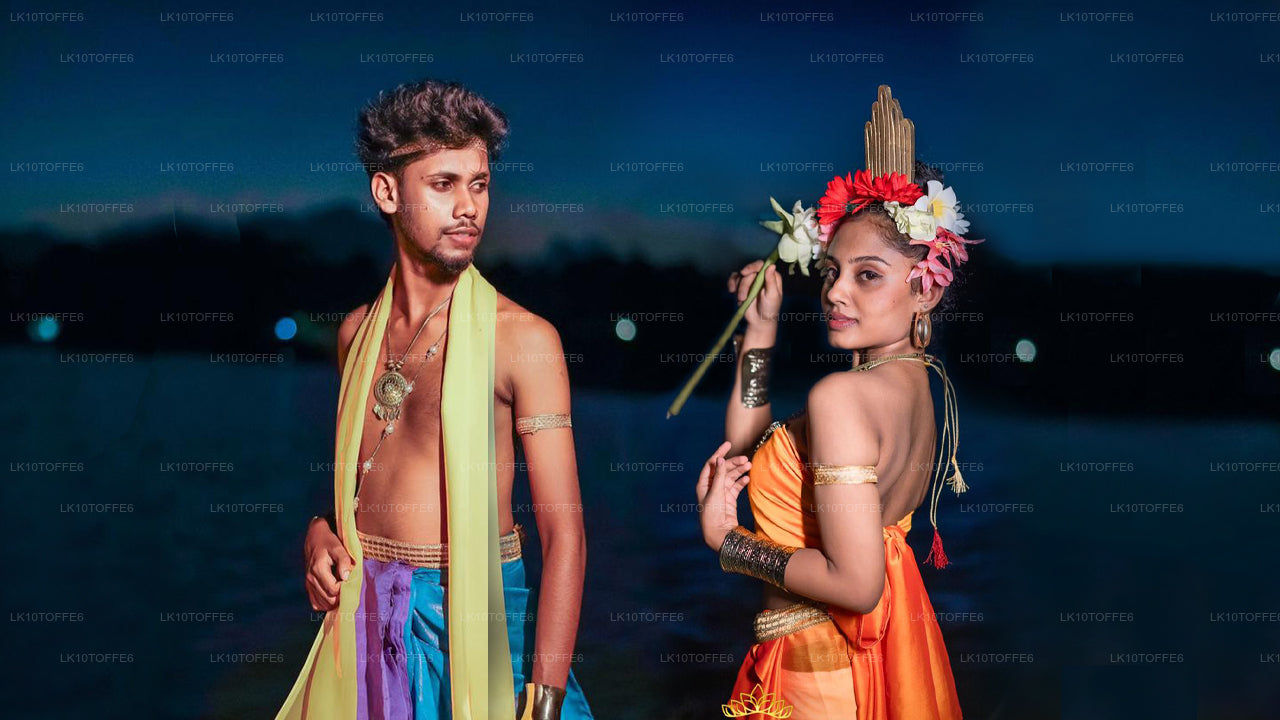
Alongside the physical games, most community celebrations include a traditional-attire competition. Young men and women dress in formal Kandyan or low-country Sinhalese dress — silk sarees, osariya style for women, national dress for men — and are judged on appearance, composure, and knowledge of customs. The winners are crowned Avurudu Kumaraya (New Year Prince) and Avurudu Kumariya (New Year Princess) for that community. The pageant is taken seriously in smaller towns, where it carries genuine social prestige.
Where are Avurudu games typically held?
Games are organised at the village (grama niladhari) level, meaning almost every community in the island's rural districts holds its own programme. Urban versions take place in school grounds, temple premises, and public parks. The Esala Perahera Festival in Kandy is the country's most widely known cultural celebration, but Avurudu is arguably more pervasive because it reaches every corner of the island simultaneously. Visitors staying in village guesthouses or rural boutique properties during mid-April stand a good chance of being invited to participate rather than merely watch.
How have traditional New Year games changed over time?
Many games survive in their original form. Some, like Ankeliya, have become rarer as they depend on specific ritual contexts. Others have crossed into digital culture: mobile applications now feature simplified versions of Pancha Keliya, Kana Mutti Bindeema, and the greased-pole climb, introducing the games to a generation that encounters them on a screen before encountering them in a field. Whether this preserves or dilutes the tradition is a live debate among scholars of Sri Lankan folk culture.
What has not changed is the social function of these games. They are a mechanism for community cohesion — a reason for neighbours to gather, for rivalries to be settled harmlessly, and for younger generations to learn the rhythms of the culture they are inheriting. For visitors, arriving in Sri Lanka in April with some knowledge of the games is a genuine way to engage rather than observe.
Related reading
6 pages on closely related subjects.