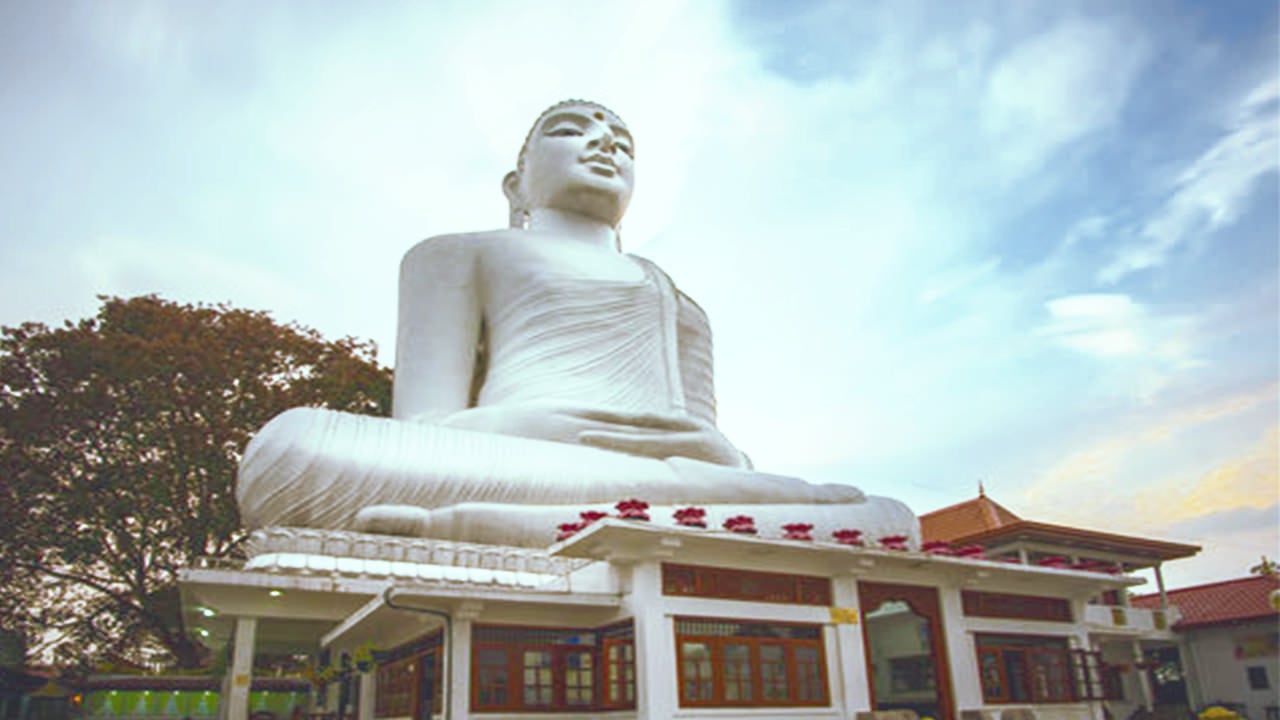
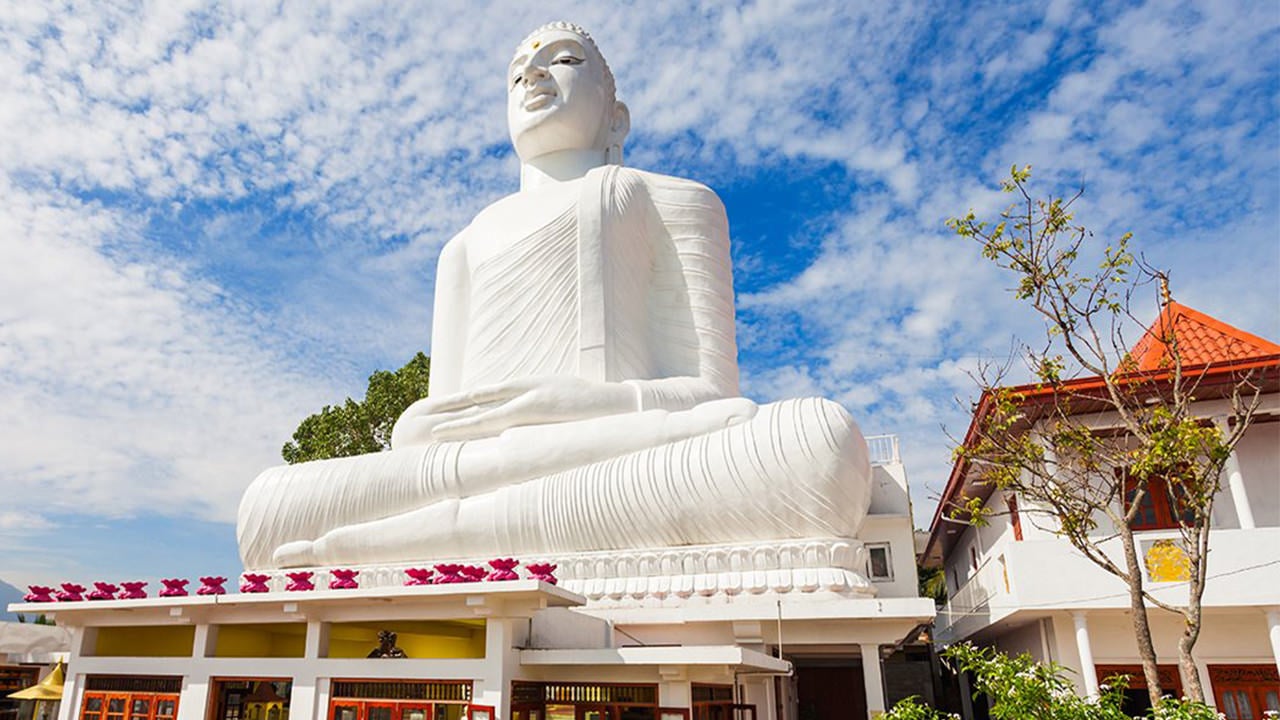
Perched on a hill overlooking Kandy, the Bahirawakanda Vihara Buddha Statue is one of the most recognisable landmarks in Sri Lanka's hill country. The white seated figure rises high enough to be visible from much of the city below, offering both a place of active Buddhist worship and a vantage point that rewards the climb with panoramic views across Kandy Lake and the surrounding ridges.
What is the Bahirawakanda Vihara Buddha Statue?
The statue depicts the Buddha in a seated meditation posture and stands roughly 26 metres tall. It was constructed in 1972 and has served as a functioning vihara — a Buddhist monastery and place of worship — ever since. The site is located approximately 2 km from the Temple of the Tooth Relic, Kandy's most celebrated religious landmark, and the two sites complement each other naturally on a half-day circuit of the city.
The name "Bahirawakanda" translates loosely as "gnome mountain" or "demon hill" in Sinhala — a name whose origin is rooted in the folklore attached to this hilltop long before the statue was built.
What are the legends behind Bahirawakanda?
Two distinct folk stories explain both the hill's unusual name and the history of religious activity on its summit.
The first concerns an ancient temple dedicated to Bahiravar, a protective deity whose worship arrived during the reign of the Nayakkar kings. In parts of India, this deity's rites historically involved animal sacrifice. According to local legend, the practice became distorted as it took root here: priests reportedly threatened divine retribution unless virgin women were offered as sacrifices. The people of the region, gripped by fear and superstition, complied for a time. The cycle finally broke when the betrothed of Dunuwilla Gajanayake Nilame — the Chief of the Royal Mahouts — was taken for sacrifice. He used his position at court and considerable personal courage to secure her release, causing enough disruption that the ritual collapsed entirely. The temple fell into abandonment over the years that followed.
The second story explains the hill's name more literally. According to legend, a gnome had secretly infiltrated the royal court by assuming the identity of a palace minister. Aware that people feared strange noises emanating from the hill, the disguised gnome advised the king that an annual sacrifice of a young woman would appease whatever spirit haunted it — thereby establishing a new superstition. The scheme unravelled when the chosen sacrifice one year turned out to be the beloved of the gnome minister's own son. The son climbed the hill, confronted his father, rescued the young woman, and then — being half-gnome himself — mimicked the sounds the villagers associated with an appeased spirit. The community took this as a sign that the sacrifice had been accepted, the couple quietly left Kandy that same night, and the superstition gradually lost its hold.
Both stories share a common thread: communities overcoming fear and superstition, a theme that gave the hilltop its distinctive name long before it became a site of Buddhist devotion.
What can you see and do at Bahirawakanda?
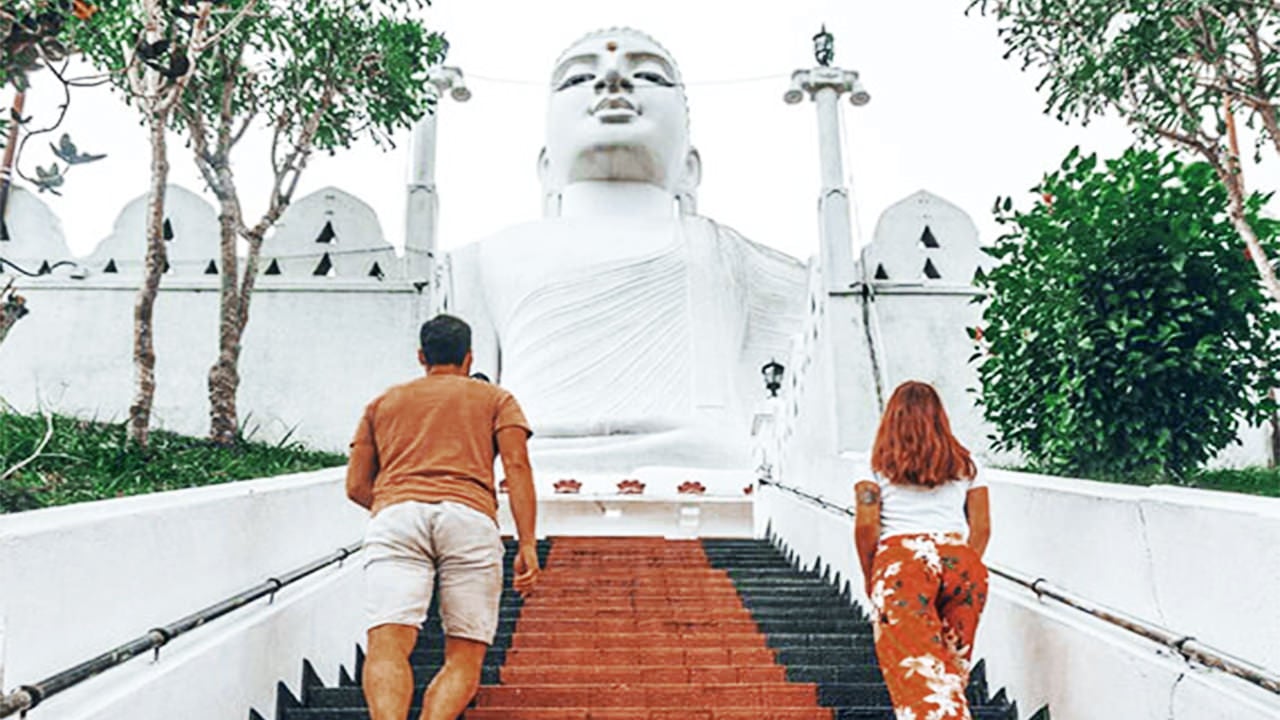
The statue itself is the principal draw, but the experience involves more than simply viewing it from the base. Visitors climb a series of steps to reach the hilltop complex, where the statue is set within a working temple precinct. Monks reside here, and the site maintains an active schedule of religious observance.
- Panoramic views: The hilltop offers one of the best elevated perspectives of Kandy city. On a clear day, the view extends across the lake, the surrounding ridges, and the rooftops of the old town.
- Temple precinct: The grounds include shrine rooms and smaller stupas typical of a Theravada Buddhist vihara. Visitors are welcome, though respectful dress — covered shoulders and legs — is expected.
- Photography: The open terrace around the statue base provides unobstructed sightlines for photography in most directions. Early morning light from the east illuminates the face of the statue directly.
- Sunset visits: Many visitors time their climb for late afternoon, when the light softens over the valley and the city below begins to illuminate.
How do I get to Bahirawakanda from Kandy city centre?
The site sits roughly 2 km from Kandy's central Dalada Veediya street. The most straightforward approach is by tuk-tuk from anywhere in the city centre, which takes around ten minutes. Drivers will typically drop visitors at the base of the steps leading up to the hilltop. Some visitors who are comfortable with a short uphill walk choose to combine the approach on foot from the Kandy Lake area, though the final ascent is steep.
If you are planning a broader tour of Kandy's landmarks — combining Bahirawakanda with the Temple of the Tooth, the Kandy Lake, and the city's colonial-era architecture — the Esala Perahera Festival period (typically July or August) brings the city to life in ways that add considerable context to a visit like this, though the crowds are significantly larger at that time.
When is the best time to visit Bahirawakanda?
The site is open throughout the year and visits are possible in most weather conditions, though the hilltop is exposed and can be cloud-covered during periods of heavy rain. Kandy's two monsoon influences — the south-west monsoon from May to July and intermittent north-east weather from October to January — bring spells of rain but rarely prevent a visit entirely. The drier months of January through April and August through September typically offer the clearest views from the summit.
For a quieter experience, arriving early in the morning on a weekday avoids the peak of local pilgrimage traffic and tour group schedules. Early mornings also tend to produce cleaner air quality and better visibility across the valley.
What should visitors know before going?
- Remove footwear before entering the temple precinct, as is standard at Buddhist sites across Sri Lanka.
- Dress modestly: shorts, sleeveless tops, and beachwear are not appropriate. Sarongs can often be hired or borrowed at popular religious sites if needed.
- The site is an active place of worship, not a tourist park. Quiet and respectful behaviour is expected at all times.
- There is no formal entry fee for visiting the hilltop, though donations to the temple are welcomed.
- Carry water, particularly if you are visiting during warmer months — the climb, though short, is exposed to the sun.
How does Bahirawakanda fit into a wider Kandy itinerary?
Most visitors to Kandy spend between one and two days in the city. A logical pairing is to visit the Temple of the Tooth Relic in the morning — ideally timing arrival with one of the daily puja ceremonies — and then travel to Bahirawakanda in the afternoon for the views and the quieter atmosphere of the hilltop vihara. The Kandy Tourist Information Center can provide current opening times and any local advisories that affect the site.
Beyond Kandy itself, the central highlands offer a range of complementary experiences — from the cloud forests and walking trails of Horton Plains National Park to the tea country around Ella and Nuwara Eliya. Bahirawakanda works well as a final stop in Kandy before heading uphill into the tea districts.