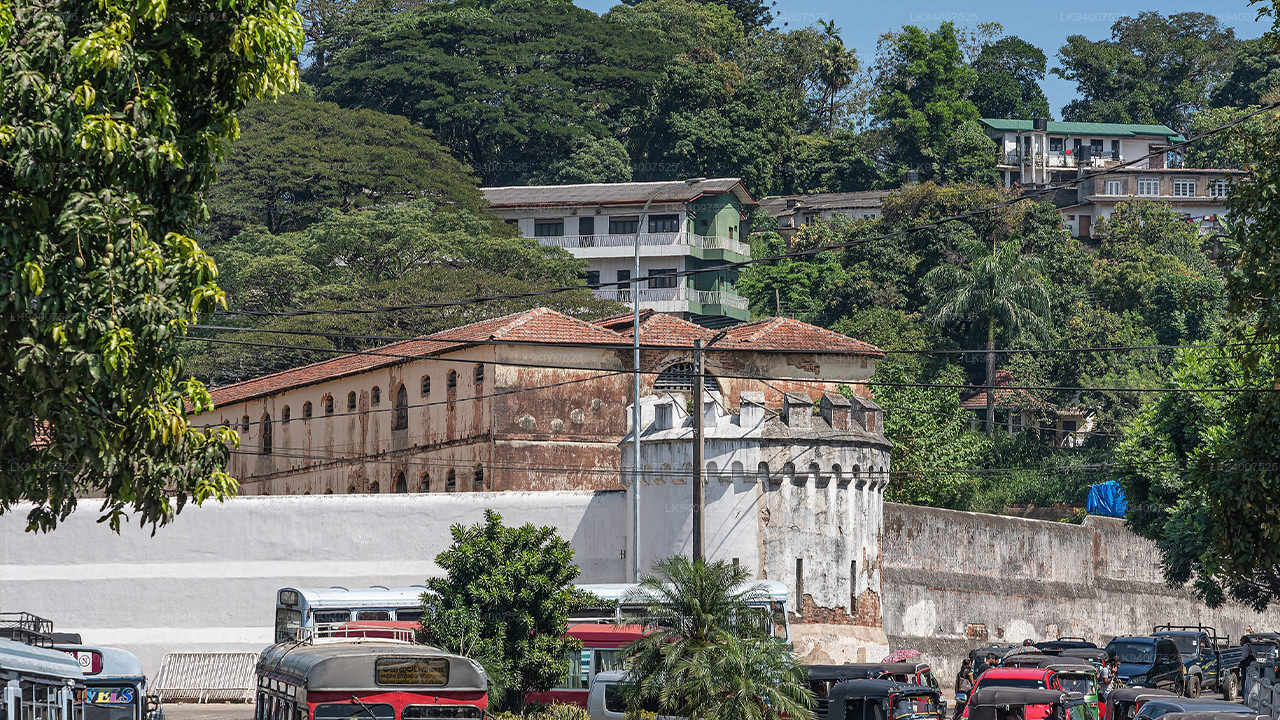
Bogambara Prison stands in the heart of Kandy as one of Sri Lanka's most historically layered landmarks. For 138 years it served as a maximum-security institution — the second largest prison in the country after Welikade in Colombo — before its gates finally closed on 1 January 2014. Today the compound sits at the edge of a significant transformation: the government has earmarked the site to become the Bogambara Cultural Park, a cultural tourism destination that will return a major slice of Kandy's urban core to public life.
What is the history of Bogambara Prison?
The prison's origins trace back to the colonial era under British Ceylon. The grounds were established on land reclaimed by filling in the Bogambara Wewa, a historic artificial lake that once formed part of Kandy's royal landscape. The buildings were designed by F. Vine of the Public Works Department of Ceylon, and the architecture of the main gate and perimeter walls is widely said to draw inspiration from the Bastille in Paris — a deliberate statement of colonial authority in a city that had only recently come under British rule after the fall of the Kandyan Kingdom.
The prison occupied approximately 5.3 hectares (around 13 acres). Its central structure was a three-storey main building of roughly 8,500 square metres, housing 382 cells with a capacity of 408 prisoners. A separate hospital building of around 840 square metres stood to the west of the main block. For most of its operational life, Bogambara held inmates convicted of serious offences, functioning as the judicial and correctional anchor for the Kandy region and surrounding districts.
The story of Ehelepola Nilame, one of the most dramatic figures of the late Kandyan Kingdom period, is woven into the broader history of power and punishment in Kandy — a context that gives sites like Bogambara added historical weight for visitors interested in Sri Lanka's pre-colonial and colonial past.
Why was Bogambara Prison closed?
By the early 21st century, the prison had become severely overcrowded and its colonial-era infrastructure was no longer considered adequate for a modern correctional facility. Authorities constructed a purpose-built replacement: the Dumbara Prison Complex in Pallekele, a few kilometres north of central Kandy. On 1 January 2014, all inmates were transferred to Pallekele and Bogambara was formally decommissioned after 138 years of continuous operation.
The closure opened an immediate question about what should happen to a 5.3-hectare site in one of Sri Lanka's most visited cities. Urban planners, conservationists, and tourism authorities argued that the colonial-era buildings — despite their grim purpose — held genuine architectural and historical value worth preserving.
What will replace the prison — the Bogambara Cultural Park
In 2019, the Sri Lankan government formally declared that the Bogambara site would be redeveloped as a cultural tourism centre. The proposed Bogambara Cultural Park is intended to reactivate the land for public use, incorporating heritage interpretation, open green space, and facilities aligned with Kandy's status as a UNESCO World Heritage city.
The project sits within a broader effort to integrate Kandy's layered colonial and pre-colonial history into a coherent visitor experience. Kandy already draws travellers for the Esala Perahera Festival and the Temple of the Sacred Tooth Relic; the cultural park, once complete, is expected to add another dimension to what the city offers beyond its religious monuments.
Timelines for the park's completion have been subject to revision, so visitors planning a trip specifically to see the transformed site should check current developments before arrival.
What does the architecture of Bogambara Prison look like?
The Bastille comparison is not merely symbolic. The main gate of Bogambara Prison was designed with a solidity and gravitas typical of 19th-century European penal architecture — high walls, limited fenestration, and a physical scale intended to project permanence and state power. Constructed from locally sourced materials under the direction of the Public Works Department of Ceylon, the buildings represent a specific chapter of British colonial construction in the island's hill country.
For architectural historians and students of colonial heritage, the compound offers a relatively intact example of Victorian-era institutional design in a tropical setting — a typology found in only a handful of surviving structures across South Asia.
How do I get to the Bogambara Prison site from central Kandy?
The Bogambara site is located within walking distance of Kandy's city centre, close to the Kandy Lake and the main commercial district. Visitors staying in central Kandy can reach it on foot in under fifteen minutes from the Temple of the Sacred Tooth Relic. Tuk-tuks and taxis are readily available from anywhere in the city for those who prefer not to walk. Access to the interior of the grounds depends on the current stage of the redevelopment project, so it is advisable to check locally before visiting.
For a broader orientation to what Kandy has to offer, the Kandy City Tour curated by Lakpura covers the city's major landmarks in a structured half-day itinerary.
Is Bogambara Prison worth visiting?
As a site currently in transition, Bogambara Prison rewards visitors who are interested in colonial history, urban heritage, and the process of repurposing difficult spaces for public benefit. The exterior architecture is accessible even if the grounds are not fully open, and the location — at the centre of a city already rich in cultural heritage — means it fits naturally into a wider Kandy itinerary.
Those with a deeper interest in the history of Sri Lanka's carceral institutions and colonial administration will find the site genuinely significant. For casual visitors, the forthcoming Bogambara Cultural Park represents a future draw that is worth watching as development progresses.
Nearby places
14 places within about 25 km, nearest first.
- Kandy View Pointunder 1 km
- Kandy Railway Stationunder 1 km
- Kandyan Art Association Cultural Centreunder 1 km
- Maha Wahalkadaunder 1 km
- Misty Hills, Kandyunder 1 km
- Royal Classic Resort, Kandyunder 1 km
- Sharon Inn, Kandyunder 1 km
- The Hermitage by Edwards Collection, Kandyunder 1 km
- Asgiri Viharaya - Adahana Maluwa Gedige Viharayaunder 1 km
- Asgiriya Maha Viharayaunder 1 km
- Asgiriya Chapterunder 1 km
- Asgiriya Maha Viharaunder 1 km
- Bahirawakanda Vihara Buddha Statueunder 1 km
- Tiesh Gem Museum1 km