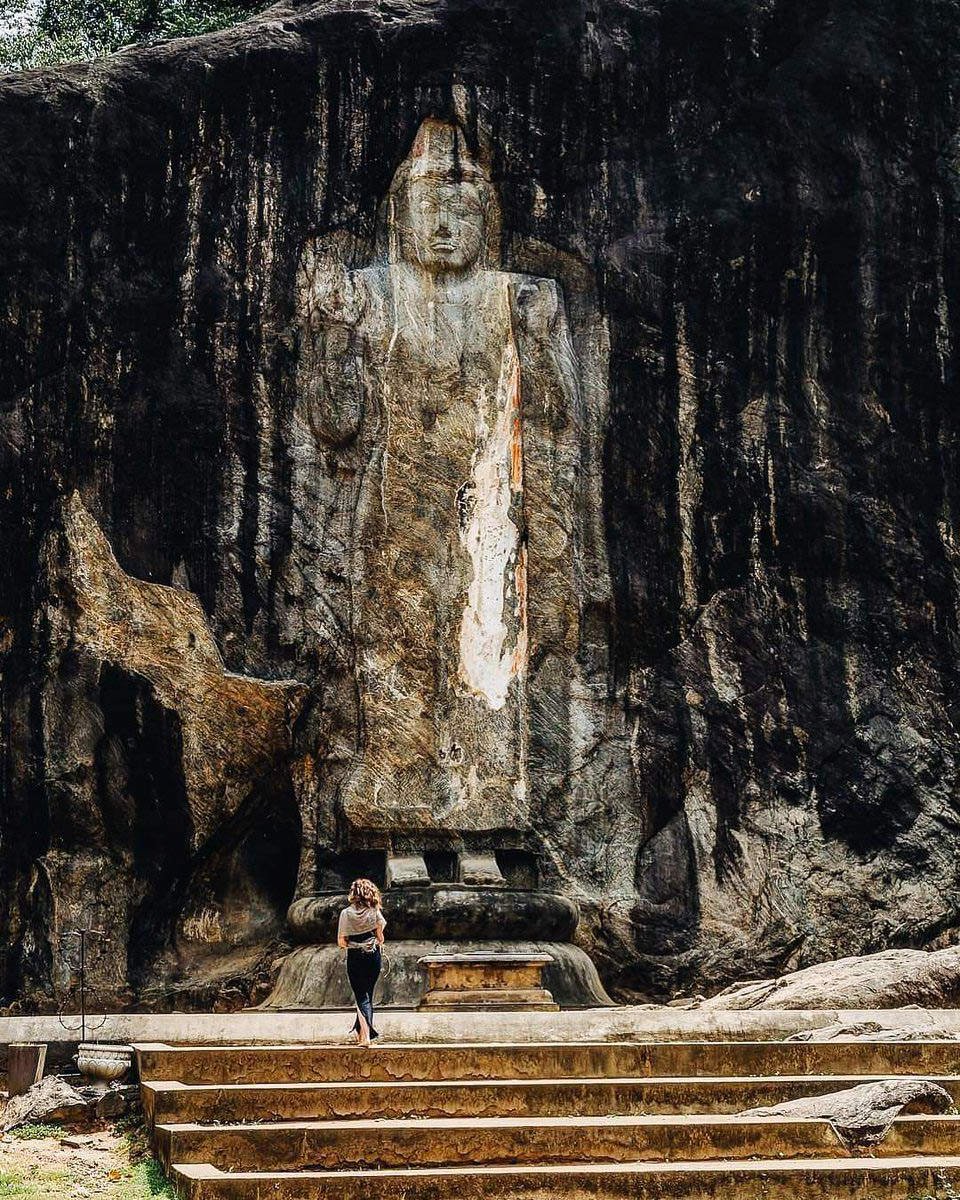


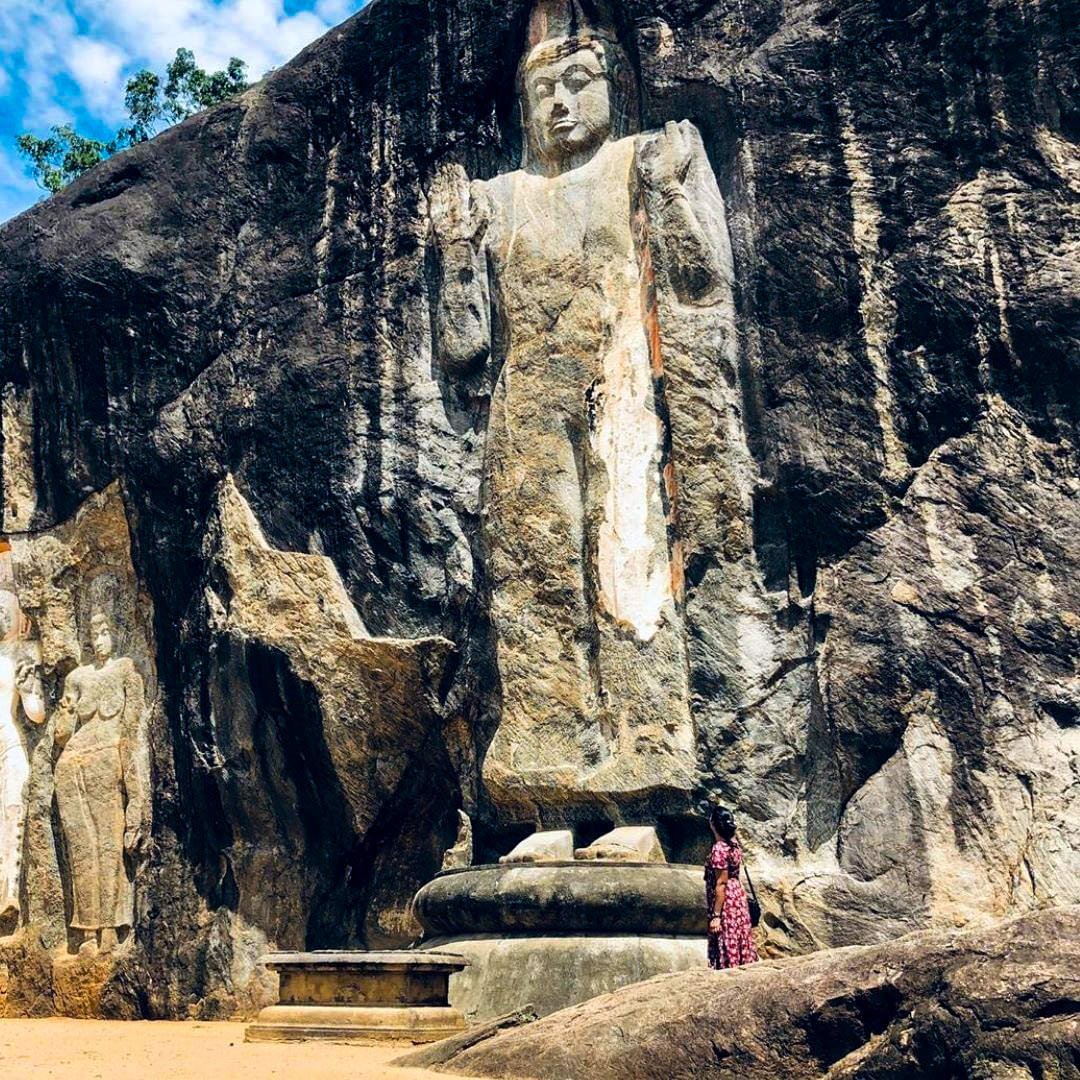
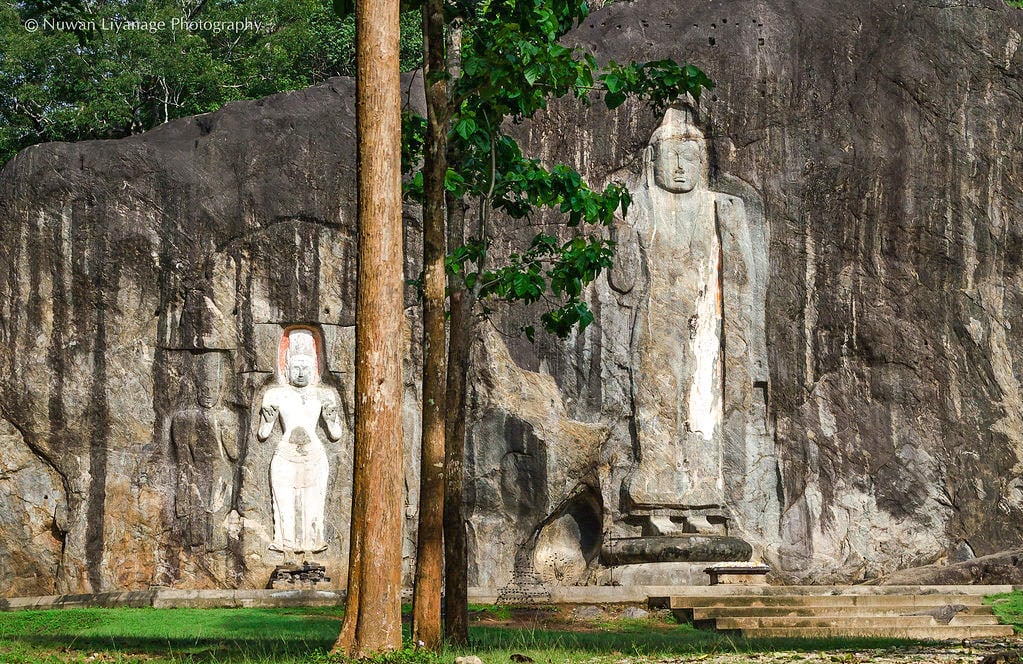
Carved into a granite outcrop in the quiet scrubland south of Wellawaya, the rock-cut figures of Buduruwagala rank among Sri Lanka's most evocative and least-crowded ancient sites. Seven figures in total — each several metres tall — emerge from the rock face, their detail remarkably preserved despite roughly a thousand years of exposure to the elements. The site belongs to the Mahayana Buddhist tradition, which enjoyed a concentrated period of influence in Sri Lanka around the 9th and 10th centuries CE.
What can I see at Buduruwagala?
The dominant figure is a standing Buddha rising approximately 15 metres — the tallest ancient standing Buddha on the island. Faint traces of the original stucco robe still cling to the surface, and a long vertical streak of orange pigment suggests the figure was once painted in bright colours. Flanking this central Buddha are two groups of three figures, arranged symmetrically on either side.
The three figures to the Buddha's right are interpreted as follows:
- Avalokitesvara — the bodhisattva of compassion in Mahayana Buddhism, positioned at the centre of this group. A faint white wash still covers parts of the figure.
- Tara — standing to Avalokitesvara's left, she is thought to be his consort. This is one of the few depictions of Tara in Sri Lankan rock art.
- Prince Sudhana — identified by local tradition, occupying the rightmost position in this trio.
The three figures to the Buddha's left include:
- Maitreya — the future Buddha, shown with a crown at the centre of the group. A small stupa is carved into the headdress, a classic iconographic marker.
- Vajrapani — to Maitreya's left, holding a vajra (an hourglass-shaped thunderbolt symbol). This figure is a rare example of Tantric Buddhist iconography in Sri Lanka.
- A third figure — on the right of this group, variously interpreted as Vishnu or Sahampath Brahma, reflecting the syncretic religious environment of the period.
Several figures hold their right hands with two fingers folded toward the palm, a gesture interpreted as a beckoning mudra. The name Buduruwagala itself is a straightforward Sinhala compound: Budu (Buddha), ruva (images), gala (rock).
How old are the Buduruwagala carvings?
Scholars generally date the figures to around the 9th–10th century CE, placing them firmly within the Mahayana Buddhist phase of Sri Lankan religious history. This was a relatively brief period when Mahayana and Vajrayana influences, likely arriving via South India, coexisted alongside the Theravada tradition that ultimately became dominant on the island. The iconographic complexity of the Buduruwagala panels — bodhisattvas, Tantric symbols, and consort figures — reflects this transitional moment. Comparable Mahayana-era rock art can be found at Polonnaruwa, though the cultural context there spans a broader chronological range.
An ancient stupa, uncovered in more recent decades, stands approximately halfway along the access track between the main road junction and the carved panels — easy to miss but worth pausing at.
How do I get to Buduruwagala from Wellawaya?
Buduruwagala lies around 9 km south of Wellawaya town, reached via a side road that branches west from the main southern highway. The final stretch — roughly 4 km from the road junction — is an unpaved track suitable for most vehicles but best navigated by tuk-tuk, car, or motorbike. The track crosses a sequence of small irrigation tanks and open scrubland, which makes for pleasant birdwatching along the way; egrets, herons, and various waders are commonly seen around the water margins.
Those who prefer to walk or cycle from the junction will find the route manageable in the early morning or late afternoon. Midday heat in this low-country region can be considerable, particularly between March and September, so plan accordingly. A tuk-tuk from Wellawaya and back is the most practical option for most visitors.
When is the best time to visit Buduruwagala?
The site can be visited year-round, but the most comfortable conditions fall between November and April, when the surrounding dry zone receives less rainfall and temperatures, while warm, are slightly moderated. Early morning visits are recommended both for the cooler air and for the quality of light on the rock face, which catches the morning sun at a favourable angle and brings out the texture of the carvings. Avoid midday if you plan to walk the access track. The site is rarely crowded; weekday mornings in particular are likely to be very quiet.
What wildlife might I see around Buduruwagala?
The scrub forest and tank margins around Buduruwagala support a range of dry-zone wildlife. Birdwatchers regularly spot painted storks, grey herons, little egrets, and various kingfisher species around the small lakes along the track. Peacocks are common in this part of Sri Lanka and are frequently seen near the site. The area also lies within range of wild elephants, though encounters on the access road are uncommon. If wildlife is a priority, combining a visit to Buduruwagala with a stop at the nearby Elephant Transit Home in Udawalawe makes logical geographic sense.
Are there guides available at Buduruwagala?
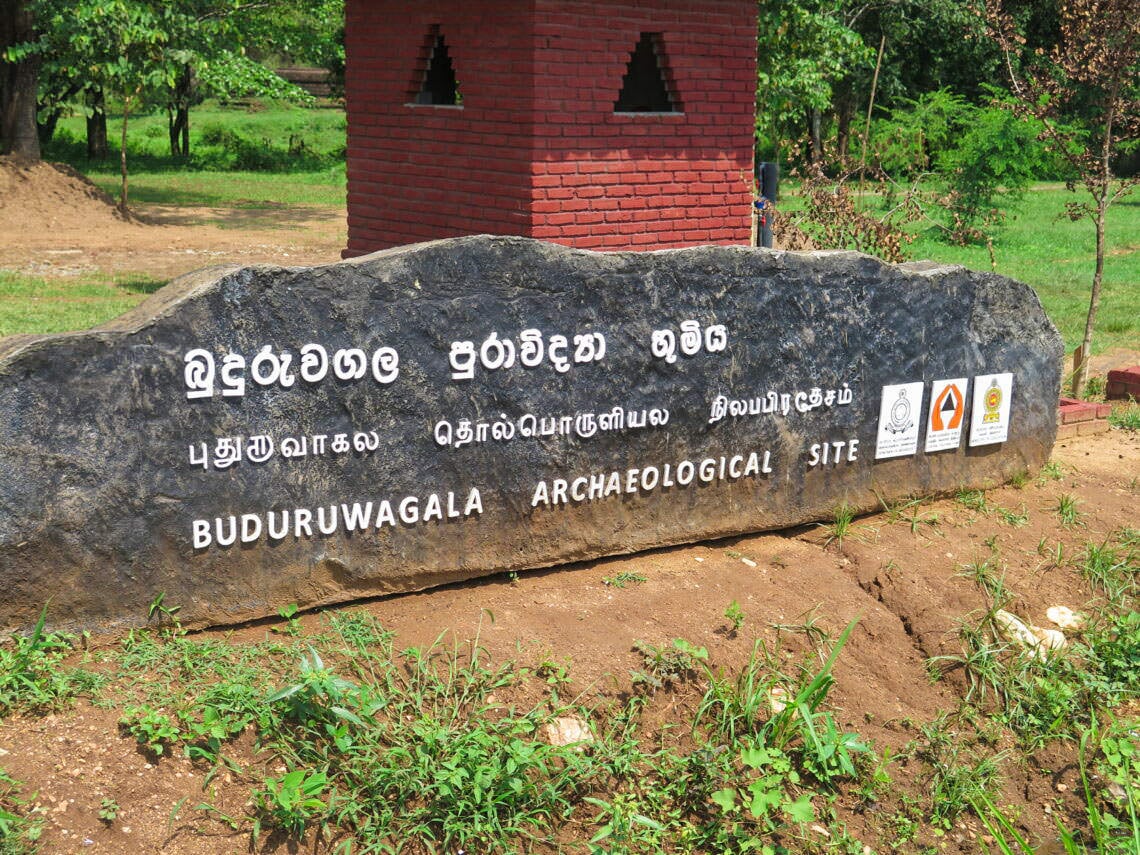
Informal local guides sometimes approach visitors at the site entrance and can provide useful contextual information about the individual figures and their iconography. There is no formal guiding service; anyone who accompanies you will typically expect a tip rather than a fixed fee. The site itself has basic signage, but having a guide who understands the Mahayana iconography enriches the visit considerably. Arrive with small-denomination rupee notes.
Practical information for visiting Buduruwagala
| Detail | Information |
|---|---|
| Location | Approximately 9 km south of Wellawaya, Uva Province |
| Access road from junction | Around 4 km on unpaved track |
| Opening hours | Typically dawn to dusk (no artificial lighting) |
| Entry fee | A small fee is charged; confirm the current rate locally |
| Nearest town | Wellawaya (transport hub with guesthouses and food) |
| Best combined with | Ella (approx. 25 km north), Udawalawe National Park (approx. 45 km west) |
Visitors coming from the hill country often pair Buduruwagala with a stay in Ella, which sits around 25 km to the north and offers accommodation across a wide price range. The drive between the two passes through attractive dry-zone and transitional landscape.
Nearby places
8 places within about 25 km, nearest first.
- Buduruwagala Lake10 km
- Thanamalwila City16 km
- Ranawaranawa Wewa17 km
- Tanamalwila City17 km
- Udawalawe City17 km
- Koslanda17 km
- Udawalawe National Park18 km
- Beragala18 km
Related reading
9 pages on closely related subjects.