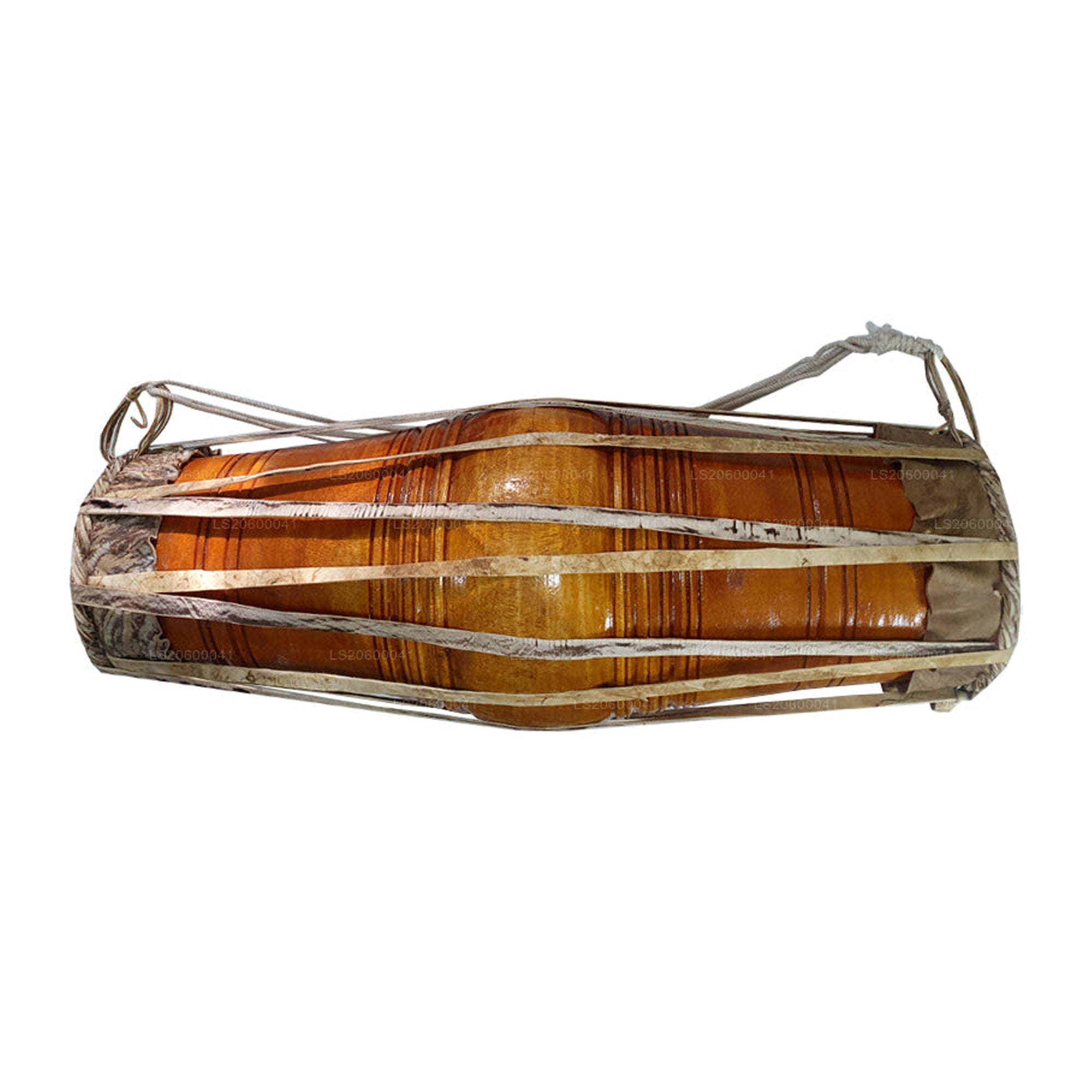
The Geta Beraya is the barrel drum of the Sri Lankan hill country, also called the udarata beraya or up-country drum. It is a two-voiced instrument: one head answers the other, and the player works both at once with the bare hands, so a single drummer carries the low and the high line of the rhythm together. That interplay — a deep, round note on one side and a tighter, brighter note on the other, struck in patterns that move constantly between the two — is what the instrument exists for, and what makes it recognisable from a distance in a procession or a dance hall.
The shell is carved from one hollowed log of kohomba — margosa, Azadirachta indica, the tree English also calls neem. The tradition works in kohomba, ehela and kos (jackfruit); the drum offered here is the kohomba one. The form is widest at the centre and tapers towards both ends, and it is this swelling waist that gives the drum its Sinhala name: geta beraya, the drum with a knot. The outside is turned with fine ring grooves banding the barrel and finished in a deep glossy lacquer, orange-amber over the grain, so the shell reads as one continuous body rather than a joined one.
The two heads are different skins and different voices. The left head is treated cattle hide and sounds low. The right head is treated goat skin and sounds higher. Each is held in a plaited hide rim hoop, and the two hoops are joined by long flat straps of hide lacing that run the length of the shell in a zig-zag from rim to rim. The lacing is the tuning mechanism: drawing it up raises the tension across both heads and lifts the pitch, easing it lets the heads relax and the pitch fall. The traditional descriptions of the instrument name deer skin for the lacing straps.
- Shell: a single hollowed log of kohomba (margosa), barrel form, turned ring grooves, deep lacquer finish.
- Length: 28 inches, about 71 cm.
- Heads: left head treated cattle hide, low in pitch; right head treated goat skin, higher in pitch.
- Lacing: flat hide lacing in a zig-zag between the two rim hoops, along the full length of the shell.
- Worn: horizontally at the waist on a twisted carrying cord, both heads facing outward.
- Played: with the bare hands only, both hands at once, never with sticks or beaters.
This is the principal drum of Kandyan dance: the ves and naiyandi forms are set to it, and dancers learn their sequences to its patterns. It also belongs to temple ceremony and to the Esala Perahera, the great procession in Kandy, where ranks of these drums move with the dancers and the elephants. It should not be confused with the Yak Beraya, the low-country ritual drum, which is a different instrument with a different repertoire. In construction and behaviour the geta beraya is closely comparable to the Indian mridangam — a double-headed barrel drum with each face tuned to a different pitch, played with the hands.
Care. The heads and the lacing are natural hide and they respond to weather, so keep the drum out of direct sun, away from damp, and out of the path of air conditioning blowing straight onto it. Expect the sound to settle over the first weeks as the hide relaxes into a new climate. The lacing can be eased or drawn up to bring the heads back to pitch; tighten it gradually, a little at a time, rather than in one pull.
This is a working instrument rather than an ornament — it is built to be worn, played and tuned. Traditional drum-making in Sri Lanka is concentrated in the village of Kuragala, in the Udunuwara division of Kandy District, where families have kept the craft across generations. Lakpura ships the drum from Sri Lanka.