Sri Lanka punches far above its weight as a destination for naturalists. An island roughly a quarter the size of the United Kingdom shelters over 27 endemic bird species, hundreds of endemic plants, and — perhaps most surprisingly — 129 identified species of dragonfly, of which 56 are found nowhere else on Earth. That level of endemism, around 43 percent, places Sri Lanka among the most important dragonfly destinations in Asia and makes it a compelling target for odonatologists and curious wildlife travellers alike.
Why does Sri Lanka have so many endemic dragonflies?
The short answer is geography and habitat diversity. Sri Lanka separated from the Indian subcontinent millions of years ago, allowing its fauna to evolve independently. The result is a spectrum of freshwater environments — highland streams, lowland lagoons, paddy-field irrigation channels, river oxbows, and reed-fringed tanks — packed into a relatively small area. Each habitat type supports different assemblages of species, and the southwestern wet zone in particular, with its intact rainforest, harbours the greatest concentration of endemics.
The island's isolation also means there has been little gene flow with continental species. Populations that colonised Sri Lanka long ago gradually diverged, producing forms unique to the island. This process mirrors what happened with the island's reptiles, amphibians, and plants, all of which also show elevated endemism compared with neighbouring regions.
What are the best sites for dragonfly watching in Sri Lanka?
A focused tour typically strings together several distinct habitat zones, each offering a different cast of species.
- Sinharaja Forest Reserve (wet zone lowlands): The Sinharaja Forest Reserve is the single richest site for endemic dragonflies. Streams running through primary rainforest support specialist species that cannot survive in disturbed habitats. Early mornings along the forest trails, particularly near shallow, clear-water streams, yield the highest diversity.
- Kelani River headwaters and Kitulgala area: Fast-flowing rocky streams at mid-elevation are ideal for species that require well-oxygenated water. The riverine forest around Kitulgala is accessible and productive, especially from December through April.
- Horton Plains National Park: The Horton Plains plateau above 2,000 m hosts a small but distinct highland community, including species adapted to cooler temperatures. The grassland streams and bog margins here are unlike any other habitat in Sri Lanka.
- Madu Ganga wetlands: The tidal lagoon and mangrove system of Madu Ganga near Balapitiya supports a different suite of species, including several damselflies that favour brackish-edge environments. A slow boat trip through the channels is an effective way to cover this habitat.
- Udawalawe and the dry zone tanks: The large irrigation reservoirs and their surrounding scrub in the dry zone offer open-water species rarely seen in the wet zone. The margins of Udawalawe National Park are particularly accessible and dragonfly activity peaks in the hours after sunrise.
When is the best time to visit Sri Lanka for dragonfly watching?
Dragonfly activity in Sri Lanka is year-round, but timing and location need to be matched carefully. The wet zone southwest — including Sinharaja — is most productive during the inter-monsoon periods, typically March to April and October to November, when rainfall is moderate and flying insects are abundant without persistent heavy downpours. The dry zone sites in the north and east are at their best from May through September, when the southwest monsoon keeps the wet zone soaked but the north remains clear. Horton Plains can be visited any time, though mornings are clearest between January and March.
What species might I see?
Even a brief visit to multiple habitats can accumulate a long list. Some species that regularly feature on guided dragonfly itineraries include:
- Heliogomphus desligneyi — a stream-dwelling endemic gomphid found in clear forest streams in the wet zone
- Tetrathemis platyptera — an endemic with distinctive broad hindwings, seen near rainforest pools
- Elattoneura caesia — a slender damselfly of shaded streams in the wet zone foothills
- Neurothemis intermedia — one of the more conspicuous species of open wetlands and paddy margins
- Macrogomphus lankanensis — a large endemic gomphid of mid-elevation rivers
Alongside dragonflies, excursions to these habitats almost always produce sightings of endemic birds, reptiles such as hump-nosed lizards, and a wide range of butterflies — making a dragonfly-focused tour equally rewarding for general naturalists.
How do I get around Sri Lanka on a dragonfly tour?
Most productive sites are not connected by public transport in a practical way for wildlife watching. A private vehicle with a naturalist driver-guide allows you to reach stream locations at the optimum early-morning hour, carry field equipment, and move between habitats efficiently. Road quality varies — some forest-edge sites require a 4WD approach track — so it is worth confirming vehicle type when arranging transport.
Colombo is the standard arrival point. From there, a nine- or ten-day circular route can cover the wet-zone highlands, the central hills, and the dry-zone plains without excessive daily driving distances. Ella makes a logical overnight base for the transition between the wet and dry zones, offering easy access to mid-elevation streams in both directions.
What equipment should I bring for dragonfly watching?
Dragonfly watching requires less equipment than birdwatching but a few items make a significant difference:
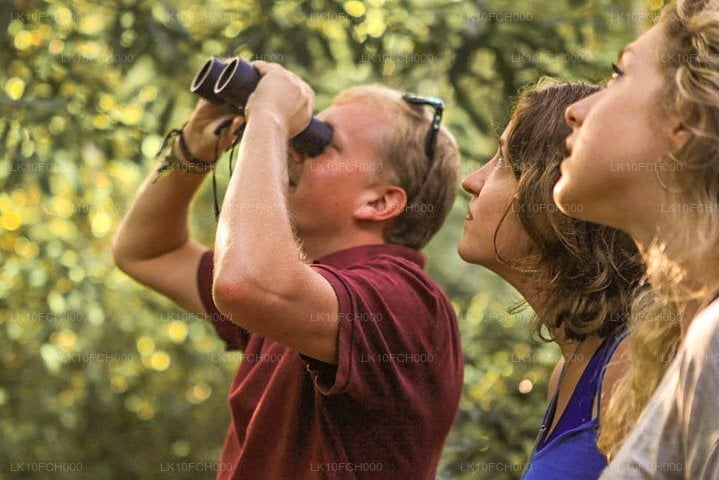
- Close-focus binoculars: Standard birding binoculars with a minimum focus distance of 1.5–2 m are suitable; purpose-built close-focus models work better for small damselflies.
- Macro camera or telephoto lens: Many species will perch obligingly on streamside vegetation, allowing photography without capture. A 100 mm macro or a telephoto of 300 mm+ covers most situations.
- Field guide: Dragonflies of Sri Lanka by Matjaž Bedjanič, Karen Conniff, and Nerina Šalamun is the standard reference and is worth sourcing before departure.
- Light-coloured, long-sleeved clothing: Protects against sun and forest leeches — common in wet-zone habitats — without the bulk of heavy fabric.
- Waterproof footwear: Stream crossings are routine at the best sites.
Is dragonfly watching suitable for children or beginners?
It is an accessible activity for anyone with an interest in natural history. Unlike some wildlife pursuits, dragonfly watching does not demand pre-dawn starts in cold conditions. Many species are bold and perch in the open, making observation straightforward. The challenge lies in learning to distinguish similar species — a task that most visitors find engaging rather than frustrating, particularly with a knowledgeable guide on hand. Children often take to dragonfly watching readily because the insects are large, colourful, and active throughout the day.