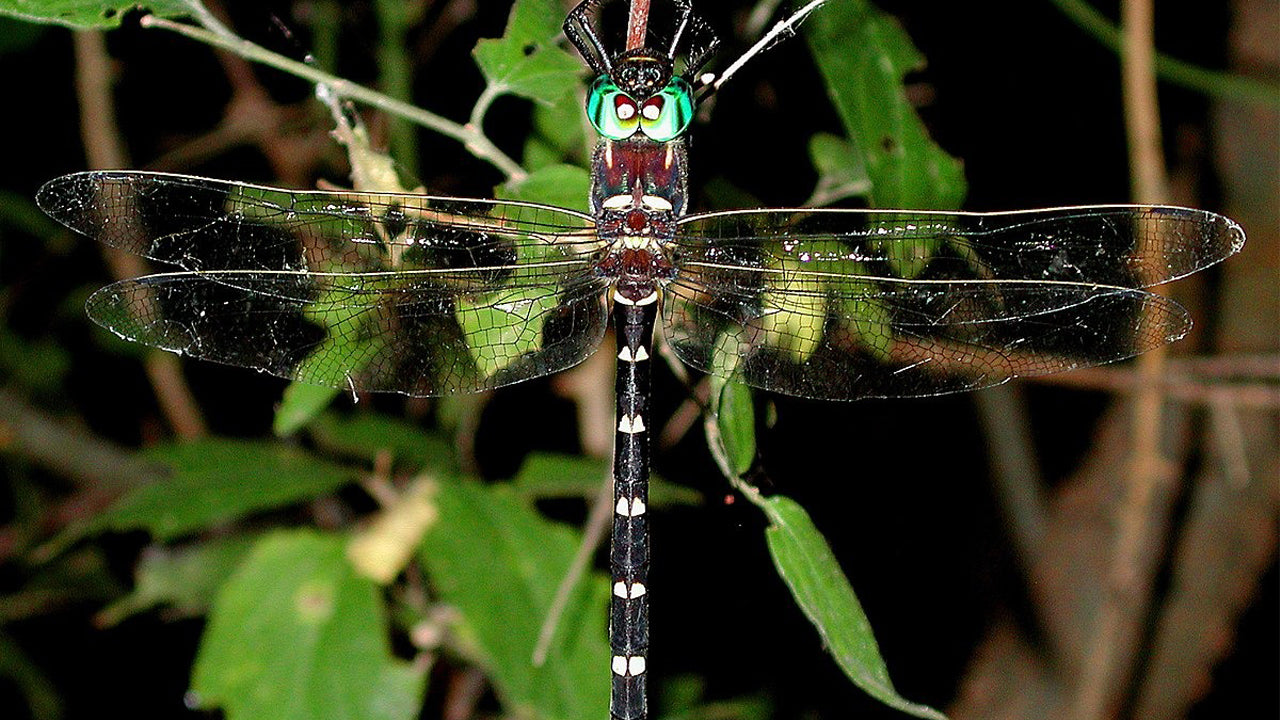
The Vermilion Forester is one of Sri Lanka's most recently documented dragonfly species — a medium-sized, brightly coloured odonate that has captured the attention of entomologists and wildlife enthusiasts alike. First reported from the Sinharaja Forest Reserve, it has since been observed at several other lowland rainforest sites across the island's southwestern wet zone. Despite more than fifteen years of intermittent observation, surprisingly little is known about its biology or breeding ecology, making it a compelling subject for ongoing research.
What does the Vermilion Forester look like?
The species belongs to the family Libellulidae — the skimmers — and sits comfortably in the medium size range for Sri Lankan dragonflies. Its most immediate identifying feature is its vivid colouration: a rich vermilion red that covers much of the abdomen and sets it apart from the island's other forest-dwelling odonates at a glance.
Beyond colour, the Vermilion Forester has a distinctive body shape and wing venation that, taken together, make misidentification unlikely even for observers who are not specialist odonatologists. The combination of a robust thorax, proportionally short abdomen, and characteristic wing patterning distinguishes it clearly within the regional fauna.
Where does the Vermilion Forester live?
The species is associated with marshy, shaded interiors of lowland rainforest — environments that are almost entirely confined to Sri Lanka's wet zone, particularly the lowlands south and west of the central highlands. Adult individuals are typically encountered perched on exposed vegetation, usually around one metre above the ground, often near standing or slow-moving water within the forest understorey.
Sinharaja remains the most reliably productive site for observers, given the reserve's exceptional conservation status and the relative accessibility of its trail network. The Makandawa Rainforest and other intact lowland forest fragments in the wet zone have also yielded sightings, suggesting the species may be more widely distributed than the available records currently indicate — though this remains to be confirmed through systematic survey work.
Is the Vermilion Forester endemic to Sri Lanka?
Yes. The Vermilion Forester is a Sri Lankan endemic, meaning it occurs nowhere else on Earth. Endemism is particularly high among Sri Lanka's odonates: the island's geographic isolation and the ecological diversity of its wet-zone forests have together produced a remarkable concentration of species found only here. The Vermilion Forester is one of the most recently added names to that list, underscoring how much remains to be discovered even in relatively well-studied groups.
Sri Lanka's dragonfly fauna is broadly divided between wet-zone forest specialists and drier, more open-water species. The Vermilion Forester belongs firmly to the former category, which makes the continued integrity of the island's remaining lowland rainforest critical to its survival.
What do we know about Vermilion Forester behaviour?
Field observations over the past fifteen years have established a consistent behavioural picture of adults: they favour perching on low, exposed stems and leaves within the forest interior, typically in the vicinity of marshy ground or standing water. This perching habit — relatively low, in open spots within otherwise dense vegetation — is characteristic of several libellulid genera and likely reflects a combination of thermoregulation and territorial display.
- Perching height: typically around one metre above the ground
- Microhabitat: marshy areas within intact lowland rainforest
- Activity period: adults observed during daylight hours; peak activity windows not yet formally documented
- Breeding habitat: not yet confirmed; presumed to involve slow or standing water within or adjacent to forest
The absence of confirmed breeding records is one of the most significant gaps in current knowledge. Larvae (nymphs) have not been formally described from the wild, and the larval microhabitat — whether still pools, seepages, or waterlogged leaf litter — remains unknown.
Why is the Vermilion Forester important for conservation?
As a forest-dependent endemic with an apparently restricted range, the Vermilion Forester is inherently vulnerable to any reduction in the area or quality of lowland wet-zone rainforest. Sri Lanka's lowland forests have contracted significantly over the past century due to agricultural conversion and timber extraction, and the fragments that remain face ongoing pressure from encroachment and invasive species.
The species has not yet been formally assessed on the IUCN Red List as a standalone taxon, but it is generally regarded by Sri Lankan odonatologists as being of high conservation concern. Its continued presence in Sinharaja — a UNESCO World Heritage Site — offers some degree of legal protection, but observations beyond the reserve boundaries highlight the need for broader habitat safeguards.
The fundamental challenge is that conservation planning for a species with largely unknown biology is inherently difficult. Understanding where it breeds, what larval habitats it depends on, and how its populations are structured across the wet zone would substantially improve the quality of any management response.
How can I see the Vermilion Forester in Sri Lanka?
Sinharaja Forest Reserve is the most practical starting point for anyone hoping to observe this species. The reserve's trail system passes through exactly the kind of marshy, shaded interior where the Vermilion Forester has been consistently recorded, and local guides are familiar with productive areas. Early morning visits are generally recommended for dragonfly observation, as adults tend to be most active once temperatures have risen but before the heat of midday drives them to shelter.
Patience and slow movement pay dividends — the species' perching behaviour means it is often spotted by walking quietly along trails and scanning low vegetation near wet ground. A pair of close-focus binoculars (minimum focus around 1.5–2 metres) is useful for confirming identification without disturbing the insect.
- Wear muted, dark clothing to avoid alerting perching individuals.
- A macro-capable camera or smartphone lens helps document sightings for the record.
- Log confirmed sightings with local biodiversity databases such as the Dragonfly Association of Sri Lanka or iNaturalist to contribute to the species' range map.
- Enter the reserve with a registered guide — this is a legal requirement in Sinharaja and also materially improves your chances of finding the species.
When is the best time to look for dragonflies in Sinharaja?
Dragonfly activity in Sinharaja is broadly tied to moisture and temperature. The inter-monsoon periods — roughly March to April and October to November — often bring stable, warm, humid conditions that suit adult odonates well. That said, Sinharaja receives rainfall throughout the year given its position in the wet zone, and dragonfly activity is rarely absent entirely.
The two main monsoon seasons (the southwest monsoon from May to September and the northeast monsoon from December to February) bring heavier rainfall that can reduce visibility and trail accessibility, though some observers find that the post-rain period immediately following heavy showers is particularly productive. Visiting during the drier spells within any monsoon month remains feasible with appropriate preparation.
Are there other rare dragonflies to look for in Sri Lanka's wet-zone forests?
Sri Lanka supports one of the highest dragonfly endemism rates in Asia relative to its land area. Sinharaja and the surrounding wet-zone forest complex hold a disproportionate share of these endemics, several of which are similarly little-studied. Species such as forest-associated gossamerwings (family Chlorocyphidae) and various endemic damselflies share the marshy understorey habitats favoured by the Vermilion Forester, making any visit to these forests potentially rewarding for odonate enthusiasts beyond a single target species.
The cloud forest habitats of the central highlands harbour a partially distinct community of high-altitude species, providing an additional dimension to any Sri Lanka dragonfly itinerary.