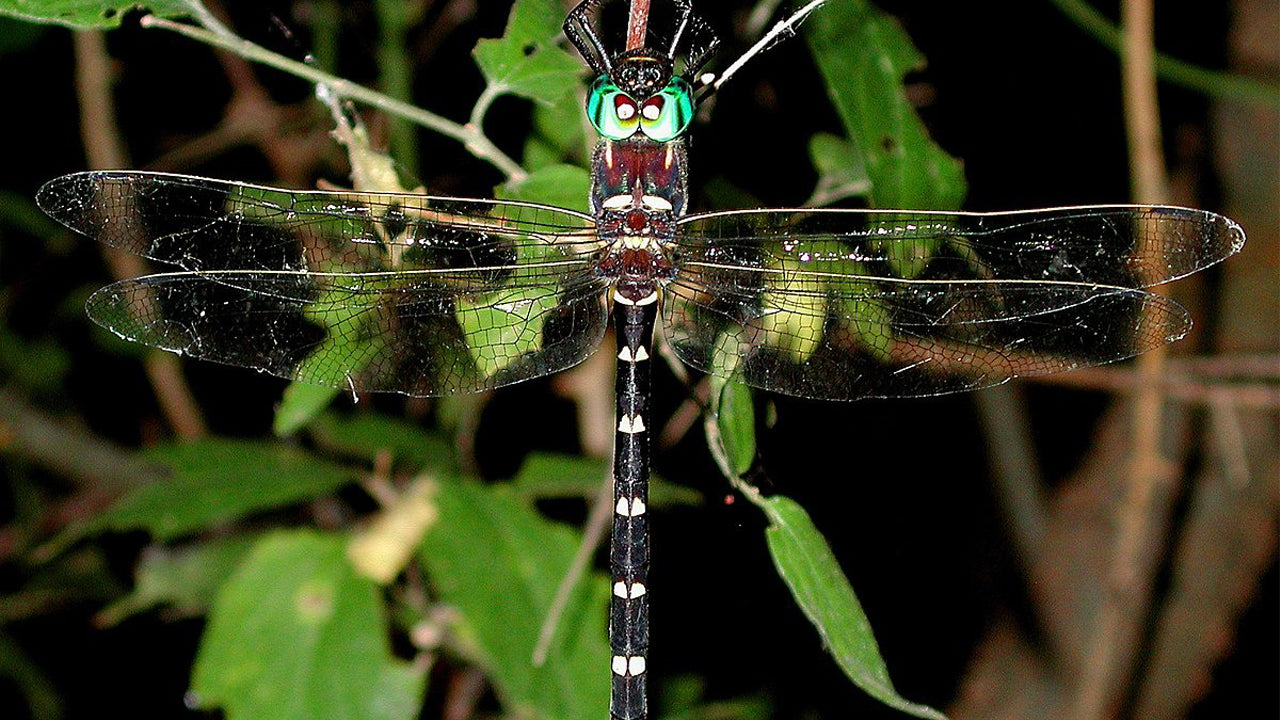
Green's Gem (රත් මිණි ඉරටුකූරා) is one of Sri Lanka's most distinctive endemic damselflies — a compact, jewel-toned insect that rewards patient observers along the island's shaded stream banks and river margins. Despite measuring roughly 2.5 cm (about an inch) in total length, it is surprisingly easy to spot once you know what to look for: the male's bold colour patterning stands out sharply against the mossy rocks and riparian foliage it favours as a perch.
What exactly is Green's Gem, and why is it special?
Green's Gem belongs to the family Chlorocyphidae, a group of damselflies characterised by wings that extend beyond the tip of the abdomen — an unusual trait that gives them a broader, more butterfly-like silhouette than most other damselflies. The species is entirely endemic to Sri Lanka, meaning it exists nowhere else on Earth. Within the island's rich odonata (dragonfly and damselfly) community, Green's Gem is considered a flagship species for healthy lowland stream ecosystems.
The Chlorocyphidae family is sometimes called "gossamerwings" or "jewels" in informal literature, and Green's Gem lives up to that reputation. The male displays a vivid, contrasting colour pattern across its wings and abdomen that functions both as a signal to rival males and as a courtship display to females.
Where does Green's Gem live in Sri Lanka?
The species is distributed across the lowlands and lower hill country of Sri Lanka's wet and intermediate zones — broadly the south-western quarter of the island and sections of the central foothills. It is most reliably encountered along large streams and rivers with intact riparian vegetation: overhanging trees, ferns, and mossy boulders provide the sheltered, humid microhabitats it requires.
Green's Gem typically perches on exposed rocks in or near flowing water, or on low vegetation at the water's edge. It is rarely found far from permanent, clean-running streams; its presence in an area is therefore a reasonable indicator of good water quality. The Sinharaja Forest Reserve, with its network of well-shaded forest streams, is among the habitat types most associated with wet-zone odonata including this species.
Altitude is a key limiting factor. Green's Gem is primarily a lowland insect, seldom recorded much above 500–600 m, which broadly excludes the higher hill-country zones frequented by cloud-forest specialists.
How do you identify Green's Gem in the field?
Field identification is relatively straightforward for males. Key features to look for:
- Size: Very small — around 2.5 cm total length. Noticeably smaller than most dragonflies sharing the same stream.
- Wings: Held open or partially open at rest (unlike many damselflies that fold wings along the body); distinctly longer than the abdomen.
- Colour pattern: Males carry a striking combination of metallic or iridescent tones on the body and patterned markings on the wings that make them unmistakable among Sri Lankan Chlorocyphidae.
- Perch posture: Typically rests flat on rock surfaces or broad leaves near flowing water, wings angled slightly forward.
Females are considerably more cryptic — generally brown or dull green — and are harder to separate from related species without close inspection. A good macro lens or binoculars focused at close range significantly improves the chance of a confident identification.
What behaviour can you observe?
Male Green's Gems are territorial insects. A single male will claim a section of stream bank or a favoured rock surface and defend it actively against rival males of the same species. The defence takes the form of rhythmic, highly choreographed aerial sparring: the two males rise from their perches and perform a looping, hovering flight display before one retreats. Full physical contact is rare; the display is primarily visual.
This territorial behaviour makes them surprisingly easy to watch — a resident male will return to the same perch repeatedly after each encounter, allowing extended observation. Early morning, when damselflies are warming up and activity is building, is often the most productive time for behavioural watching. Activity typically drops during the hottest midday hours.
Mating and egg-laying are less frequently documented in the field, but females are assumed to oviposit (lay eggs) into submerged plant material or moss-covered rocks in flowing water, consistent with other Chlorocyphidae.
When is the best time to look for Green's Gem?
Like most odonata, Green's Gem is most active during warmer, sunnier months when adult populations peak. In the wet zone, adults can typically be found year-round near permanent streams, but numbers are generally higher during drier spells when water levels stabilise and suitable exposed rocks are more accessible. Overcast or rainy days tend to reduce activity and make sightings harder.
Mid-morning to early afternoon — roughly 08:00 to 13:00 — is usually the optimal observation window. Walking slowly along a shaded stream bank and pausing frequently at open rocky sections is the most effective search strategy.
How does Green's Gem fit into Sri Lanka's broader biodiversity?
Sri Lanka has a remarkably high number of endemic odonata relative to its land area, a consequence of the island's long isolation and the diversity of its freshwater habitats. Green's Gem is one of several endemic Chlorocyphidae recorded here, and its continued presence is closely tied to the health of lowland river systems — habitats under pressure from agricultural run-off, riparian deforestation, and water extraction.
For naturalists visiting Sri Lanka, the country's endemic damselflies are an often-overlooked complement to the celebrated bird and mammal lists. A dedicated odonata walk along a wet-zone river can yield multiple endemic species within a short stretch of bank. The Madu Ganga wetland system and its associated waterways are among the accessible sites where freshwater biodiversity — including odonata — is well represented in the lowland wet zone.
Tips for photographing Green's Gem
- Use a macro lens (90–105 mm equivalent) or a telephoto macro combination to avoid disturbing the perched insect.
- Approach slowly and laterally — a direct head-on approach is more likely to flush the damselfly from its perch.
- Look for individuals perched on pale or light-coloured rocks, which provide the best contrast for wing-pattern photography.
- Bright but partly overcast light reduces harsh shadows without eliminating the iridescent sheen on the wings.
- Patience is more effective than pursuit — territorial males return to the same perch within minutes of disturbance.
Conservation status and threats
As an endemic species with a habitat range tied to clean-flowing lowland streams, Green's Gem is inherently vulnerable to any degradation of Sri Lanka's wet-zone river systems. Riparian vegetation clearance, sedimentation from upland agriculture, and stream channelisation all reduce the quality and extent of suitable habitat. While the species is not currently listed as critically threatened, the long-term protection of intact stream corridors — particularly within and adjacent to protected forest reserves — is essential for its persistence.
Citizen-science records submitted to platforms such as iNaturalist contribute meaningfully to understanding the current distribution of Sri Lanka's endemic odonata, and sightings of Green's Gem are a useful data point for freshwater conservation planning.