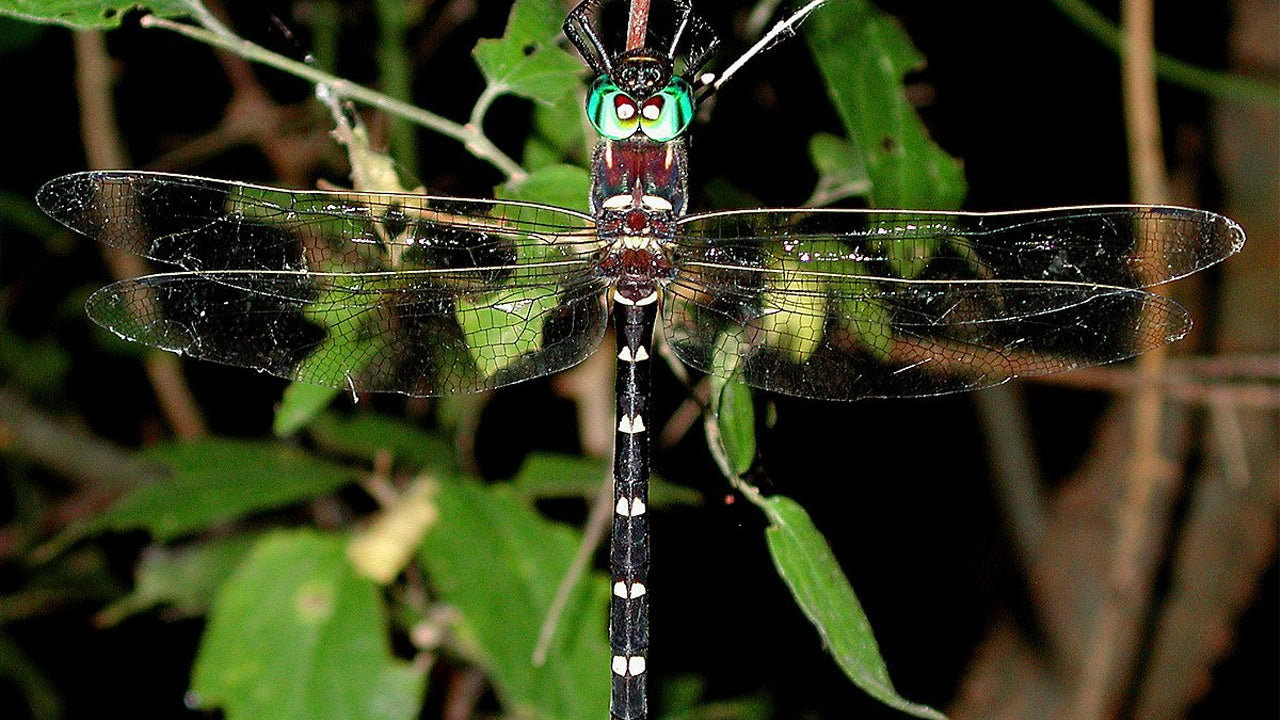
The Asian Groundling (Brachythemis contaminata) is one of the most recognisable dragonflies in Sri Lanka's lowland landscapes. Small in size yet striking in colour, it is a familiar sight hovering over paddy fields, tanks, and wetlands across the island. For wildlife enthusiasts visiting Sri Lanka, it is often among the first dragonfly species they encounter — and one of the easiest to identify.
What does the Asian Groundling look like?
The most distinctive feature of this species is its wing colouration. Males display warm orange to amber-tinted wings that catch the light as they fly low over open water, making them relatively simple to distinguish from other Sri Lankan dragonflies. The body is also orange-toned in males, deepening with maturity. Females are noticeably different: their wings are more yellowish or pale amber, and the overall body colour is less saturated — a pattern common across many Odonata species where males carry the more vivid colouring. Both sexes are compact, with a wingspan that is proportionally wide relative to body length, giving the insect a fluttery, low-skimming flight style.
Where does the Asian Groundling live in Sri Lanka?
This species is highly adaptable and thrives in a broad range of open freshwater and semi-aquatic environments. It is commonly found around irrigation tanks, slow-moving rivers, paddy fields, lagoons, and constructed wetlands. Unusually for a dragonfly, it tolerates significant water-quality degradation and can breed successfully in polluted canals and drainage channels within urban and industrial areas — a trait that sets it apart from many of its more habitat-sensitive relatives.
The Asian Groundling is typically a lowland species. It is widespread across the wet zone, dry zone, and coastal plains, but absent from dense closed-canopy forest interiors and the higher elevations of Sri Lanka's central mountains. The open, sun-exposed margins of water bodies are its preferred hunting and breeding grounds.
Where is the best place to spot the Asian Groundling in Sri Lanka?
Because the species is so widespread, opportunities to observe it arise throughout the lowland regions of the island. Some of the most rewarding locations include:
- Irrigation tanks in the dry zone — the ancient tank systems around Polonnaruwa provide ideal open-water habitat, and groundlings are frequently seen perching on emergent vegetation along the bunds.
- Wetland margins along the southern coast — estuarine and backwater environments such as those along Madu Ganga support a diversity of dragonflies, with the Asian Groundling among the most abundant.
- Paddy field edges — during and after the cultivation season, flooded paddies attract large aggregations of this species, sometimes numbering in the hundreds.
- Urban parks and garden ponds — even within Colombo and other cities, the species persists wherever standing water is present, making it a genuinely urban-tolerant insect.
- Buffer zones of national parks — the open grassland-wetland fringes of parks such as Udawalawe National Park are excellent spots, where groundlings can be observed alongside more specialised wetland species.
How does the Asian Groundling behave?
Like most dragonflies, the Asian Groundling is a highly effective aerial predator. It hunts small flying insects — mosquitoes, midges, and small flies — by making short, rapid sallies from a perch before returning. Males are territorial over water and will chase rival males or other insects from favoured perches, making them relatively active and easy to watch.
Breeding takes place in standing or slow-moving water. Females lay eggs by dipping the tip of the abdomen into the water surface, often with the male in tandem or hovering protectively nearby. Larvae (nymphs) are aquatic and can complete their development even in organically enriched or turbid water — one reason the species thrives in human-modified landscapes where cleaner-water specialists struggle.
The Asian Groundling tends to fly low and close to the water surface, which gives it the common name "groundling." This behaviour makes it considerably easier to observe and photograph than faster, higher-flying species.
What is the wider distribution of the Asian Groundling?
Beyond Sri Lanka, Brachythemis contaminata has a broad range extending across South Asia and into Southeast Asia, reaching as far as parts of the Middle East. It is one of the more range-adaptable members of the family Libellulidae (skimmers), reflecting the same ecological flexibility that makes it so common in Sri Lanka. In South Asia, it is recorded from India, Pakistan, Bangladesh, and Nepal.
Within Sri Lanka specifically, the species is considered common across the lowland dry and wet zones, and its population appears stable. It does not face the same pressures as wetland-specialist dragonflies that depend on clean, undisturbed water bodies — though broad wetland degradation and urban development remain general concerns for Sri Lanka's Odonata fauna as a whole.
Is the Asian Groundling useful to observe for citizen science?
As one of the most abundant and identifiable dragonflies in Sri Lanka, the Asian Groundling is a useful indicator species and a good starting point for anyone beginning to record dragonflies. Its tolerance of degraded habitats means it can act as a baseline species: where even groundlings are absent, water quality or habitat loss may be severe. Visitors who encounter it are encouraged to log sightings on platforms such as GBIF, contributing to the regional understanding of dragonfly distributions.
Tips for watching dragonflies in Sri Lanka
- Visit wetland edges in the morning, when dragonflies are warming up and less flighty.
- Approach slowly and avoid casting a shadow over the water — groundlings will flush if startled.
- Bring close-focus binoculars (minimum focus around 1.5–2 m) for detail without disturbing the insect.
- A macro-capable camera lens makes identification from photographs far easier, particularly for female and juvenile colouration.
- Dragonfly diversity in Sri Lanka peaks during and just after the two monsoon seasons, when standing water is most abundant.