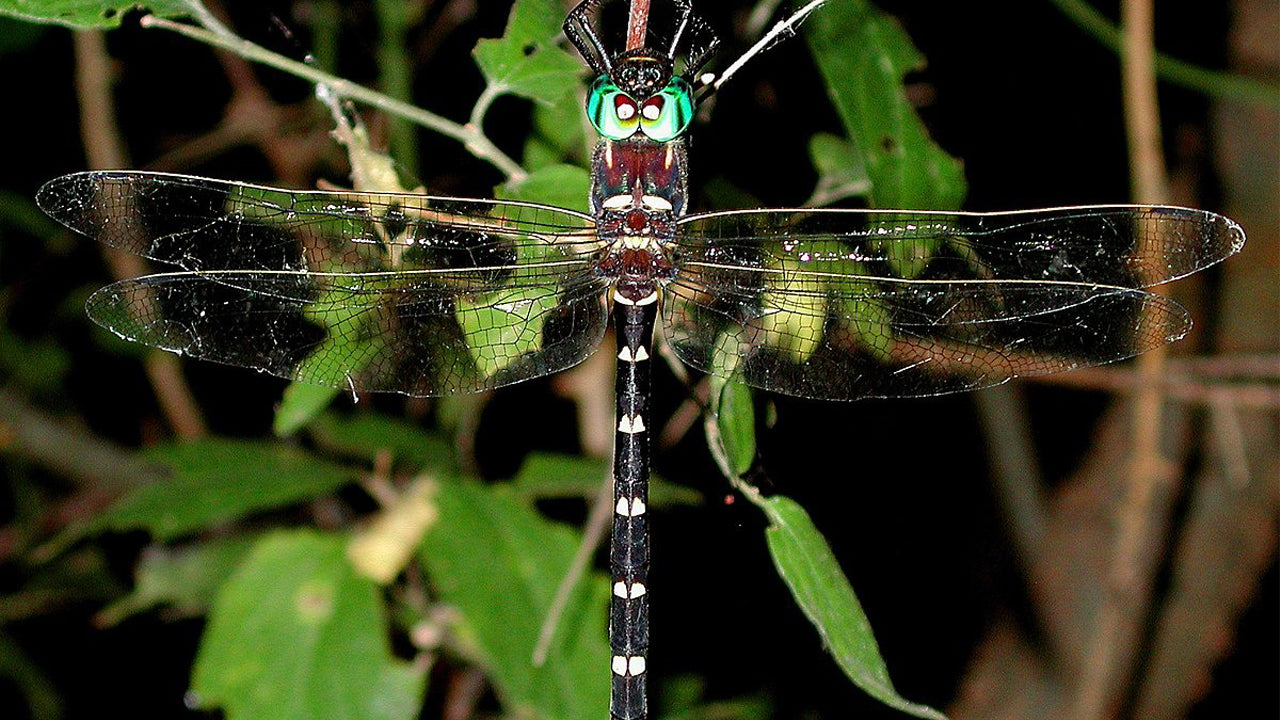
The Shining Gossamerwing (Euphaea splendens) is one of Sri Lanka's most visually distinctive damselflies. Its hind wings shift between deep green and electric blue depending on the angle of light, a quality that makes it immediately recognisable even to casual observers standing beside a lowland stream. It holds a notable taxonomic position as the sole representative of the family Euphaeidae on the island — a family otherwise concentrated across South and Southeast Asia.
Where does the Shining Gossamerwing live in Sri Lanka?
This species occupies a broad altitudinal range, from the coastal lowlands to the mid-mountain foothills, but it is most reliably encountered along medium-sized rivers and streams in the wet zone and intermediate zone. It shows a strong preference for clear, well-oxygenated water with a mix of exposed boulders and riparian vegetation — conditions typical of streams draining the country's southwestern hill ranges.
Suitable habitat exists across a wide arc of the island, from forests in the southwest to wetter sections of the central highlands. Streams within and around the Sinharaja Forest Reserve provide excellent conditions, and the species is regularly noted in species lists compiled for that area. Observers exploring the Makandawa Rainforest near Kithulgala have also recorded it along the boulder-strewn reaches of the Kelani River.
What does the Shining Gossamerwing look like?
Sexual dimorphism is pronounced. Males carry the iridescent, metallic-toned hind wings that give the species its common name — the coloration is structural rather than pigment-based, produced by light interference across the wing membrane. The body is dark, providing strong contrast against the reflective wing patches.
Females are considerably plainer. Their wings are largely transparent, and the body colouration is more subdued. Without the metallic flash, females are easier to overlook, though their behaviour at the waterside makes them worth searching for in their own right.
How does the Shining Gossamerwing behave?
Males are territorial and conspicuous. They select exposed perches — boulders mid-stream, twigs projecting over the water surface, or flat rocks at the river's edge — from which they monitor and defend stretches of suitable habitat. When two males meet at a territorial boundary, they engage in a distinctive aerial display, flying in close tandem while flashing their metallic wings at each other in a rhythmic, almost choreographed sequence. These exchanges rarely escalate beyond display, and one male typically retreats after a short confrontation.
The purpose of the wing display extends beyond territorial defence. Males use the same iridescent flash to attract and court females, and the intensity of the reflection may signal individual fitness. Observers who spend time beside a productive stream reach will often watch several such encounters within a single morning session.
How does the Shining Gossamerwing reproduce?
Mating follows the pattern common to many Odonata, with the male grasping the female behind the head and the pair forming a wheel posture during sperm transfer. The more remarkable stage comes after mating, during oviposition. The female descends to the water surface and then continues below it, crawling along submerged rocks and plant stems to lay her eggs directly onto underwater substrates. She can remain fully submerged for extended periods — sometimes many minutes — extracting dissolved oxygen through the body surface in a manner analogous to the plastron respiration seen in some aquatic insects.
This behaviour is unusual among Sri Lankan damselflies and makes the female difficult to observe during egg-laying, since she is effectively invisible beneath the water's surface. Patient watchers crouching at stream edge sometimes spot the faint disturbance as she descends, or catch her re-emerging at the water's surface when oviposition is complete.
When is the best time to look for the Shining Gossamerwing?
Like most Sri Lankan Odonata, adults are most active during the warmer, drier months when stream levels stabilise and solar exposure is high enough to warm the boulders they prefer to perch on. The southwest monsoon period (typically May to September) raises river levels and reduces perch availability along many lowland streams, which can make observation harder in the wet zone during peak rains. The inter-monsoon months of March–April and October–November often provide good conditions across the intermediate zone.
Morning hours — broadly between 08:00 and 11:00 — are generally most productive. Males begin perching once the sun warms their chosen rocks, and territorial activity peaks before the midday heat causes most individuals to retreat to shadier vegetation.
How does the Shining Gossamerwing fit into Sri Lanka's dragonfly diversity?
Sri Lanka supports a notably rich Odonata fauna relative to its land area, with a significant proportion of species found nowhere else. The Shining Gossamerwing contributes to this diversity both taxonomically — as the island's only Euphaeidae — and ecologically, as an indicator of clean, well-structured stream habitat. Its continued presence in a river system is generally a positive sign for water quality and riparian integrity.
Odonate surveys have increasingly been incorporated into broader biodiversity assessments in Sri Lanka, and citizen-science records submitted through global platforms have helped map the species' distribution more precisely in recent years. Visiting naturalists are encouraged to record and submit observations through recognised databases, contributing to the baseline needed for long-term monitoring.
Tips for observing the Shining Gossamerwing in the field
- Approach stream edges slowly and keep low — damselflies perching on boulders will flush if they detect sudden movement.
- Polarised sunglasses help cut surface glare and make submerged females easier to spot during oviposition.
- Bring close-focusing binoculars (minimum focus around 1.5 m) rather than relying solely on a camera; the wing iridescence is easiest to appreciate with the naked eye or optics at short range.
- Note the time and microhabitat of any sightings — whether the perch is a mid-stream boulder, a bank-side rock, or overhanging vegetation — as this detail is useful in submitted records.
- Combine an Odonata walk with a broader nature trail: streams that support the Shining Gossamerwing typically also host other endemic damselflies, freshwater fish, and riparian birds.