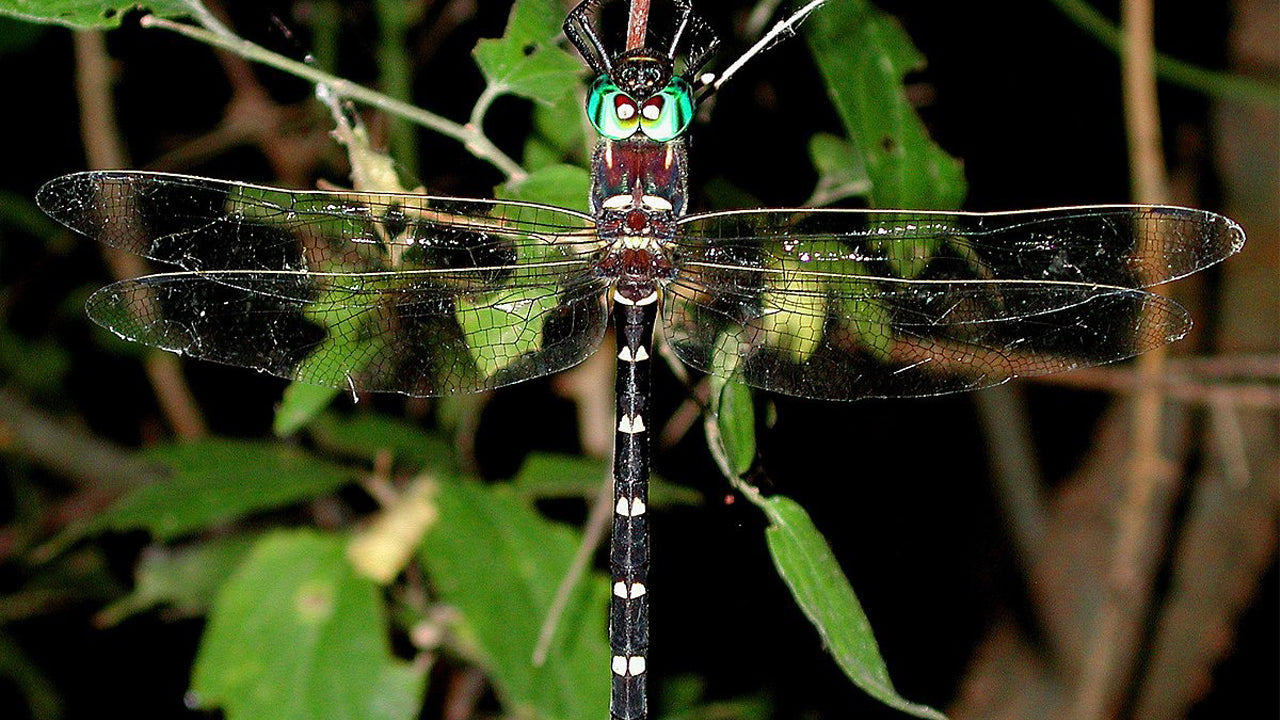
The Black-tipped Flashwing (Vestalis apicalis), known in Sinhala as තටු අගිසි දිලිසි ඉරටුකූරා, is among the most visually striking damselflies found in Sri Lanka. With a total body length of around three inches, it ranks as one of the island's largest damselfly species. Its metallic green body and broad, glassy wings make it instantly recognisable along shaded stream banks, and the bold black wingtips on males set it apart from related species at a glance.
What does the Black-tipped Flashwing look like?
Both sexes share the vivid metallic green coloration that gives the Flashwing group their name, but male and female individuals differ in one key respect: males carry prominent black tips on their wings, while females typically display clear or lightly tinted wingtips. The wings themselves are noticeably broad compared to most other Sri Lankan damselflies, contributing to the species' characteristic slow, fluttering flight over water.
Immature individuals tend to appear duller in colour, lacking the full metallic sheen of adults. These younger damselflies are generally found away from open waterways, resting on low vegetation within forest gaps as they mature.
Where does the Black-tipped Flashwing live in Sri Lanka?
This species occupies the lowland and lower montane zones of Sri Lanka's wet and intermediate climatic regions — broadly the southwestern and central portions of the island. It is particularly associated with clean, flowing water: small forest streams, river margins, and the shaded banks of larger rivers all serve as prime habitat.
One of the most rewarding places to observe the species is along riparian corridors within the Sinharaja Forest Reserve, where undisturbed stream habitats support high densities of endemic odonates. The Makandawa rainforest and similar wet-zone forest patches also provide suitable conditions.
Adults are most often seen perched motionless on overhanging leaves and stems just above the water surface, occasionally launching short display flights. Multiple individuals — both male and female — are frequently encountered at the same stream section, making it one of the more reliably observable endemic damselflies in the country.
What is the behaviour and life cycle of this damselfly?
Like other members of the family Chlorocyphidae, the Black-tipped Flashwing is a diurnal insect, active during daylight hours and most visible in the morning and early afternoon when light filters through the forest canopy and illuminates its metallic wings. Males are loosely territorial around favoured perch sites, occasionally fanning their wings in brief displays.
Reproduction is closely tied to the stream environment. Females oviposit — lay their eggs — directly into the stems and roots of riparian vegetation that overhangs the water. This behaviour helps ensure that newly hatched larvae, known as naiads, drop into the stream where they will spend their aquatic juvenile stage. The larvae are predatory, hunting small invertebrates in the stream substrate before eventually emerging as winged adults.
Immature adults disperse into nearby forest gaps during their early days, a behaviour common across many damselfly species. Returning to streamside habitat signals sexual maturity.
Is the Black-tipped Flashwing endemic to Sri Lanka?
Yes. The Black-tipped Flashwing is an endemic species, meaning it is found nowhere else in the world. Sri Lanka's isolation as an island, combined with its diverse mosaic of wet forests and clear mountain streams, has allowed a remarkable number of odonate species to evolve in isolation. The island supports well over 100 dragonfly and damselfly species, a significant proportion of which are endemic — a fact that makes Sri Lanka a destination of genuine interest for odonatologists and naturalist travellers alike.
The Black-tipped Flashwing is considered one of the more commonly encountered endemics, which is reassuring from a conservation perspective, though the health of its stream habitats remains important for its continued abundance.
When is the best time to see the Black-tipped Flashwing?
Damselfly activity in Sri Lanka's wet zone is broadly year-round, but adults tend to be most active and most visible during the inter-monsoon periods — typically around March to April and again from October to November — when stream levels are stable and sunlight penetrates the forest canopy more readily. Mornings, when dew has dried and temperatures are rising, are generally the most productive time for observation.
During heavy monsoon rains, high and turbid stream water can make streamside observation difficult, though the species does persist through such periods in the adult stage.
How can I observe damselflies responsibly in Sri Lanka?
Most productive damselfly-watching requires little more than patience and a slow, quiet approach along a stream bank. Moving carefully and avoiding shadows cast over the water reduces disturbance. A pair of close-focus binoculars (capable of focusing within two metres) transforms the experience, revealing the metallic structural coloration that photographs alone rarely capture fully.
Visiting protected areas such as national parks and forest reserves ensures that the stream habitats these species depend on remain intact. Staying on designated paths and avoiding trampling of riparian vegetation — the very substrate in which females lay their eggs — makes a tangible difference.
What other wildlife might I encounter in the same habitat?
The lowland stream margins where the Black-tipped Flashwing is found are rich in associated wildlife. Other endemic damselfly and dragonfly species are frequently present at the same sites. Kingfishers, including the endemic Sri Lanka Blue Magpie in wetter forest areas, are regular companions along forest streams. Freshwater crabs, endemic fish species, and various amphibians share the same riparian microhabitat.
Birdwatchers and herp enthusiasts often find that planning a morning around a productive stream produces encounters with multiple endemic species within a short walk — the Black-tipped Flashwing is frequently a bonus sighting rather than the sole target.