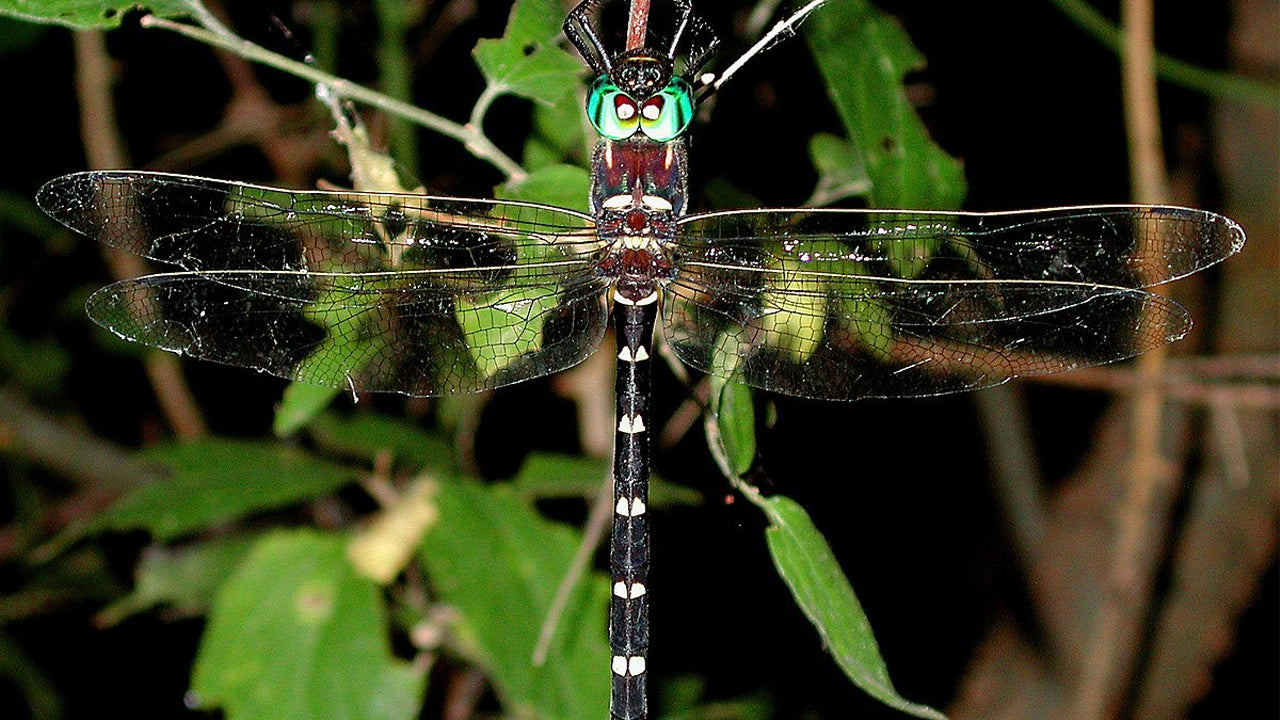
Wall's Grappletail (Heliogomphus wallsi) is a medium-sized dragonfly found nowhere else on Earth. Endemic to Sri Lanka and classified within the family Gomphidae, it is one of the island's more frequently encountered stream dragonflies in the wet zone — a quiet but rewarding find for naturalists exploring forest streams and boulder-strewn rivers.
What does Wall's Grappletail look like?
Like all Gomphidae dragonflies recorded in Sri Lanka, Wall's Grappletail is predominantly black with pale yellowish or greenish markings running along the thorax and abdomen. The pattern varies subtly between individuals, but the contrast between the dark body and lighter banding is a reliable field cue.
The most reliable identifying feature of the Gomphidae family as a whole is the distinct gap between the compound eyes. In most dragonfly families the eyes meet at the top of the head; in gomphids they are widely separated, giving the head a noticeably broader, more rectangular appearance. This trait alone is usually enough to place a sighting in the correct family at a distance.
Where does Wall's Grappletail live?
This species favours lowland rainforests, submontane forests, and any habitat with a closed or near-closed forest canopy over clear, fast-moving water. It is strongly associated with rocky streams and small rivers where boulders break the current, creating the perching sites that territorial males prefer.
Wall's Grappletail is considered a fairly common endemic across Sri Lanka's wet zone — the south-western quarter of the island that receives the heaviest rainfall — and extends into parts of the intermediate zone where suitable forest cover remains. Strongholds for the species include well-forested riparian corridors within reserves such as the Sinharaja Forest Reserve, one of South Asia's last remaining lowland rainforest blocks and a UNESCO World Heritage Site.
How does Wall's Grappletail behave?
Males are highly territorial and spend long periods perched on exposed rocks in or beside streams, returning to the same favoured boulders repeatedly. This perching habit makes them unusually straightforward to observe — approach slowly from downstream and they often hold their position long enough for a close look or photograph.
Females are considerably less conspicuous. They visit streams mainly for mating and egg-laying, spending the rest of their adult lives in the forest understorey away from open water. During oviposition, a female will dip the tip of her abdomen repeatedly into the water surface at the stream's edge, depositing eggs among gravel or submerged debris.
As with most odonate adults, Wall's Grappletail is an active aerial predator, hunting small flying insects over and around the stream corridor. The larval (nymph) stage is entirely aquatic, with larvae burrowing into stream-bed sediment where they may remain for a year or more before emerging as adults.
When is the best time to look for Wall's Grappletail?
Adult dragonflies are most active during warmer, sunnier parts of the day, typically from mid-morning through early afternoon. In Sri Lanka's wet zone, the species can be encountered year-round, though activity naturally peaks during and immediately after the south-west monsoon (May to September) when water levels and riparian vegetation are at their most productive.
Early dry-season mornings — when dew-covered individuals are slower to take flight — can offer particularly good observation opportunities. Overcast days tend to suppress activity, so clear or partly cloudy conditions give the best results.
Why is Wall's Grappletail ecologically significant?
Sri Lanka's dragonfly fauna is remarkably diverse for an island its size, with a high proportion of endemic species concentrated in the wet zone. Odonates like Wall's Grappletail are sensitive indicators of freshwater ecosystem health: their presence signals clean, well-oxygenated, unpolluted streams with intact forest cover alongside.
The species' dependence on forested watersheds also links its conservation directly to broader forest protection efforts. Deforestation, agricultural encroachment on stream banks, and water pollution all reduce suitable habitat. Monitoring gomphid populations is therefore a practical way to track the health of Sri Lanka's remaining wet-zone forest streams.
How can I find Wall's Grappletail on a visit to Sri Lanka?
The most productive approach is to visit a forest stream within the wet zone on a clear morning. Walk slowly along the bank, scanning boulders and emergent vegetation at water level. Binoculars help with initial identification before moving closer. A macro-capable camera or a phone with a good zoom will let you record the diagnostic eye gap for later confirmation.
Several accessible sites in the wet zone offer good conditions. Well-maintained forest trails in reserves with undisturbed stream crossings are typically most productive. The Makandawa Rainforest near Kithulgala is one such location, known for clear forest streams and a range of endemic wildlife. Always stay on marked paths to avoid disturbing both the dragonflies and the riverbank vegetation they depend on.
Is Wall's Grappletail endangered?
The species is currently regarded as fairly common within its range, which distinguishes it from some of Sri Lanka's rarer endemic gomphids. That said, "fairly common" should not be read as secure: its range is essentially restricted to the wet zone, a region facing ongoing pressure from land conversion and informal settlement. Continued forest protection, particularly along riparian corridors, is the primary factor determining its long-term status.
What other endemic dragonflies share its habitat?
Sri Lanka's wet-zone streams support a rich odonate community. Several other Gomphidae are recorded on the island, along with endemic damselfies in families such as Platycnemididae and Chlorocyphidae. A forest stream survey in the wet zone on a good day may turn up half a dozen or more endemic species within a short stretch of water, making odonate watching a rewarding complement to birdwatching or general wildlife photography.