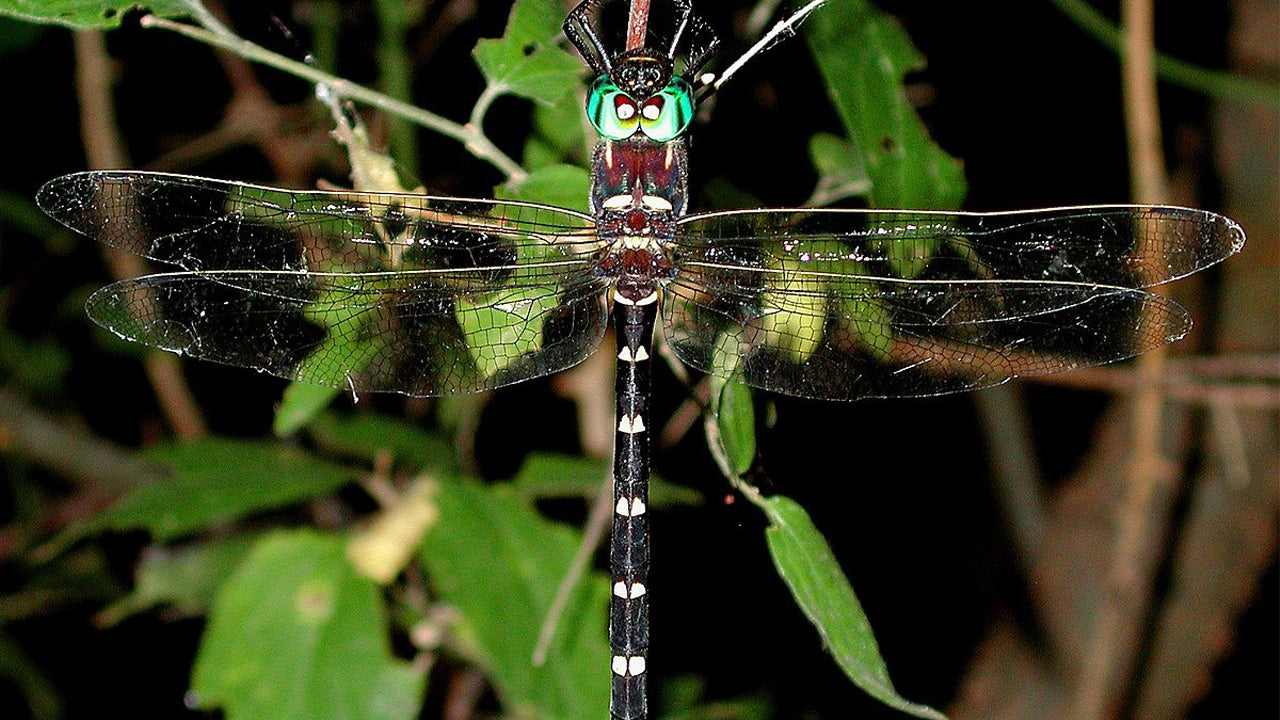
Yeebury's Elf (Tetrathemis yerburii) holds the distinction of being among the smallest dragonflies recorded in Sri Lanka, with a body length of roughly 2.5 centimetres — about an inch from head to tail. Compact and easily overlooked, it is nonetheless a fascinating species, particularly for the way it reproduces, which sets it apart from virtually every other dragonfly found on the island.
Where Does Yeebury's Elf Live?
This species is a specialist of the lowland wet zone, the southwestern quarter of Sri Lanka where annual rainfall is high and closed-canopy forest persists. Within that zone, it gravitates toward small, still pools sheltered beneath dense forest cover — the kind of dim, humid microhabitat that most visitors never actively seek out.
Males hold territory around these pools, perching on low vegetation at the water's edge and making short, low flights to assert dominance or intercept females. Beyond undisturbed forest pools, Yeebury's Elf has also been recorded at water wells, fern-covered ponds, and home gardens with heavily planted, shaded water features that mimic its natural environment. This tolerance for human-modified habitats gives it a somewhat wider distribution than many of Sri Lanka's rarer odonates, though intact forest pools remain its stronghold.
The Sinharaja Forest Reserve, a UNESCO World Heritage Site and one of the last substantial tracts of primary lowland rainforest in Sri Lanka, represents ideal habitat for this species. Other suitable sites include the fringes of the Makandawa Rainforest near Kithulgala, where shaded pools and high humidity persist year-round.
What Makes Yeebury's Elf Unusual Among Sri Lankan Dragonflies?
Most dragonflies deposit their eggs directly into or onto water. Yeebury's Elf does something markedly different. The female selects a leaf, stem, or other piece of vegetation positioned directly above a pool and attaches her eggs there, above the water surface. The eggs remain exposed in this suspended position until they are ready to hatch.
When hatching occurs, the larvae drop from the vegetation into the pool below, where they begin their aquatic development. This strategy — sometimes described as aerial oviposition — is rare among Sri Lankan odonates and makes Yeebury's Elf a subject of genuine scientific interest beyond its small size. Researchers studying odonate reproductive ecology consider this behaviour a notable adaptation, possibly reducing the risk of egg predation by aquatic invertebrates.
How Do the Larvae Develop?
Once the larvae reach the pool, they follow the typical odonate pattern of aquatic development, passing through a series of nymphal instars before eventually emerging as adults. Because the pools they inhabit are small and often shaded, water temperatures tend to be stable and oxygen levels relatively consistent — conditions well suited to slow, steady larval development.
The larvae are predatory, feeding on microinvertebrates within the pool. The duration of larval development in the wild is not precisely documented for this species, but it is likely tied to seasonal rainfall patterns that maintain pool water levels across the wet zone.
When Is the Best Time to Spot Yeebury's Elf?
Dragonfly activity in the wet zone of Sri Lanka tends to peak during and just after periods of rainfall, when pools are full and breeding conditions are optimal. For Yeebury's Elf, the inter-monsoon and southwest monsoon periods — roughly May through July — see heightened activity, though adults can be encountered throughout much of the year in suitable habitat. Early morning, when temperatures are lower and males are actively establishing territories around pools, offers the best observation window.
Patience and quiet movement are essential. Because the species favours dim, enclosed forest pools rather than open water, binoculars designed for close focus are more useful than those optimised for distance.
How Does Yeebury's Elf Compare to Other Small Sri Lankan Dragonflies?
| Feature | Yeebury's Elf | Typical Wet-Zone Dragonfly |
|---|---|---|
| Body length | ~2.5 cm | 3–7 cm (varies by species) |
| Preferred water body | Small, shaded forest pools | Streams, ponds, paddy fields |
| Egg-laying method | Above water on vegetation | Directly into or onto water |
| Larval entry to water | Drop from hatching site | Hatch directly in water |
| Habitat tolerance | Forest pools + shaded gardens | Varies widely by species |
Why Is Yeebury's Elf Significant for Sri Lanka's Biodiversity?
Sri Lanka's odonate fauna is exceptionally rich relative to the island's size, with a high proportion of endemic species found nowhere else on Earth. Yeebury's Elf contributes to that diversity and serves as an indicator species for the health of lowland wet-zone forest ecosystems. Where this dragonfly is present in reasonable numbers, it generally signals that the pool ecosystem it depends on — clean, still water with intact surrounding canopy — remains functional.
Threats to its habitat include forest clearance, drainage of small pools for agriculture, and the introduction of invasive aquatic plants that alter pool chemistry and light levels. Conservation of closed-canopy wet-zone forest, including formal protected areas and community-managed forest buffers, directly supports the continued survival of this species.
Tips for Responsible Wildlife Watching
- Stay on established paths to avoid disturbing pool edges where larvae are developing.
- Avoid introducing anything — including water from other sources — into forest pools.
- Use slow, deliberate movements near pools; rapid approach causes territorial males to retreat quickly.
- Record sightings through citizen-science platforms such as iNaturalist, which contributes to distribution mapping for species like Yeebury's Elf.
- Visit forest reserves with a knowledgeable guide who can identify suitable microhabitats without damaging them.