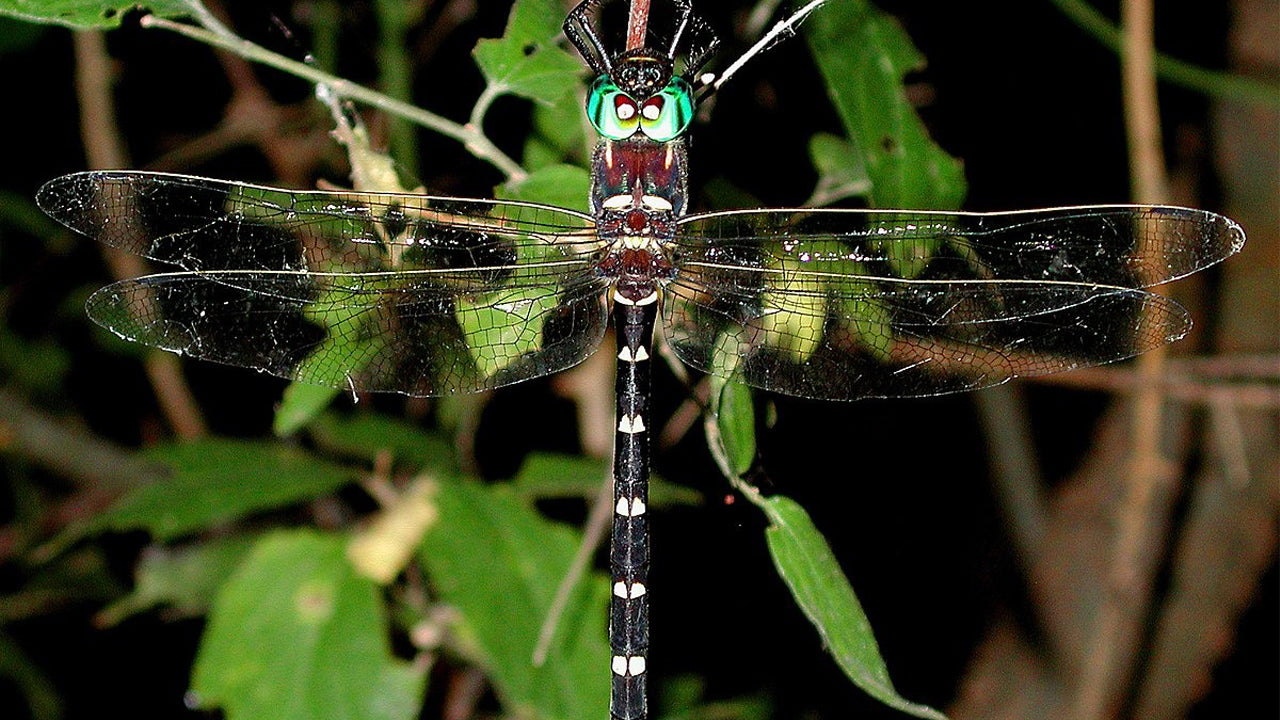
The Fiery Emperor (Anax immaculifrons), known in Sinhala as අග්නි රාජ බත්කූරා, is one of the most impressive dragonflies found in Sri Lanka. With a body length exceeding three inches, it ranks among the largest odonates on the island and belongs to the family Aeshnidae — a group of large, powerful fliers found across tropical and temperate regions worldwide. In Sri Lanka, however, this species has a notably restricted range, making encounters with it a genuine highlight for naturalists visiting the highlands.
Where Does the Fiery Emperor Live in Sri Lanka?
Unlike many dragonfly species that tolerate a range of water bodies, the Fiery Emperor is closely tied to fast-moving highland streams and rivers. It favors clear, well-oxygenated water at higher elevations, and its presence is generally considered an indicator of good water quality in montane habitats. Within Sri Lanka, the species is confined to the central highlands — the same upland landscapes associated with tea country, cloud forest, and national parks such as Horton Plains National Park.
Beyond Sri Lanka, the Fiery Emperor has a wide distribution spanning much of Asia and extending into parts of Europe, but its highland restriction on the island means it is not encountered in the lowland dry zone or along the coast.
What Does the Fiery Emperor Look Like?
Adult Fiery Emperors are large and robustly built, with a wingspan proportionate to their considerable body length. The abdomen typically displays a pattern of blue and black banding in males, while females tend toward greener or more brownish tones. The thorax is strongly muscled, reflecting the species' capacity for sustained, fast flight. Like all members of the Aeshnidae family, the Fiery Emperor has very large compound eyes that meet at the top of the head, giving it excellent all-round vision — an adaptation essential for aerial pursuit of prey.
How Does the Fiery Emperor Behave?
This is a highly active species. During daylight hours, the Fiery Emperor is almost continuously on the wing, patrolling territories along stream margins and over open water. Resting individuals are rarely observed; when they do perch, they typically hang from vegetation in a vertical position in shaded areas near water. Their flight is strong and direct, and they are capable of sustained aerial hunting, taking smaller insects on the wing.
Territorial males will repeatedly patrol the same stretch of stream, occasionally engaging in aerial disputes with rival males. Observers are most likely to spot the species in the late morning and early afternoon when temperatures are warmest and activity peaks.
How Does the Fiery Emperor Reproduce?
Reproduction in the Fiery Emperor follows a pattern distinctive to the Aeshnidae family. Rather than depositing eggs on the surface of the water or onto rocks, females use a spine-like ovipositor to insert eggs directly into the tissues of submerged aquatic plants. This endophytic egg-laying strategy offers the eggs some protection from both desiccation and predation.
During oviposition, females can be observed perching on emergent or floating vegetation with the tip of the abdomen submerged, carefully working the ovipositor into plant stems or leaves just below the waterline. Males may guard nearby during this process. The aquatic larvae that hatch are predatory, feeding on invertebrates and small aquatic organisms in the stream substrate before eventually emerging as adults.
When and Where Is the Best Time to See the Fiery Emperor?
The Fiery Emperor is most reliably encountered during the warmer, drier months when highland streams are at lower levels and adult dragonflies are most active. Midday visits to clear, rocky montane streams in the central highlands offer the best chance of observation. Locations within and around protected areas in the hill country — particularly those with intact riparian vegetation — are productive sites.
- Look along clear, fast-flowing streams between roughly 1,000 and 2,000 metres elevation.
- Visit between late morning and early afternoon for peak flight activity.
- Scan open water surfaces and stream margins where males patrol territories.
- Watch for females hovering low over emergent vegetation during egg-laying.
The Sinharaja Forest Reserve and surrounding hill-country habitats support a rich diversity of odonates, and a visit to these areas can yield multiple dragonfly species alongside the Fiery Emperor.
What Is the Conservation Status of the Fiery Emperor?
Globally, the Fiery Emperor is not considered threatened, given its broad distribution across Asia and parts of Europe. Within Sri Lanka, however, its restriction to highland habitats makes local populations potentially vulnerable to land-use change, water extraction, and degradation of stream quality. The health of montane watersheds — influenced by factors such as plantation management, erosion, and agricultural runoff — directly affects the availability of suitable habitat for this and many other highland stream species.
Documenting sightings through citizen science platforms contributes meaningfully to understanding the species' local distribution and population trends over time.
How to Identify the Fiery Emperor Compared to Other Sri Lankan Dragonflies?
Sri Lanka hosts a diverse odonate fauna, and several large dragonfly species can be found in highland areas. The Fiery Emperor can be distinguished by a combination of its exceptional size, the characteristic large fused eyes of the Aeshnidae, and its preference for fast-moving highland streams rather than still or slow-moving water. Its almost constant flight during the day, rarely pausing to rest in exposed positions, also sets it apart from many percher-type dragonflies that are commonly seen resting on rocks or vegetation.
| Feature | Fiery Emperor | Typical Percher Dragonflies |
|---|---|---|
| Body length | Over 3 inches | Variable, often smaller |
| Flight habit | Almost continuously airborne | Frequently perches in open sun |
| Habitat preference | Highland streams and rivers | Ponds, tanks, slow streams |
| Egg-laying method | Inside plant tissue (endophytic) | Often on water surface or mud |
| Eye structure | Large, fully meeting at top of head | Separated or partially meeting |