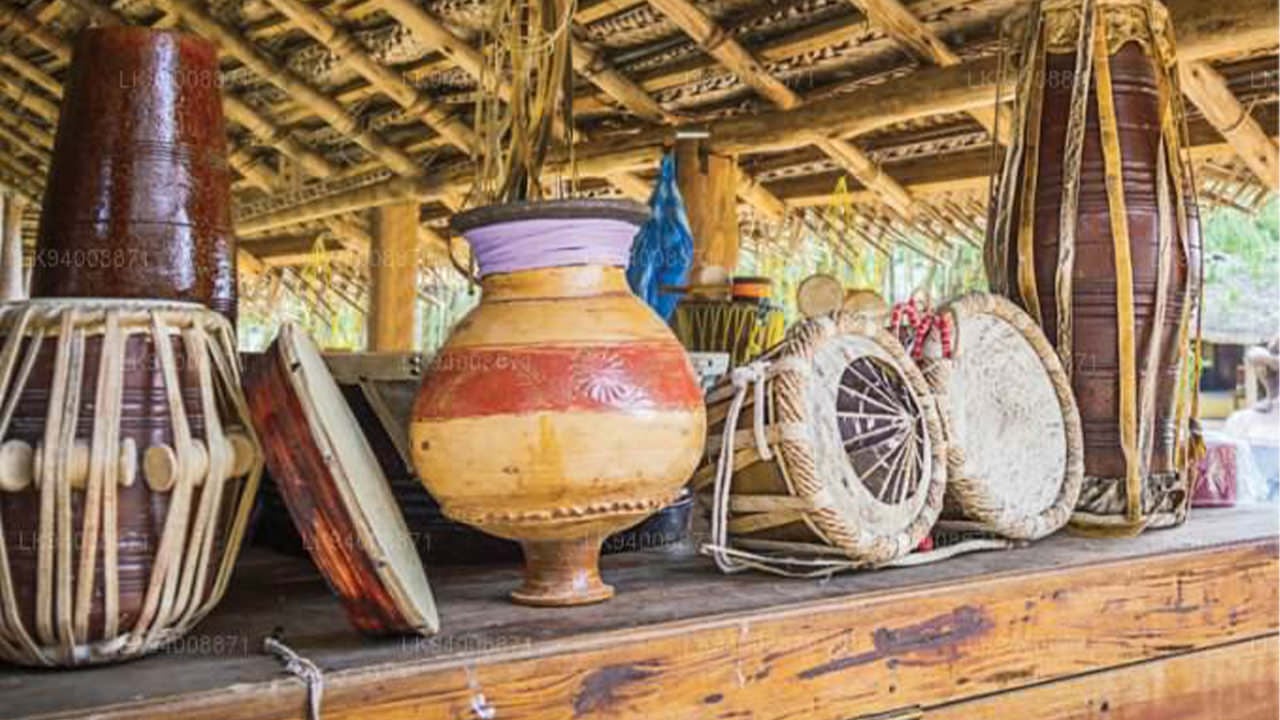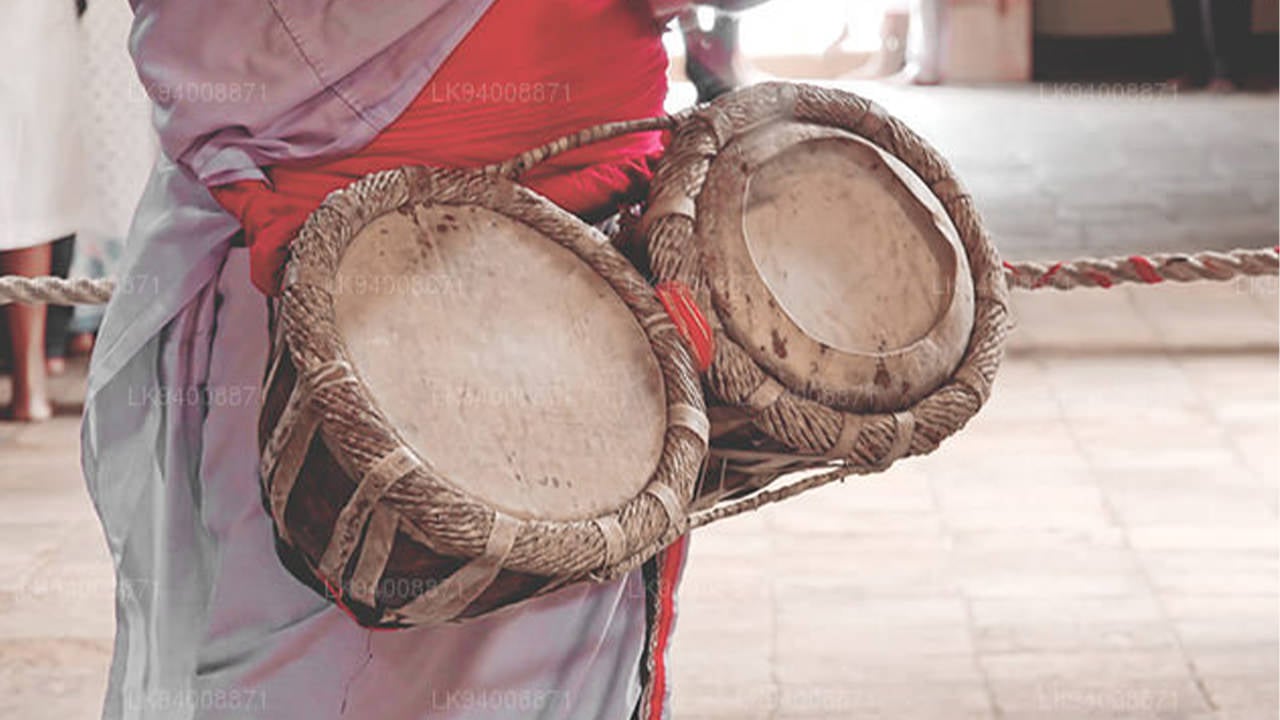
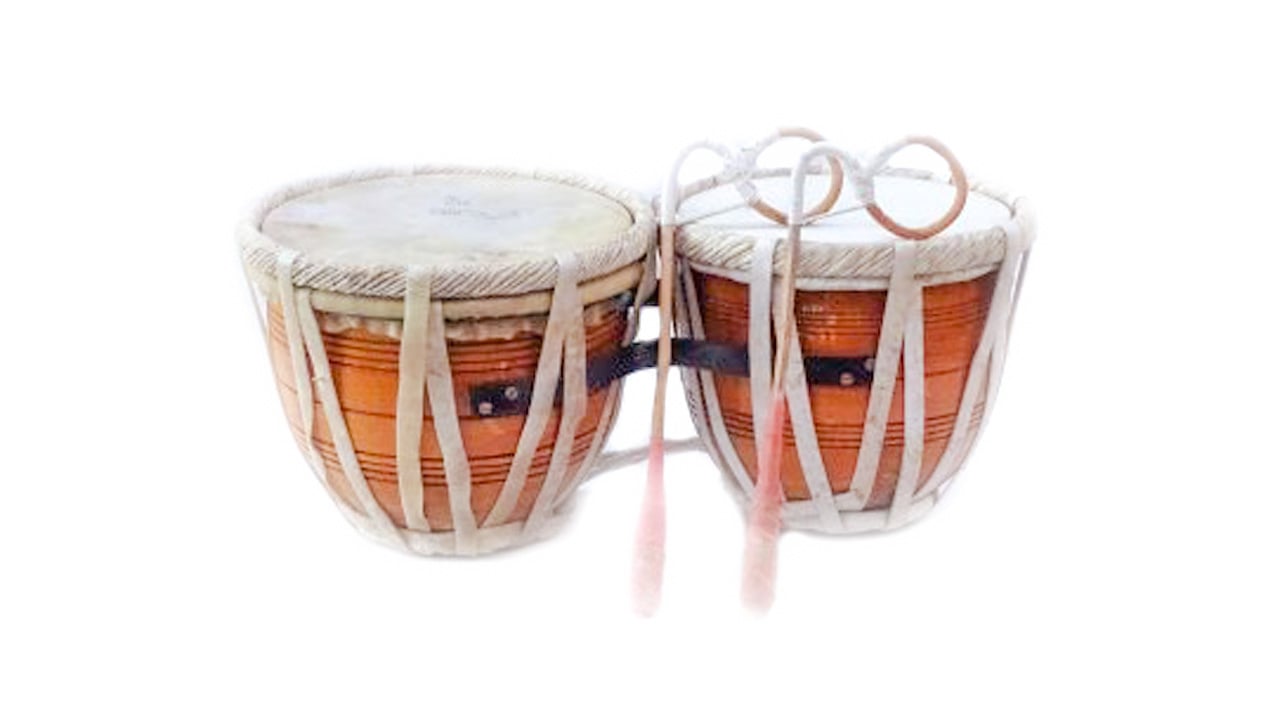
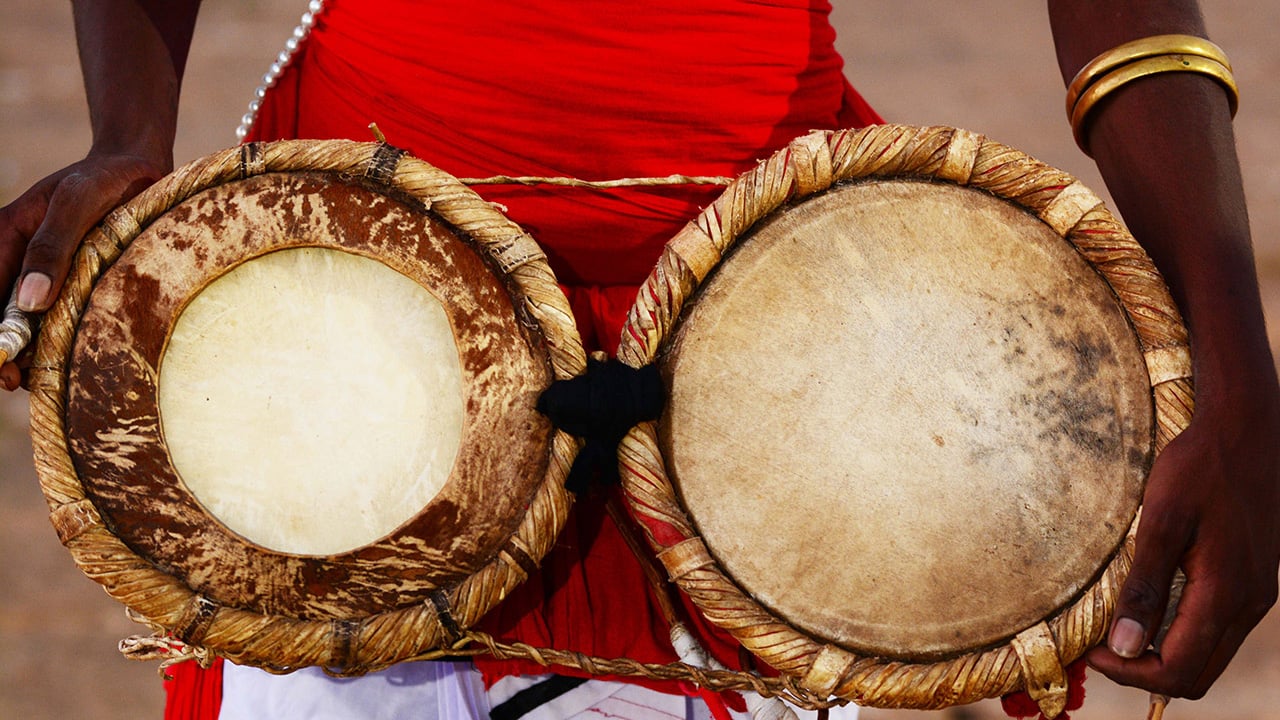


The Thammattama is one of Sri Lanka's most distinctive traditional percussion instruments — a double drum whose two halves produce contrasting tones and together carry the rhythmic heartbeat of Buddhist ceremony. While many of the dozens of drum types documented in ancient Sinhala literature have disappeared from living practice, the Thammattama endures, heard at temple rituals, Pirith recitations, and alms-giving ceremonies across the island.
What is the Thammattama and how does it work?
The Thammattama consists of two connected barrel drums played simultaneously. The right drum produces higher-pitched tones; the left produces lower, deeper sounds. A player strikes both with a pair of rounded sticks — traditionally carved from Kaduru wood — and rarely applies equal pressure to each side. The interplay between the two pitches gives the instrument its characteristic richness and allows drummers to execute rhythmic patterns impossible on a single drum.
Unlike many percussion instruments that exist simply to mark time, the Thammattama carries specific ritual meanings. Distinct rhythmic patterns are played to invite devotees into a temple, to summon Buddhist monks for a Pirith ceremony, or to signal the beginning of an alms-giving. Each rhythm is, in effect, a message the congregation understands without words.
What materials are used to make a Thammattama?
The bodies of Thammattama drums are turned from the timber of three specific trees: Kohomba (Azadirachta indica, neem), Ehela (Cassia fistula, golden shower), and Jak (Artocarpus heterophyllus). Each wood brings a slightly different resonance, and craftsmen choose according to availability and the intended tonal character of the instrument.
The playing surfaces are covered with animal skins, selected according to the pitch and tension required. The beater sticks, as noted, come from Kaduru — a dense, flexible timber that gives the player precise control. Even today, no synthetic materials have replaced these traditional choices in quality instruments; the acoustic results depend on the specific combination of wood grain, skin thickness, and stick hardness.
Historically, making a drum was not a purely commercial act. Craftsmen traditionally observed a small ceremony before beginning work — an acknowledgement that the instrument would serve a sacred purpose. While such customs are less consistently observed in modern workshops, the finest drum-makers still treat the process with care, and instruments made several generations ago are sometimes still in use in family collections and temple ensembles.
How old is the tradition of Sri Lankan drumming?
References to drums appear throughout Sri Lanka's classical literature, including the Pujawaliya, Thupawansaya, and Dalada Siritha. These texts collectively name around thirty-three distinct drum varieties. Today, only approximately ten types remain in active use; the rest survive only as names in manuscripts — a reminder of how much living knowledge depends on unbroken chains of practice.
The Thammattama, along with the Dawula and Udekki, is thought to have origins elsewhere in Asia, arriving in Sri Lanka through centuries of cultural contact across the Indian Ocean. However, prolonged local use has transformed these instruments into something distinctly Sri Lankan. The shapes have evolved, the woods and skins are all sourced locally, and the rhythmic vocabulary played on them exists nowhere else. Origin and identity, in this case, are different things.
During the era of the Sinhala kings, drumming was a profession of social standing. Royal courts and Buddhist temples employed permanent drummers, and villages were sometimes granted to skilled practitioners as payment for their service — a recognition that ritual music was not incidental to Buddhist and royal life, but essential to it. You can trace some of this history through the remains of ancient ceremonial culture in places such as Polonnaruwa, where the relationship between royal patronage and religious practice is still visible in the architecture.
Where is the Thammattama heard today?
The Thammattama is primarily a temple instrument. It is heard at:
- Pirith ceremonies — overnight or multi-day chanting events at which monks recite protective Buddhist texts, and the drum marks key transitions in the ritual
- Alms-giving (Daane) events — where drumming signals the start of the offering to the Sangha
- Temple entry invitations — specific rhythms played to call worshippers to worship at designated times
- Perahera processions — large ceremonial parades, most famously the Esala Perahera Festival in Kandy, where multiple drum ensembles accompany the procession of the Sacred Tooth Relic
Outside strictly religious contexts, the Thammattama also appears in cultural performance settings and in the curricula of traditional music schools, where young Sri Lankans learn the instrument's classical rhythmic patterns.
How does the Thammattama relate to other Sri Lankan drums?
Sri Lankan percussion divides broadly into drums played by hand and those played with sticks. The Thammattama falls in the stick-played category, alongside the Dawula — a larger, single-headed bass drum often paired with wind instruments in procession — and the Geta Beraya, which is the principal drum of the Kandyan dance tradition. The Udekki, by contrast, is an hourglass-shaped tension drum played by hand and associated with certain ritual and folk-dance forms.
Each drum occupies a specific ceremonial and musical niche. They are rarely interchangeable: a Thammattama rhythm cannot simply be transferred to a Dawula and retain its meaning. This specificity is part of what makes Sri Lanka's traditional drum culture so layered and, for outsiders, so worth understanding before attending a ceremony.
What should visitors know about experiencing traditional drumming in Sri Lanka?
Travellers interested in traditional drumming have several practical options. Temple festivals, particularly around the Kandy region and along the Cultural Triangle, frequently feature live drumming in authentic ceremonial contexts. Attending a Pirith ceremony at a local temple — with the permission and awareness of the monks — is one of the quietest and most sincere ways to hear the Thammattama in its intended setting.
Cultural centres in Kandy also offer introductory demonstrations of traditional instruments, and some village-based cultural experiences include short workshops. For orientation before a visit, the Kandy Tourist Information Center can point travellers toward upcoming festivals and events where drumming forms part of the programme.
If you are attending the Esala Perahera, plan well in advance: the procession runs across several nights in July or August and draws large crowds. Positions close to the route give the clearest view — and the clearest sound — of the full drum ensemble.
Is the tradition of making Thammattama drums at risk?
Like many craft traditions tied to ceremonial life, Thammattama-making faces quiet pressure from changing economics. The number of craftsmen with deep knowledge of the traditional process — selecting the right timber, treating the skins correctly, calibrating the tension — is smaller than it was a generation ago. Commercial demand for cheaper, mass-produced instruments has shifted part of the market.
At the same time, renewed interest in Sinhala cultural heritage, supported by music schools, the Department of Cultural Affairs, and individual master craftsmen, is working to document and transmit these techniques to younger practitioners. Instruments made by skilled craftsmen today, using traditional methods, remain objects of real acoustic quality and cultural depth — sought by serious performers rather than simply as decorative pieces.