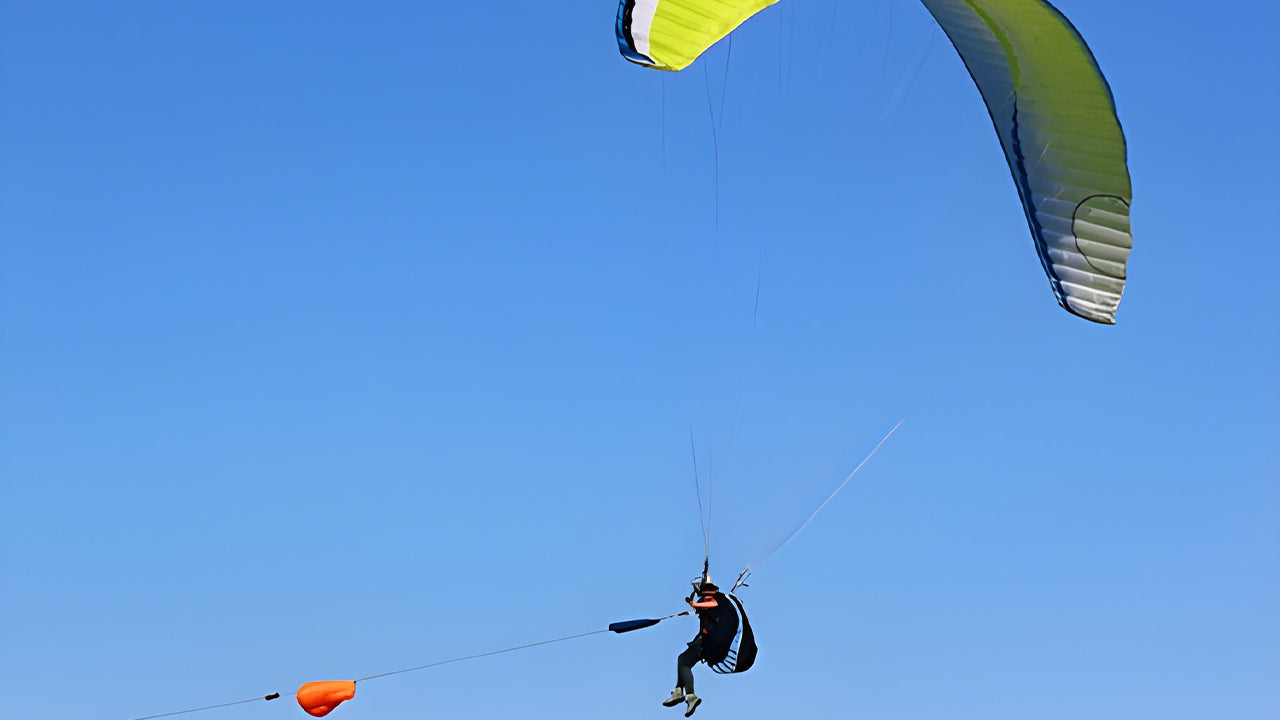
Paragliding is one of the most accessible forms of free flight: a lightweight fabric wing, a harness, and the right conditions are all it takes to soar hundreds of metres above the landscape. In Sri Lanka, the sport has found a natural home among the island's hills, ridges, and valleys, offering pilots and first-timers alike a perspective on the terrain that no road or trail can match.
How does paragliding work?
A paraglider consists of an inflatable fabric canopy — sometimes called a parafoil — connected to a harness by a network of suspension lines. The pilot sits in the harness beneath the wing; in more advanced setups, they lie in a streamlined pod to reduce drag. The wing's shape is maintained by air pressure entering vents at its leading edge and by the aerodynamic forces generated as it moves through the air. There is no engine involved.
Three natural phenomena keep a paraglider aloft: ridge lift (air deflected upward by a slope or cliff face), thermals (columns of warm air rising from sun-heated ground), and wave lift (standing waves of air on the lee side of ridges). By reading and exploiting these conditions, an experienced pilot can stay airborne for several hours and cover significant distances. For most recreational flights, however, a duration of 20 to 45 minutes is typical, and the focus is on the view rather than the distance covered.
Where can you paraglide in Sri Lanka?
Sri Lanka's topography — a central mountain massif dropping sharply to coastal plains — creates reliable ridge lift and thermal activity across several regions. The following sites are the most established for tandem and solo flights.
- Sigiriya: The flat plains surrounding the famous rock fortress produce strong thermals on clear mornings, and the aerial view of the fortress itself is genuinely remarkable. Tandem flights from the Sigiriya area suit first-time fliers who want a memorable backdrop.
- Kurunegala: The rocky outcrops and gently rolling hills around Kurunegala provide dependable lift conditions. The site is well-suited to both tandem introductory flights and, for licensed pilots, solo cross-country runs.
- Ella and the hill country: The escarpments around Ella and the broader central highlands offer some of the most dramatic elevation changes in Sri Lanka, making them attractive to experienced pilots. Wind conditions here are more variable, so flights are weather-dependent.
- Horton Plains plateau: The high-altitude grasslands near Horton Plains generate orographic lift along their windward edges. Access and permissions for flying here require prior arrangement.
When is the best time to paraglide in Sri Lanka?
Sri Lanka's two monsoon systems divide the island into distinct flying seasons. The southwest monsoon (roughly May to September) brings strong, unpredictable winds to the western and southern coasts and the hill country, making those areas unsuitable for paragliding during that period. The dry season for the west and central regions — broadly November through April — tends to offer the most consistent thermals and calmer upper winds.
For sites in the north and east of the island, the pattern reverses: the northeast monsoon affects those areas from about October to January, while February through August is generally the better window. Sigiriya and Kurunegala, lying in the dry zone, are flyable across a longer season, though early mornings on clear days in the cooler months (December to March) typically produce the best lift and visibility.
What should a first-time paraglider expect?
The vast majority of visitors experience paragliding in Sri Lanka as a tandem flight, sitting in a harness in front of a licensed instructor who controls the wing. The pre-flight briefing covers how to run during launch (a short, brisk walk into the wind as the wing rises overhead) and how to land safely. Flights typically last between 15 and 40 minutes depending on conditions.
There are a few practical points to bear in mind:
- Weight and health restrictions apply — operators set their own limits, but participants with serious heart conditions, recent injuries, or who are pregnant should not fly.
- Wear closed, flat-soled footwear and avoid loose items that could snag the lines.
- Cameras and phones should be secured; a small chest mount or wrist strap is worth arranging in advance.
- Flights can be postponed on the day if wind conditions are unsafe. Reputable operators will not fly in unsuitable weather.
How does paragliding differ from hot-air ballooning?
Both activities offer an aerial view of Sri Lanka's landscape, but the experience is quite different. Hot-air ballooning is passive — you drift with the wind at the mercy of the balloon envelope and the direction of the breeze — while paragliding is actively piloted, with the instructor steering the wing through turns and controlling altitude throughout the flight. Paragliding also launches from hillsides rather than flat ground, which in Sri Lanka means the take-off itself is part of the spectacle.
A short history of the sport
The technical foundation of paragliding was laid in the 1960s when NASA engineer Domina Jalbert developed the ram-air parafoil — a rectangular canopy divided into cells that inflate with forward motion and hold their shape without a rigid frame. The design found early use in parachuting, but it was not until 1978, when three friends descended a mountainside in the French Alps using modified parachutes, that foot-launched gliding captured broader attention. During the 1980s, dedicated paraglider designs spread across Europe, and by the 1990s the sport had established formal competition structures and licensing bodies in dozens of countries. Today paragliding is practiced worldwide, with Sri Lanka developing steadily as a destination for both introductory tandem flights and more advanced cross-country flying.
Is paragliding safe?
Like all aviation activities, paragliding carries inherent risk, and safety depends heavily on pilot training, equipment maintenance, and sound judgment about weather. Tandem flights with a licensed instructor reduce passenger risk significantly — the instructor handles all decisions about whether conditions are safe to fly. When booking, verify that your operator holds the relevant local permits and that pilots are certified through a recognised paragliding or aviation authority. Reputable operators in Sri Lanka will carry liability insurance and conduct a thorough pre-flight check before every flight.
Related reading
2 pages on closely related subjects.