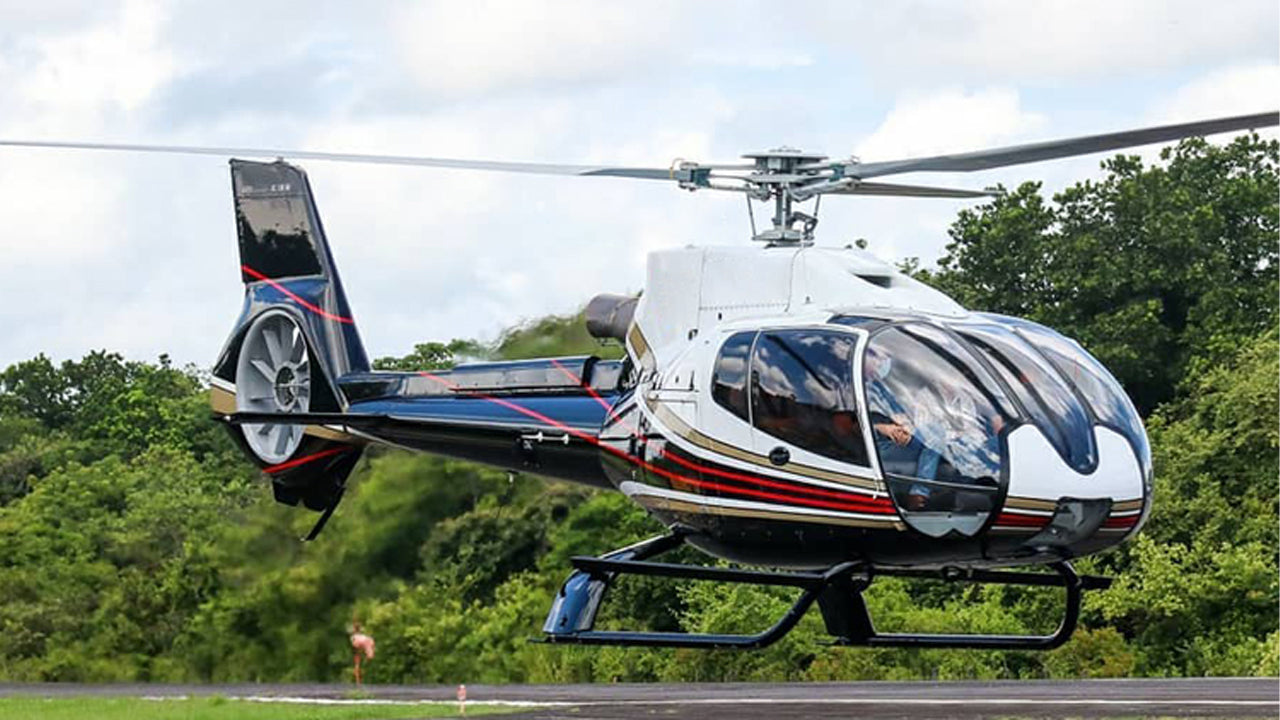
A road journey that takes five hours can become a twenty-minute flight above tea estates, national parks, and coastline. Air transfers in Sri Lanka — by helicopter or light aircraft — are the most time-efficient way to move between the island's major tourist regions, and they turn the journey itself into part of the experience. Lakpura operates and coordinates air transfers across a network of domestic airports and helipads, connecting visitors to destinations that would otherwise consume a full day of driving.
What types of air transfer are available in Sri Lanka?
Two main options cover most traveller needs: helicopter transfers and fixed-wing airplane transfers.
- Helicopter transfers offer point-to-point flexibility, can land at helipads close to resorts or landmarks, and seat four to five passengers comfortably. They are well suited to short hops — Colombo to Sigiriya, for example, or the south coast to Kandy.
- Light aircraft transfers operate on scheduled and chartered routes between domestic airports. Ratmalana Airport near Colombo serves as the principal hub, with scheduled connections to Koggala (for Galle and the south), Batticaloa (for the east coast), Ampara, Weerawila (for Yala), and Sigiriya Airfield (for the Cultural Triangle).
- Scenic charters are available for travellers who want a dedicated sightseeing flight — a loop over Sigiriya, a coastal sweep above Hikkaduwa, or an aerial perspective of the Hill Country — without a specific destination transfer.
All three formats are available through Lakpura as standalone bookings or as components within a broader itinerary.
Which routes are most popular for air transfers?
The busiest corridors reflect the classic Sri Lanka tourist circuit. Colombo or Negombo to Sigiriya is the single most requested route: it cuts a four-plus-hour road journey to roughly twenty minutes and deposits passengers within reach of Sigiriya Rock Fortress and the wider Cultural Triangle. The Colombo-to-Galle route via Koggala Airport is equally popular among guests heading to the south coast who prefer not to spend their first afternoon in a vehicle.
Other well-travelled routes include:
- Ratmalana to Weerawila — gateway to Yala National Park and Udawalawe National Park
- Ratmalana to Batticaloa — for the east coast, Pasikuda, and Trincomalee-area itineraries
- Colombo to Kandy or Nuwara Eliya — overflying the tea-estate belt of the Central Highlands
- Sigiriya to Jaffna — covering the full length of the island in under an hour
What will you see from the air?
The aerial perspective changes completely depending on the route. Flights departing Colombo head over the coastal wetlands and lagoons of the Western Province before the terrain rises into the patchwork of rubber and coconut plantations of the low country. On routes toward the Cultural Triangle, the ancient reservoirs — wewas — that define the Dry Zone landscape become visible as vast, still mirrors in the scrub forest below.
Flights tracking the southern coast reveal the reef systems and long sandy bays between Bentota and Tangalle, as well as the mangrove channels of the Madu Ganga estuary near Balapitiya. Hill Country routes pass above the rolling contours of Ceylon tea estates, cloud forest ridges, and the distinctive red-roofed bungalows of colonial-era plantation districts. On clear days, the escarpment of Horton Plains is visible to the south.
Wildlife sightings from altitude are not guaranteed, but passengers on low-level helicopter runs over the Dry Zone parks have spotted elephant herds at water holes, and the boundary between forest and paddy field tells its own ecological story.
When is the best time to fly — visibility and weather?
Sri Lanka's dual monsoon system divides the year into distinct weather windows depending on the region.
| Period | Best visibility regions | Notes |
|---|---|---|
| December – April | West coast, South coast, Hill Country | Southwest monsoon absent; clear mornings ideal for flights |
| June – September | East coast, Cultural Triangle, North | Northeast monsoon absent; Trincomalee, Batticaloa routes excellent |
| May, October – November | Variable island-wide | Inter-monsoon periods; afternoon convective cloud common; morning slots preferred |
Helicopter operations are more sensitive to low cloud and crosswinds than fixed-wing aircraft, so morning departures are generally recommended year-round. All commercial air transfers are subject to Civil Aviation Authority of Sri Lanka (CAASL) safety standards, and operators will postpone or reroute flights when conditions do not meet requirements.
Which airports and airfields serve domestic air transfers?
Sri Lanka's domestic aviation infrastructure is more developed than many visitors expect. Key facilities include:
- Bandaranaike International Airport (CMB), Katunayake — international gateway; some helicopter charters originate here
- Ratmalana Airport (RML), Colombo South — primary hub for domestic fixed-wing transfers
- Koggala Airport (KCT) — southern terminus serving Galle and Mirissa
- Sigiriya Airfield (GIU) — Cultural Triangle hub, close to Dambulla and Polonnaruwa
- Weerawila Airport (WEW) — southern inland airport for Yala and Hambantota
- Batticaloa Airport (BTC) — east coast gateway
- Jaffna International Airport (JAF) — northern terminus with periodic domestic connections
How does an air transfer compare with road or rail travel?
For travellers on tighter itineraries, the comparison is straightforward. The overland journey from Colombo to Sigiriya typically takes between four and five hours depending on traffic through Kurunegala; the helicopter transfer covers the same distance in around twenty minutes. The drive from Colombo to Ella via the scenic train route is a half-day commitment; an air transfer reduces it to under an hour.
Road travel through Sri Lanka has its own pleasures — the train from Kandy to Ella is widely considered one of the world's great scenic rail journeys — but for guests arriving with limited time, or those connecting two distant points mid-itinerary, air transfer is the rational choice. It also removes the fatigue that accumulates across multiple long drives, which is a real consideration on itineraries that cover several provinces.
For shorter hops where road conditions are manageable, private driver transfers remain an economical alternative and allow stops en route.
What should you know before booking an air transfer?
- Luggage limits are strict on light aircraft and helicopters. Soft-sided bags are strongly preferred; most operators allow around 10–15 kg per passenger on fixed-wing routes and less on helicopters. Confirm the specific allowance when booking.
- Passenger weight affects helicopter loading. Operators may request passenger weights in advance for weight-and-balance calculations.
- Check-in times at domestic airports are shorter than at international terminals, but punctuality still matters — slots are limited and delays can cascade.
- Weather cancellations do occur. Have a road-transfer contingency in your itinerary for weather-sensitive routes, particularly during inter-monsoon periods.
- Photography is generally permitted from the cabin; some helicopter doors can be opened or removed for aerial photography on dedicated charters.
How do I book an air transfer through Lakpura?
Lakpura handles the full booking process — route selection, operator liaison, airport logistics, and ground transfers at each end. Air transfers can be booked as standalone services or integrated into a multi-day private itinerary. Because domestic flight seats are limited and popular routes fill quickly in peak season, early booking is advisable. Hot-air ballooning over Dambulla or Sigiriya is a complementary aerial experience worth considering alongside a transfer if your itinerary includes the Cultural Triangle.
Related reading
7 pages on closely related subjects.