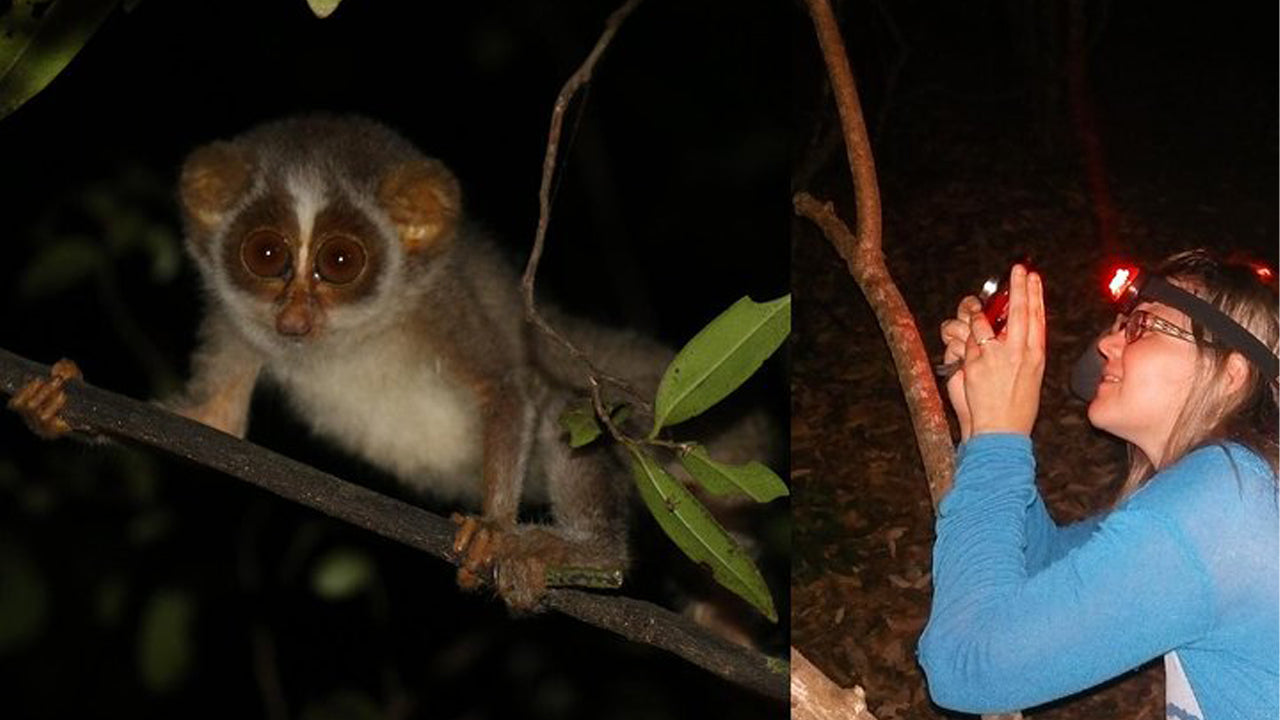
Sri Lanka occupies a tiny fraction of Asia's landmass, yet it supports a surprisingly rich primate community — one that has evolved in relative isolation for millions of years. Of the island's primate species and subspecies, every single one is endemic, and all are listed as endangered or critically endangered. That combination of exclusivity and conservation urgency makes Sri Lanka one of the most compelling destinations in Asia for serious primate watchers.
Which primate species can you see in Sri Lanka?
Sri Lanka is home to three main groups of primates, each occupying a distinct ecological niche.
- Toque macaque (Macaca sinica) — The island's most visible primate, distinguished by a neat whorl of hair on the crown of its head. Three subspecies are distributed across the dry zone, intermediate zone, and wet zone. They are highly social and often habituated to humans near temples and archaeological sites.
- Purple-faced langur (Semnopithecus vetulus) — A darker, more secretive leaf monkey found mainly in the wet zone lowlands and montane forests. Four subspecies occur across different elevation bands. They are considerably shyer than macaques and spend most of their time high in the forest canopy.
- Tufted gray langur (Semnopithecus priam thersites) — Found primarily in the dry zone, this pale, long-tailed langur is frequently spotted near ancient ruins and in scrub forest.
- Red slender loris (Loris tardigradus) — A nocturnal prosimian with enormous forward-facing eyes adapted for night vision. Two subspecies are known; both are rare and restricted to low-altitude wet zone forests. Spotting one requires a guided night walk in the right habitat.
Primates fall into two broad evolutionary divisions: the simians (monkeys, apes, and humans) and the prosimians (lorises, lemurs, and tarsiers). Sri Lanka's macaques and langurs are Old World simians, while the slender loris is a prosimian — a lineage that retains traits closer to the earliest primates.
Where are the best places to watch primates in Sri Lanka?
Location matters enormously. The right habitat for each species is determined by rainfall, elevation, and forest type.
Polonnaruwa
The ruined medieval capital is arguably the most accessible site for primate watching in the country. Toque macaques live in large, well-studied troops among the ancient monuments, and tufted gray langurs are a regular sight in the surrounding scrub forest. The Polonnaruwa area also hosts the Primate Research Center, which conducts long-term behavioural studies on the local macaque population. Guided walks are available, and the center has basic accommodation for those who want to spend more time observing troops across multiple days. The dry-zone forest here allows relatively open sightlines, making it much easier to follow animals than in dense wet-zone canopy.
Sinharaja Forest Reserve
The Sinharaja Forest Reserve, a UNESCO World Heritage Site in the southwestern lowlands, is the stronghold of the purple-faced langur's wet-zone subspecies. Sightings are less predictable than at Polonnaruwa — the dense canopy and steep terrain mean you hear animals before you see them — but an encounter with a langur troop in primary rainforest is a genuinely different experience. Loris sightings on night walks within or adjacent to Sinharaja have also been recorded.
Horton Plains and the central highlands
The montane subspecies of the purple-faced langur inhabits cloud forest edges at elevations above roughly 1,500 metres. Horton Plains National Park offers the most accessible montane primate experience, where langurs are occasionally seen feeding at forest margins in the early morning.
Wilpattu and the dry-zone national parks
Tufted gray langurs and dry-zone toque macaques are common throughout the northern dry zone. Wilpattu National Park's open villus (natural clearings) make it straightforward to observe both species without entering thick forest.
Temples and urban fringes
Toque macaques have adapted well to human-modified environments. They are a constant presence at pilgrimage sites such as Kataragama and Dambulla, where offerings and tourist snacks have conditioned them to associate people with food. While this proximity makes photography easy, feeding wild primates is strongly discouraged — it disrupts their natural foraging behaviour and can lead to aggressive interactions.
When is the best time to watch primates in Sri Lanka?
Unlike many wildlife categories, primates in Sri Lanka are present year-round and do not migrate. Activity peaks in the cooler morning hours between roughly 6 am and 9 am, when troops move through their home range foraging. The dry season (roughly May to September in the dry zone, December to March on the south and west coasts) generally offers easier forest access and better visibility through thinned-out vegetation. Rain is not a barrier to primate watching, but sustained downpours push animals into dense cover and make tracking harder.
How do guided primate watches work?
Reputable guided experiences fall into two broad formats. Day walks focus on macaques and langurs in accessible sites like Polonnaruwa or Sinharaja edges; a knowledgeable guide will read vocalisation patterns and movement cues to locate troops efficiently. Night walks — primarily aimed at slender lorises — operate in suitable wet-zone forest after dark, using low-intensity red-light torches to minimise disturbance to the animals. The loris is slow-moving and cryptic, and even experienced guides cannot guarantee a sighting, but success rates are meaningful in good habitat at the right season.
A guided night walk with loris watching from the Wilpattu area gives access to dry-zone forest habitat where the species has been recorded; Kitulgala provides an alternative base in the wet zone.
What do I need to know about primate conservation in Sri Lanka?
All of Sri Lanka's primate taxa are protected under national wildlife law, and trade or harassment of any species is illegal. The principal threat is habitat loss: as forest cover declines, primate populations become fragmented into isolated patches that cannot support genetically viable groups over the long term. Secondary pressures include electrocution on uninsulated power lines at forest edges and, in some areas, crop raiding that brings animals into conflict with farming communities.
The Primate Research Center at Polonnaruwa has contributed substantially to global knowledge of macaque behaviour and ecology. Volunteers with a background in biology or animal behaviour occasionally participate in data collection; enquire directly with the center for current programmes.
When visiting any site, maintain a distance of at least several metres from primates, never offer food, and follow your guide's instructions. Stressed or food-conditioned animals bite, and any interaction that causes an animal to act defensively is a sign to back off.
Practical tips for primate watching in Sri Lanka
- Wear muted, earthy colours — primates associate bright colours with alarm signals in some contexts.
- Keep noise to a minimum and move slowly; sudden movements cause troops to scatter into the canopy.
- Bring binoculars (8x42 or 10x42 are standard for forest work) — canopy animals are often 20–30 metres above ground.
- A camera with a long telephoto lens (at least 300mm equivalent) is useful for documentation without approaching too closely.
- For night walks, red-filtered torches are preferable to white-light headlamps, which can temporarily impair an animal's night vision.
- Arrange guides through established centres or licensed naturalists rather than informal operators, who may take groups too close to sensitive species.