

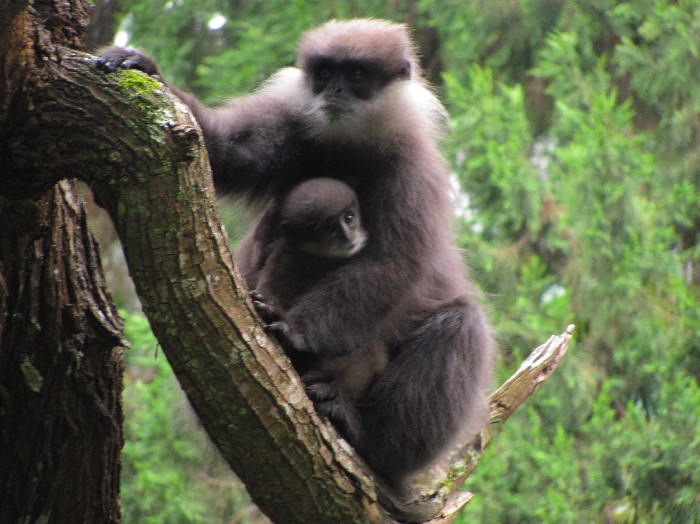
The Purple-faced Langur (Trachypithecus vetulus, also classified as Semnopithecus vetulus) is a leaf monkey found only in Sri Lanka, and it is the shyest of the island's three monkeys. Dark and retiring, it spends most of its life high in the trees, from the rainforests of the south-west to the misty hills of the central highlands. It is listed as Endangered, so every sighting is worth the effort.
How do you identify a Purple-faced Langur?
Despite the name, the face is not really purple. It is dark, with a paler lower part and a fringe of pale whiskers.
- Coat: mostly brown, with whitish to grey "trousers" on the legs and a white or whitish-grey rump.
- Hands and feet: purplish-black.
- Size: males measure 50 to 67 cm from head to rump, with a tail of 67 to 85 cm. Females are slightly smaller. Weight is typically about 3 to 11 kg, depending on the subspecies.
It is much darker than the silver-grey Gray Langur, and it lacks the cap of hair and the reddish coat of the Toque Macaque.
What are the subspecies of the Purple-faced Langur?
Four subspecies are recognised, and each lives in a different part of the island:
- Southern lowland wet zone (T. v. vetulus): the wet forests of the south-west.
- Northern lowland wet zone (T. v. nestor): the smallest subspecies, at about 4 to 6 kg. It lives in the most densely populated part of the country.
- Dry zone (T. v. philbricki): the largest subspecies, found in the forests of the northern and eastern lowlands, including around Polonnaruwa.
- Montane (T. v. monticola): the "Bear Monkey" of the high hills, with a long, thick coat suited to the cold.
What does the Purple-faced Langur eat?
The Purple-faced Langur is mostly a leaf eater, and it also takes fruit, flowers and seeds. In cultivated areas, fruit such as jak, rambutan, banana and mango can make up as much as half of its diet, which can bring it into conflict with growers.
How do Purple-faced Langurs live?
Groups are small and widely scattered, and most contain only one adult male. These langurs rarely come to the ground, and they are quieter and more retiring than macaques. They are most easily found by listening for movement in the canopy.
Where can you see Purple-faced Langurs in Sri Lanka?
- Sinharaja Forest Reserve: an important stronghold in the wet zone, where troops move through the rainforest canopy.
- Horton Plains National Park: the place to look for the Bear Monkey, often at the edges of the cloud forest in the early morning.
- Polonnaruwa: the dry-zone subspecies lives in the forests around the Monkey Kingdom, though it is seen less often than the other two monkeys.
- Knuckles Mountain Range: forest patches in the hills, usually with a local guide.
To plan a dedicated trip, see our guides to monkey watching and primate watching in Sri Lanka.
Why is the Purple-faced Langur endangered?
The IUCN Red List classes the species as Endangered. The main threat is the loss and fragmentation of its forest to farmland, grazing and roads. It is also poisoned to stop crop raiding and hunted for food and medicine. In towns and villages, langurs cross power lines and roads as they travel between patches of trees, and rope bridges have been suggested as one way to help them.
Tips for seeing a Purple-faced Langur
- Look up. Scan the canopy rather than the ground, and watch for moving branches.
- Hire a local guide. Groups are small and scattered, and a guide will know where they have been feeding.
- Go early. Mornings bring the most activity and the best chance of a clear view at the forest edge.
- Stay quiet and keep your distance. These are shy animals, and they will move away if disturbed. Never offer them food.
Related reading
3 pages on closely related subjects.

