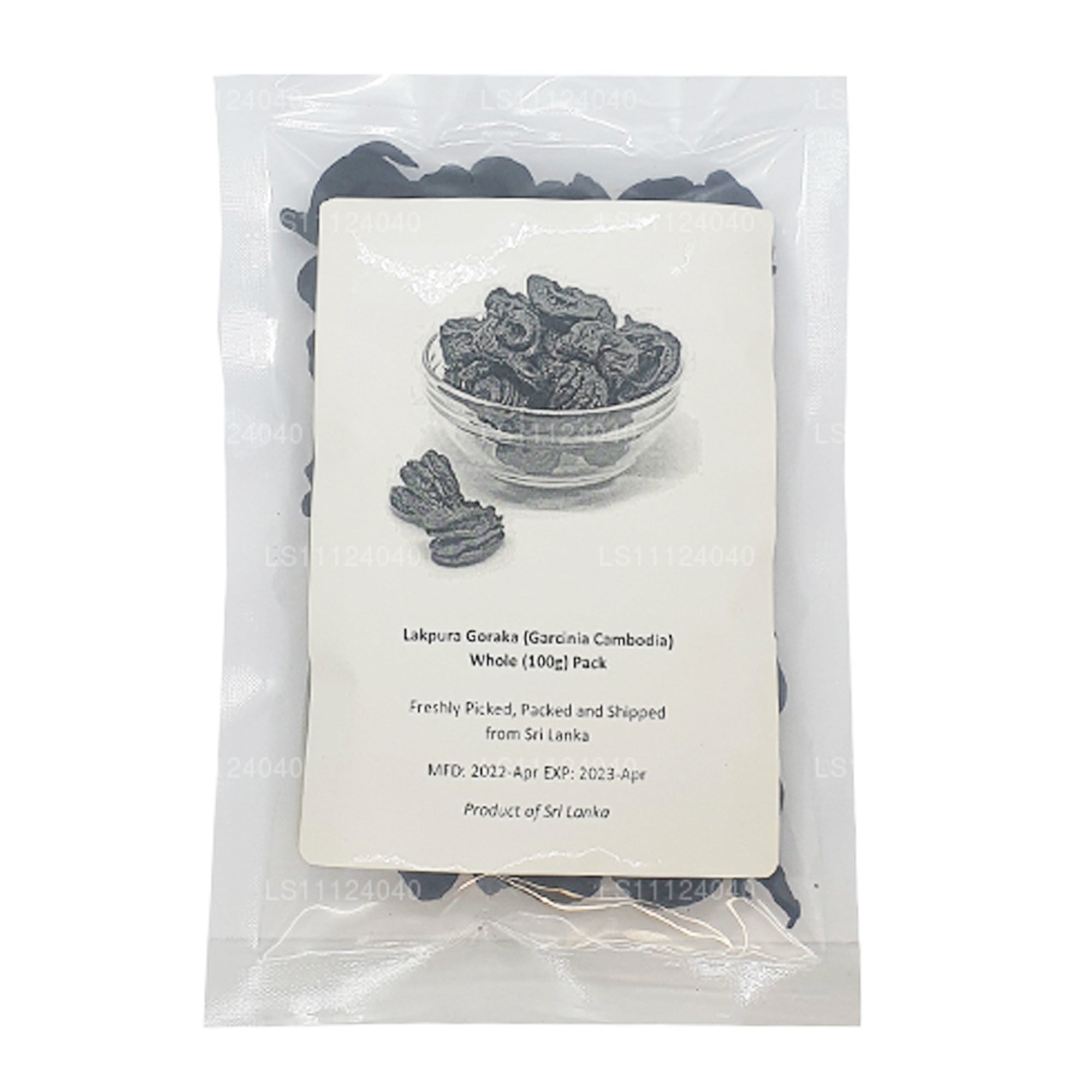
Goraka — known botanically as Garcinia morella — is one of the most distinctive ingredients in Sri Lankan cooking. Its deeply ridged, sun-dried rind lends a sharp, fruity acidity to fish curries and seafood dishes that neither lime nor tamarind can quite replicate. Beyond the kitchen, the fruit has a long history in Ayurvedic medicine and is increasingly studied for its bioactive compounds. Understanding Goraka means understanding a significant slice of Sri Lanka's culinary and botanical heritage.
What is Garcinia morella (Goraka)?
Goraka is a medium-sized evergreen tree native to the tropical rainforests of Sri Lanka and parts of South and Southeast Asia. It is shade-loving and relatively slow-growing, with horizontal or slightly drooping branches. The bark is blackish and rough, and when cut the tree exudes a characteristic dark-yellow latex — a botanical trait shared across the Garcinia genus.
The leaves are dark green, thick, and glossy, typically 5–13 cm long and 2–8 cm broad. Small white flowers appear from around February to April. The fruit that follows is yellow, purple, or red at full ripeness and is immediately recognisable by its 7–13 deep vertical grooves. The flesh ranges from mildly to distinctly acidic, surrounding six to eight seeds approximately 2.5 cm in length.
Several varieties of Goraka grow in Sri Lanka. Of these, the varieties locally described as "hot" and "cow" goraka are the ones used most widely in food preparation. A third variety — sometimes called "flower" goraka — is not used culinarily. A fourth, "country" goraka, is occasionally consumed as a fresh fruit.
How is Goraka harvested and preserved?
Young Goraka fruits are green and gradually turn yellow as they ripen. Once fully ripe, they are harvested, halved, and deseeded. The halves are sun-dried for a day, then smoked over a low fire until they turn dark brown to black. Before being stored, the dried rinds are rubbed with a mixture of salt and oil and packed into earthenware pots that are tightly sealed. Prepared this way, Goraka keeps for years without refrigeration — a practical quality that made it indispensable in Sri Lankan village kitchens long before modern food preservation existed.
Goraka is a relatively low-maintenance crop. The trees grow in home gardens and on smallholder plots with minimal inputs, making it accessible for rural households to produce for domestic use or local sale.
What are the culinary uses of Goraka?
The dried rind is too acidic to eat on its own. Its value lies in what it contributes to a dish: a rounded, fruity sourness that mellows and deepens during cooking. Across the Indian subcontinent it is variously known as Gambooge, Malabar Tamarind, and Fish Tamarind — all names that hint at its primary role as a souring agent used in place of lime or tamarind.
- Fish curries: Goraka is the defining souring ingredient in many Sri Lankan and South Indian fish curries. A piece or two of dried rind added early in cooking infuses the whole dish with characteristic tartness.
- Fish ambulthiyal: This slow-cooked dry fish preparation is arguably the most iconic use of Goraka. The combination of Goraka paste and black pepper creates a natural preservative environment; a well-made ambulthiyal keeps at room temperature for around seven days without refrigeration.
- Seafood preparation: Dried Goraka rinds are used with salt to wash and clean fish and seafood before cooking. Research suggests this treatment can reduce histamine levels in fish by around 80%, which is relevant for food safety as well as flavour.
- Preserves and fermented preparations: Goraka contributes to sourdough-style ferments and traditional pickled preparations (locally called jadi), where its acidity inhibits spoilage.
Because it is shelf-stable, dried Goraka is easy to keep in the pantry and can be used in small quantities — a few grams of rind is typically sufficient to sour a pot of curry for four to six people.
What are the medicinal properties of Goraka?
In Ayurveda, Garcinia morella is known as Vrikshamla. Classical Ayurvedic texts classify it as beneficial for the heart and describe sour-tasting substances as supportive of digestive fire (agni). Traditional Sinhala medicine has long used Goraka as a remedy for intestinal worms and hemorrhoids, and as a general digestive tonic.
Modern research has focused particularly on hydroxycitric acid (HCA), a compound found in significant concentrations in Garcinia species. Studies have examined HCA's potential role in:
- Appetite regulation and weight management
- Inhibition of fat synthesis
- Supporting healthy blood cholesterol levels
- Antioxidant activity linked to cellular protection
It is worth noting that while preliminary research is promising, clinical evidence for Goraka as a standalone weight-loss supplement in humans remains mixed. Anyone considering Goraka-based supplements for health purposes should consult a qualified healthcare professional.
The dried bark — distinct from the fruit rind — has also been used in traditional medicine, though this is a less common application than culinary use of the fruit.
How does Goraka differ from Garcinia cambogia?
Garcinia morella and Garcinia cambogia are closely related species within the same genus and are frequently confused — in Sri Lanka, both are commonly called "Goraka" in everyday speech. Garcinia cambogia (also called Garcinia gummi-gutta) is the species most extensively studied for HCA content and is the botanical source of many commercial weight-management supplements. Garcinia morella is the species more commonly used in traditional Sri Lankan cooking, though the two share many flavour and functional properties. Both species grow in Sri Lanka, and products sold under the Goraka name may derive from either.
Where does Goraka grow in Sri Lanka?
Goraka is found naturally in the island's tropical wet zone, particularly in the low-country and mid-country areas of the Sabaragamuwa, Southern, and Western provinces. It thrives in humid, shaded conditions — conditions that suit home gardens and forest margins across Sri Lanka's wetter regions. The tree is widely cultivated alongside other home-garden staples such as coconut, jak, and cinnamon, and requires no intensive management once established.
How is Goraka used beyond Sri Lanka?
Goraka and closely related Garcinia species are used as souring agents across South and Southeast Asian cuisines. In Kerala and Tamil Nadu, it is an essential ingredient in coastal fish curries. In Thailand, Indonesia, and Malaysia, related species serve similar culinary roles. The global dietary supplement industry has drawn significant attention to Garcinia extracts, which are now produced and exported at scale from Sri Lanka, India, and other producing countries.
Other species in this genus
5 more, sharing the same genus.
Related reading
3 pages on closely related subjects.