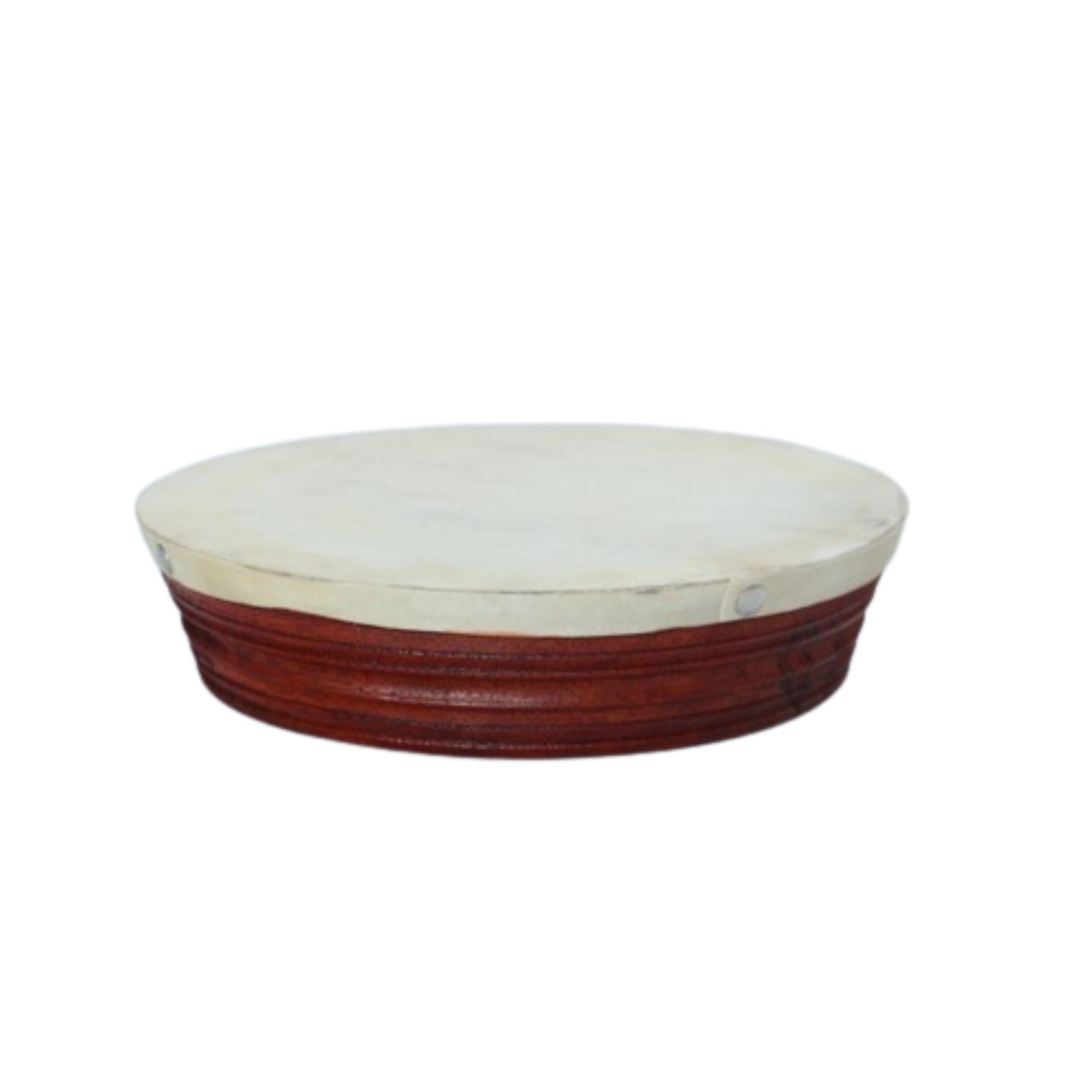
The raban (රබන්) is one of Sri Lanka's oldest percussion instruments and one of its most democratic — requiring no formal training to begin, belonging equally to child and elder, to highland village and coastal settlement. Its broad, open face and warm hand-struck resonance are inseparable from the sound of celebration across the island, most of all during the Sinhala and Tamil New Year each April. Understanding the raban means understanding something fundamental about how Sri Lankan culture marks joy and communal continuity.
What is the rabana and how is it made?
The rabana is a single-headed frame drum. Its circular wooden frame is carved from dense, workable hardwoods — traditionally Suriya, Margosa (neem), Jak, or Mara timber — chosen for both durability and the resonance they impart to the finished instrument. Goatskin, stretched tightly across the frame and secured at the edges, forms the playing surface. Frame diameters range from around 24 inches for the smallest personal instruments up to 48 inches for the largest communal versions.
No tuning pegs or mechanical fittings are used. The tension of the skin — and therefore the pitch — is managed entirely through heat, which is why fire plays a ritual as well as practical role before a session begins.
What are the two main types of rabana?
Two broad categories define the instrument's use in everyday and ceremonial life.
- Ath raban (hand rabana): The smaller, portable form. It is held on the lap or in one hand and struck with the other, making it practical for solo playing, teaching children, and informal music-making at home.
- Banku raban (bench rabana): The large communal drum that defines New Year celebrations. Banku is the Sinhala word for bench, and the instrument takes its name from the three wooden supports on which it rests at a height comfortable for players seated around it. The banku rabana is the centrepiece of village Aurudu gatherings and is the form most likely encountered by visitors.
How is the banku rabana played during the New Year?
Before the first rhythm is struck, the group leader traditionally lights a small fire beneath the banku rabana. The heat warms and tightens the goatskin, raising the pitch and improving resonance — a practical tuning method that doubles as a ritual opening to the session. Once the skin is ready, players — typically girls and women, though the tradition is not exclusive — sit in a circle around the drum on low benches or on their haunches and begin striking with both palms and fingers.
The basic rhythmic unit is called a sural. Patterns such as dontharikitatharikita serve as common entry surals, functioning as a warm-up and an open invitation for others to join. As confidence grows and the circle widens, the leader introduces a raban pada — a verse sung in call-and-response style. Raban playing competitions are a popular feature at New Year festivals and community cultural events throughout the country.
A related but distinct form worth knowing is the karakawana rabana, a spinning variant performed as part of specialised cultural demonstrations, and the raban natuma, a dance form choreographed to the drum's rhythms.
What are raban pada and raban kavi?
Raban pada (රබන් පද) are the lyric verses sung to the drum's rhythm. They cover an enormous range of subjects: daily village life, the beauty of the harvest season, playful teasing between neighbours, praise of the Buddha and kings, and the rituals of the Sinhala New Year. The phrase udin udin wara peththappu is one of the well-known opening lines that signals a session is under way.
The lyrics are often witty and improvisational, with experienced singers composing new verses on the spot in response to what a rival group has just sung. The term raban kavi emphasises the poetic quality of the words, while varam refers to specific traditional verses passed down intact through generations. In the Ruhunu (southern) tradition — particularly celebrated for the sophistication of its lyric composition — the raban sural and accompanying lyrics carry their own regional accent and phrasing, distinct from the styles of the Kandyan highlands or the low-country western coast.
What role does the rabana play in the Sinhala New Year?
No Aurudu celebration in a traditional Sri Lankan household or village is considered complete without the sound of the raban. The drum appears at every stage of the New Year sequence: during the nekath auspicious times, at the lighting of the hearth, during the oil-anointing ceremony, and throughout the Aurudu Kreeda — the sporting and cultural games that follow. Hearing that familiar opening rhythm drift across a neighbourhood on the morning of April 13 or 14 is, for many Sri Lankans, the clearest signal that the new year has truly arrived.
Beyond New Year, the instrument marks other moments of communal joy: perahera processions, weddings, and harvest thanksgivings. Its presence signals celebration and continuity rather than solemnity, which is why it occupies a different cultural register from the formal drums of ritual.
How does the rabana differ from other Sri Lankan drums?
Sri Lanka has a rich percussion heritage, and the raban occupies a distinct place within it. The comparison below outlines the key differences.
| Drum | Heads | Played with | Primary context |
|---|---|---|---|
| Raban | Single | Hands | Communal celebrations, New Year |
| Geta beraya | Double | Sticks | Kandyan dance, Buddhist ritual |
| Dawula | Single | Hands and stick | Low-country drumming ensembles |
| Tammattama | Paired kettles | Curved sticks | Kandyan ensembles |
Unlike the geta beraya — associated with Kandy's formal dance and Buddhist ritual — the raban requires no specialist training to begin. This accessibility is central to why the tradition has persisted as a community instrument rather than a purely professional one. Anyone can sit at the drum; mastery, of course, takes years.
Where can visitors experience rabana traditions in Sri Lanka?
The most immersive encounter with raban culture happens during the Sinhala New Year in April, when village-level celebrations across the island feature communal playing sessions open to bystanders. Cultural villages in the Kandy region and in the rural low country sometimes include raban demonstrations as part of their heritage programmes. Schools affiliated with Dhamma schools often maintain raban practice as part of cultural education, and public performances during the New Year period are common in both urban parks and rural commons.
For those interested in the literary dimension, collections of raban pada are published as Sinhala-language texts, preserving verses from regional traditions — the Ruhunu style of the Southern Province is particularly celebrated for the sophistication of its lyric composition.
Is the rabana tradition still actively practised today?
Yes, though its social texture has shifted. In urban settings the spontaneous neighbourhood banku raban session is less common than it once was, but formal competitions, school curricula, and cultural organisation programmes have given the tradition new institutional support. National arts councils periodically document regional styles, and recordings of raban pada from the Ruhunu tradition have been archived to preserve lyric variants at risk of being lost as older singers pass on. The instrument itself remains in active production, with craftspeople in several districts continuing to hand-carve frames and stretch skins using the same materials and methods used for centuries.
Related reading
3 pages on closely related subjects.