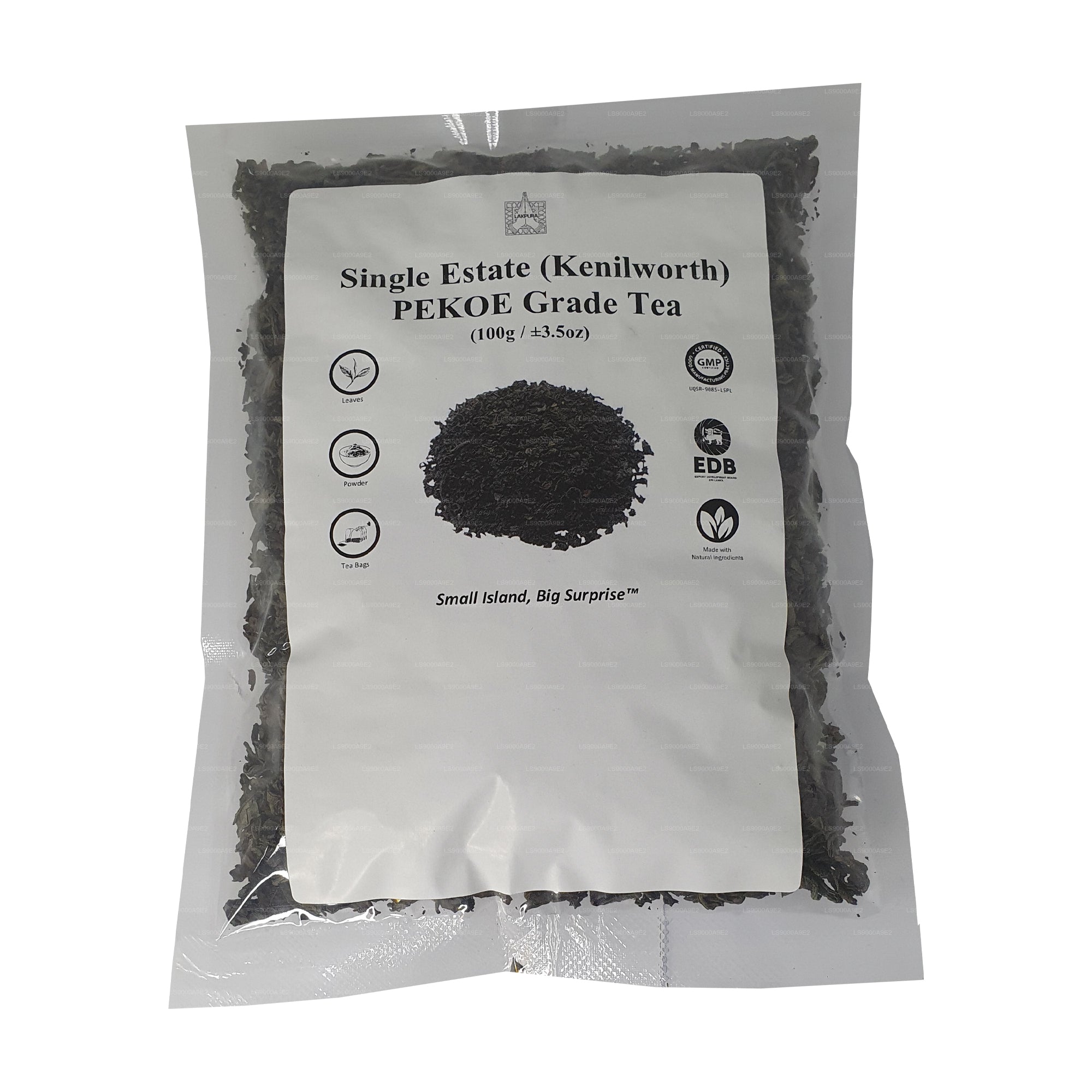
Perched at 1,385 metres on the western slopes of the Dimbula valley, Dessford Estate is one of the distinguished high-grown tea properties in Sri Lanka's central highlands. It sits within the Talawakelle/Lindula agro-climatic district, an area that receives between 192 and 205 wet days each year — a rainfall pattern that gives Dimbula teas their characteristic brisk, full-bodied character.
What makes Dessford Estate significant in Sri Lanka's tea industry?
Dessford spans a total extent of 433.99 hectares, of which 333.54 hectares are under active tea cultivation. The remaining land supports shade trees, windbreaks, and the infrastructure that sustains a resident workforce of around 811 people across four operational divisions. That scale places Dessford firmly in the upper tier of working estates in the Dimbula region.
The estate's annual production capacity exceeds 600,000 kilogrammes of western high-grown black tea — a grade recognised globally for its quality and traded actively on the Colombo Tea Auction. Ceylon Tea from this elevation is classified as "high grown" (above 1,200 metres), a designation that commands premium pricing on world markets.
Where exactly is Dessford Estate located?
Dessford lies on the western aspect of the Dimbula valley, administratively within the Talawakelle/Lindula tea district of the Nuwara Eliya District, Central Province. The western slopes of this valley benefit from the south-west monsoon more directly than estates on the leeward side, contributing to the high wet-day count that shapes the tea's growth cycle and flavour profile.
The nearest town of significance is Talawakelle, which sits on the main Colombo–Badulla railway line. Visitors travelling from Colombo can take the scenic hill-country train and alight at Talawakelle, making the estate accessible without a private vehicle, though a car or tuk-tuk is needed for the final approach up the estate roads.
What type of tea does Dessford Estate produce?
Dessford specialises in western high-grown black tea. At this altitude and latitude, the cooler temperatures slow leaf growth, concentrating the polyphenols and essential oils that produce a bright, coppery liquor with a clean, brisk finish. The estate's BOPSp (Broken Orange Pekoe Special) grade is among its more refined offerings — a small-particle grade that delivers a strong cup with good colour, well-suited to single-estate brewing.
Unlike blended teas, single-estate teas from Dessford carry the terroir of one specific hillside. Seasonal variation is noticeable: the quality months in Dimbula typically align with the dry inter-monsoon windows when slower growth concentrates flavour compounds in the leaf.
Can visitors tour Dessford Estate?
Dessford is a working commercial estate rather than a purpose-built tourist attraction, so access is generally arranged through a licensed tour operator or by prior appointment. A guided visit typically covers the plucking fields, a walkthrough of the factory floor where withering, rolling, oxidation, and drying take place, and a tasting session. Seeing the full processing cycle — from freshly plucked two-leaves-and-a-bud to finished orthodox tea — gives context that no tea shop visit can replicate.
The surrounding landscape also rewards exploration. The Dimbula valley offers panoramic ridgeline views, colonial-era bungalows, and proximity to other highland attractions. Horton Plains National Park, with its plateau grasslands and World's End escarpment, is reachable within roughly an hour's drive from the Talawakelle area.
How does the Dimbula agro-climatic district influence tea quality?
The Talawakelle/Lindula district, where Dessford sits, is one of seven recognised agro-climatic districts for Ceylon Tea under the Sri Lanka Tea Board's classification system. The high annual wet-day count — approaching 200 days in most years — ensures consistent moisture for the tea bushes, while the elevation keeps temperatures cool enough to slow cellular growth in the leaf. This combination is the foundation of the Dimbula "quality season" character: a bright, fragrant cup that differs markedly from the heavier, earthier teas produced in lower-elevation regions such as Ruhuna.
Soil composition on the western slopes tends to be well-drained laterite over granite parent rock, which prevents waterlogging despite the high rainfall and encourages healthy root development in mature bushes — some of which have been producing for over a century.
What is the workforce and social structure of Dessford Estate?
Dessford employs approximately 811 workers spread across its four divisions. The majority of estate workers in the Dimbula region are descendants of Tamil labourers brought to Sri Lanka's hill country by British planters in the nineteenth century. Estate communities are typically self-contained, with housing, schools, and medical facilities provided within the estate boundaries — a legacy of the plantation system that continues to shape social life in the central highlands today.
Understanding this history adds depth to any estate visit. The daily rhythm of plucking — which starts at dawn and follows precise quotas — has remained largely unchanged for generations, even as factory technology has modernised considerably.
How does Dessford compare to other Dimbula estates?
Dimbula is home to many well-regarded estates, including Bluefield, Kenilworth, and Shawlands, each producing teas with subtle variations in character depending on aspect, elevation, and factory methods. Dessford's output of over 600,000 kilogrammes annually places it among the larger producers in the district. Its BOPSp grade in particular has attracted consistent interest from specialty tea buyers who value traceable, single-origin teas from named estates. You can explore teas from comparable Dimbula and hill-country estates through Lakpura's single-estate range to compare flavour profiles side by side.
Nearby places
13 places within about 25 km, nearest first.
- Holyrood Estate2 km
- St Clairs Falls2 km
- Watawala Railway Station2 km
- Mlesna Tea Castle St Claire2 km
- Maha Eliya Estate (Calsay)2 km
- Queensberry Estate2 km
- Talawakelle City2 km
- Devon Falls2 km
- Talawakele Railway Station2 km
- Ihalawatawala railway station3 km
- High Forest Estate3 km
- Kotagala Railway Station4 km
- Weddemulle Estate4 km
Related reading
8 pages on closely related subjects.