This city tour takes you through four of Trincomalee's most significant sites in a single day, departing from and returning to Trincomalee Seaport. Trincomalee is one of Sri Lanka's oldest port cities, set on a large natural deep-water harbour on the northeastern coast that has drawn successive waves of traders and colonial powers across many centuries. The tour covers a Hindu temple of national importance, a colonial-era coastal fortress, a protected ancient Buddhist monastery, and a stretch of the town's open beach — a sequence that reflects the city's layered, multi-faith character.
The first stop is Koneswaram Temple, which stands on Swami Rock, a clifftop promontory where the land drops away sharply to the Indian Ocean below. The temple is dedicated to Lord Shiva and is counted among the five Pancha Ishwarams, the group of coastal Shiva temples held sacred across the island. Its earliest records reach back to the 6th century BCE, though an ancient shrine on the site was destroyed by the Portuguese in 1624 and the main shrine rebuilt, most recently restored in 1952. The architecture is Dravidian in style, with a gopuram marking the entrance and a large multi-armed statue of the deity on the rocky plinth at the compound. Koneswaram sits within the enclosure of Fort Frederick, so the two sites are visited in close succession.
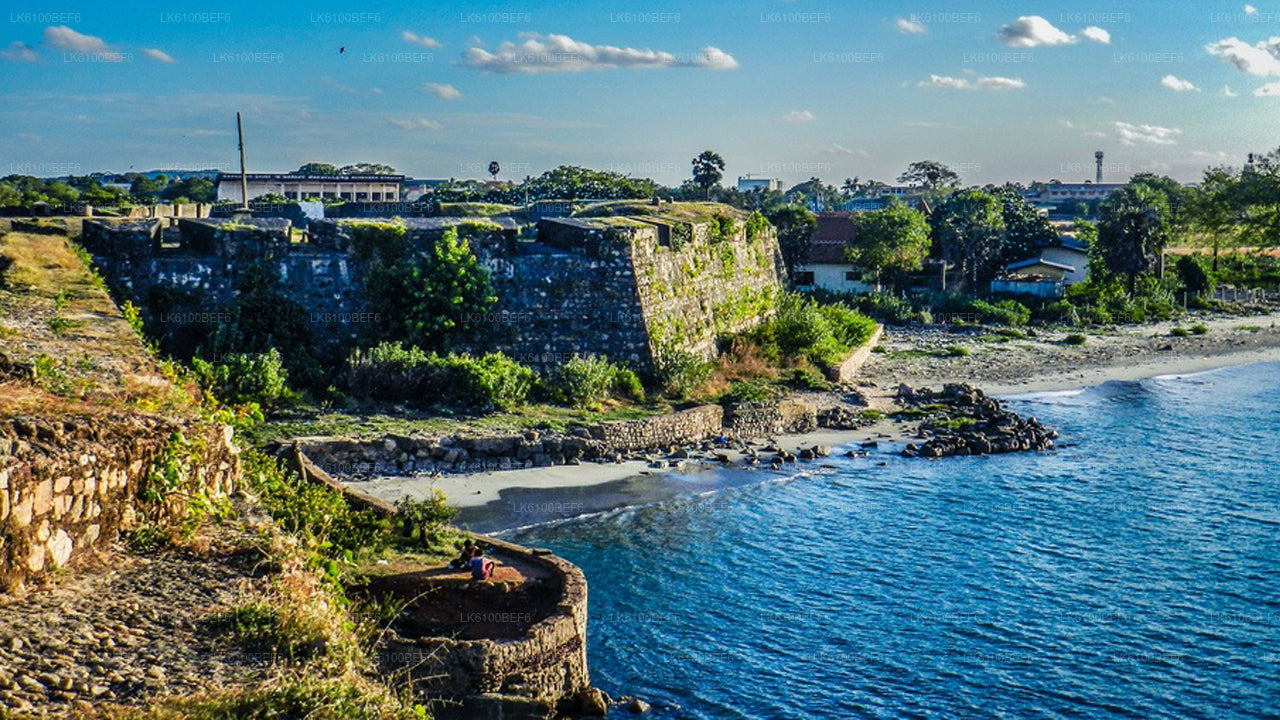
Fort Frederick occupies the same Swami Rock promontory. The Portuguese built the original fortification in the early seventeenth century using stone quarried partly from the demolished temple; a Dutch fleet took the fort in 1639 and rebuilt it, giving it the name that survives today in memory of Prince Frederick, Duke of York. The British held it from 1795 until 1948. The fort remains a working garrison of the Sri Lanka Army's Gajaba Regiment, so visitors have access to parts of the grounds rather than the entire complex — the thick angled bastions, curtain walls, and historic cannons on the ramparts are among the features that can be seen. Wild spotted deer move freely through the fort's interior.
Velgam Vehera, the third stop, is a Buddhist temple site in the Trincomalee District that has been declared an archaeological protected monument by the Sri Lanka Archaeological Department. Tradition holds that the monastery was founded during the reign of King Devanampiyathissa in the 3rd century BCE, and it received patronage from several subsequent rulers. What makes the site unusual is the evidence, in Tamil-language stone inscriptions found on site, of Tamil Buddhist worshippers contributing to its protection and upkeep — a detail that marks it as a place of cross-religious significance rather than a single-community heritage. The ruins consist of low brick platform walls, stepped foundations, paved areas, a stone image house, and a tall standing stone statue on a raised platform, all spread across an open, tree-shaded compound.
The tour concludes at Trincomalee Beach, where the coastline opens out to a broad sandy shore with calm turquoise water. The beaches around Trincomalee face east and tend to be at their calmest between April and September; colourful wooden fishing boats are often drawn up on the sand near the town. The return to the seaport follows in the afternoon. Throughout the day, transport is in an air-conditioned vehicle with an English-speaking chauffeur guide. Each person receives a litre of bottled mineral water. All taxes and service charges are covered. Entrance fees to sites, meals, drinks, gratuities, and personal expenses fall outside the arrangement, so it is worth carrying some cash for those.