

About Pilikuththuwa Raja Maha Viharaya
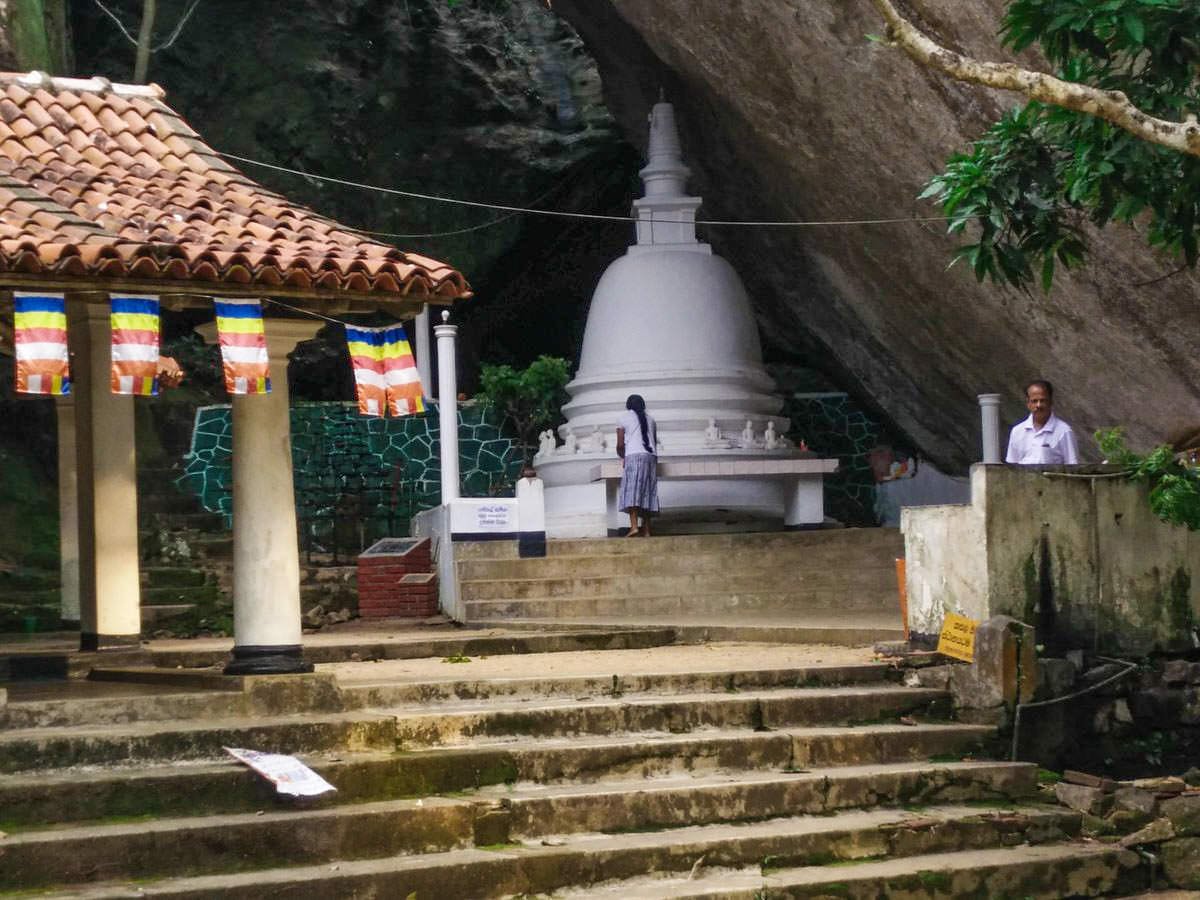
Pilikuththuwa is a cave temple in Sri Lanka with a millennia-long history. It saw great use from the 3rd century BC to the Dutch period in our recent past. The temple has almost a hundred caves spread over a space of approximately 200 acres. Amongst these 84 caves have been identified, fully explored and numbered. The cave temple is now a protected archaeological site in Sri Lanka.
Location
The temple is located in the region of Pilikuththuwa; just 30 miles from Colombo, in the Gampaha district. It can be reached by traveling to point just off Yakkala on the Colombo-Kandy highway. The temple itself on a rocky hill; while all around are beautiful paddy fields, rich stands of coconut cultivations, and dense green forests. As such, vibrant nature around the temple is host to a myriad of species. These include mammals such as the Ring-Tailed Civet, Palm Cat, Barking Deer and Sri Lankan Mongoose; bird species such as the Red Wattled Lapwing, Spotted Dove, Red-Vented Bulbul, Asian Koel, Small Bee-Eater, Magpie Robin, Hanging Parrot and Green Wood Pigeon; and a number of butterflies such as the Grey Pansy, Blue Bottle, Common Mormon, Blue Mormon, Common Sailor and White Four-ring; and a number of reptiles and amphibians.
History and Legend
Several legends and stories surround the Cave Temple of Pilikuththuwa. The main ones are regarding the odd name of the region. According to the most famous of these legends the name ‘Pilikuththuwa’ came from the era of King Valagamba from the 1st century BC. According to the story the King took refuge in one of the caves while fleeing the Indian Chola army who invaded his kingdom. It is believed that the King used these caves as a hideout while gathering his army. Later some of the caves were used by the King and Queen to store their royal garments. This apparently resulted in the area being called ‘Pili’ – Garments – ‘kuththuwa’.
Another story speaks of a more large scale matter. The area was supposed to have been divided in five divisions long ago; Pili Kotuwa, Arachchi Kotuwa, Mal Kotuwa, Halpath Kotuwa and Biligaha Kotuwa. However, with time the divisions combined to a single large region and the other four names disappeared; only the name Pili Kotuwa remained. This name then got changed with the accents of the millions who went on to live and pass through this space, until it became ‘Pilikuththuwa’.
It is said that the monastic presence in the caves began many centuries before Christ; when King Devanampiyatissa dedicated the cave complex to the Buddhist Sangha (sect). The monks built a large temple adjoining the cave and lived within many of them. It is said that the caves were also a refuge when King Rajasingha I, who ruled Sitawaka, persecuted Buddhist monks in the 16th century due to his Anti-Buddhist views. In addition, there are signs of Portuguese, Dutch and British influence within the caves as well.
The Caves
During the Stone Age the caves of Pilikuththuwa were used as living space by the civilizations of the time as has been proved by artifacts found in some of the cave
Nearby places
12 places within about 25 km, nearest first.
- Attanagalla City2 km
- Attanagalla Raja Maha Viharaya2 km
- Udugampola2 km
- Gampaha District3 km
- Daraluwa Railway Station4 km
- Ganegoda Railway Station4 km
- Gampaha City5 km
- Gampaha Railway Station5 km
- Gampaha Wickramarachchi University of Indigenous Medicine6 km
- Park Narodowy Horagolla6 km
- Horagolla Walawwa6 km
- Wandurawa Railway Station6 km