
Pilikuththuwa Raja Maha Viharaya is one of Sri Lanka's most historically layered cave temples, tracing an unbroken religious presence from around the 3rd century BC through the colonial era. Set on a rocky hill in the Gampaha district, roughly 30 miles from Colombo, the site encompasses nearly 200 acres of cave-studded terrain surrounded by paddy fields, coconut groves, and dense forest. Of the close to one hundred caves identified here, 84 have been formally documented, explored, and numbered. The Department of Archaeology now protects the complex as a gazetted archaeological site.
Where is Pilikuththuwa Raja Maha Viharaya located?
The temple sits just off the Colombo–Kandy highway, near the town of Yakkala in the Gampaha district of Sri Lanka's Western Province. The drive from Colombo typically takes under an hour, making it a practical half-day excursion from the capital. A Colombo city tour can be extended or paired with a visit here for travellers who want to combine urban and heritage experiences in a single day.
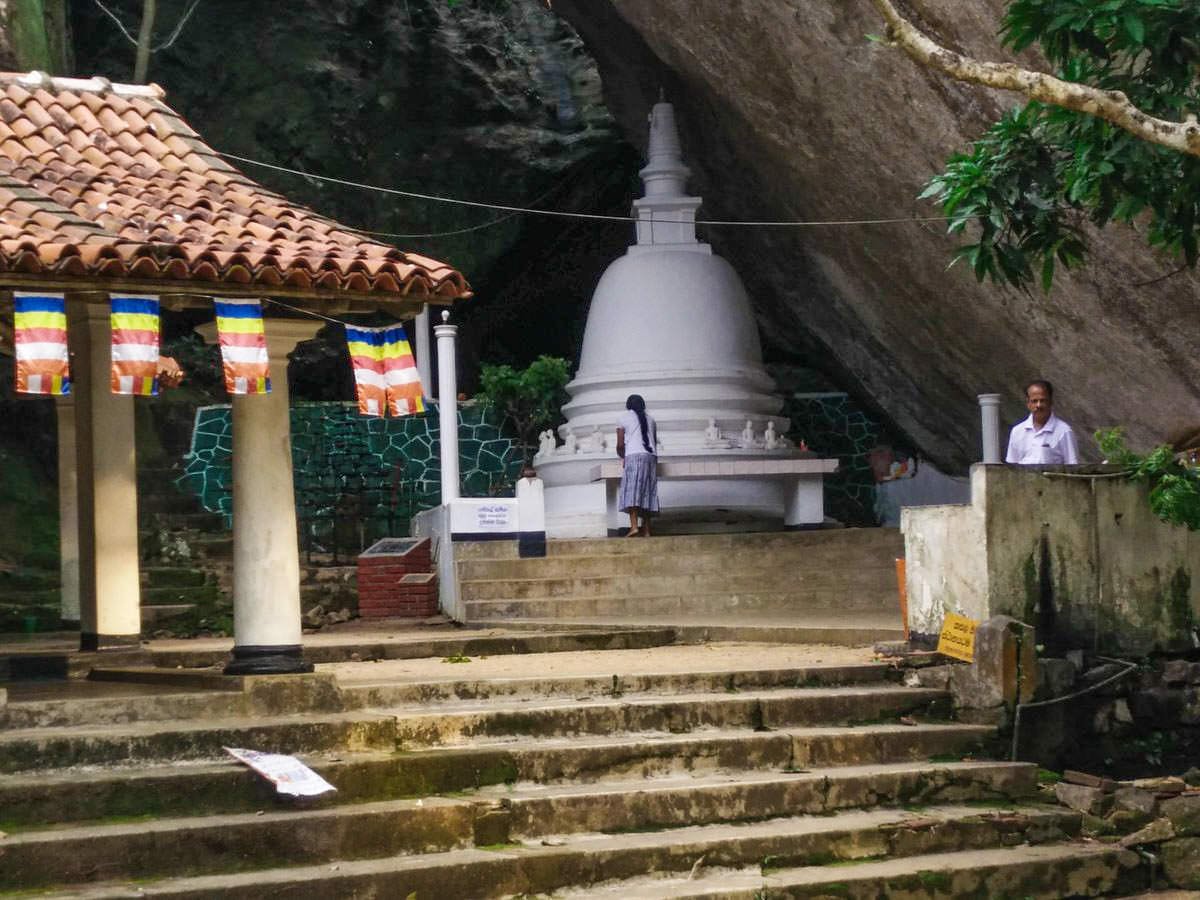
The surrounding landscape adds to the atmosphere. Terraced paddy fields frame the base of the hill, while a canopy of coconut palms and secondary forest stretches in every direction. The hill itself is composed of large granite boulders that form natural cave chambers — many still bearing their original rock-cut drip ledges, an ancient technique used to keep the interiors dry during the monsoon.
What is the history of Pilikuththuwa cave temple?
The recorded history of the site begins with King Devanampiyatissa (247–207 BC), who is credited with dedicating the cave complex to the Buddhist Sangha. Stone inscriptions consistent with this period have been found at the site, and the style of the rock-cut drip ledges matches dating techniques used for early Anuradhapura-era cave monasteries across the island.
The most celebrated chapter in the temple's history involves King Valagamba (also known as Vattagamani Abhaya) in the 1st century BC. Driven from his throne by a Chola invasion from South India, Valagamba is said to have taken refuge in the caves at Pilikuththuwa while regrouping his forces. The story goes that the king and queen also used certain caves to store their royal garments — 'pili' in Sinhala — giving the area its distinctive name. A secondary folk etymology suggests the name derives from 'Pili Kotuwa', one of five administrative divisions that once existed in the region; over generations, as those divisions merged and local speech evolved, 'Pili Kotuwa' softened into 'Pilikuththuwa'.
The 16th century added another dramatic episode. When King Rajasingha I of the Sitawaka kingdom — a Hindu convert deeply hostile to Buddhism — began persecuting Buddhist monks, the caves at Pilikuththuwa reportedly provided refuge again. This pattern of offering shelter in times of religious or political upheaval echoes across many of Sri Lanka's ancient cave complexes. Later, signs of Portuguese, Dutch, and British influence appear within certain caves, reflecting the temple's continued use and adaptation through the colonial period.
Stone Age artefacts recovered from some chambers confirm that the caves were used as habitation long before the Buddhist monastic community arrived — suggesting this rocky hill has been a human refuge for thousands of years.
What can visitors see at Pilikuththuwa Raja Maha Viharaya?
The 84 documented caves vary considerably in size and condition. Several retain well-preserved drip ledges and ancient Brahmi inscriptions on their facades. Inside, a number of caves contain reclining Buddha statues, painted murals, and votive offerings maintained by a resident monastic community that continues to occupy part of the complex today. A formal temple building adjoins the cave network, constructed in the style that evolved after the earliest monastic era.
Visitors should allow at least two to three hours to walk the full circuit of numbered caves. The terrain involves some scrambling over bare rock and uneven paths, so comfortable footwear is advisable. As with all active Buddhist temples in Sri Lanka, modest dress — covered shoulders and knees — is expected, and shoes must be removed before entering shrine rooms.
What wildlife lives around Pilikuththuwa?
The wooded hillside and surrounding agricultural land together support a diverse community of species that rewards patient observation.
- Mammals: Ring-tailed Civet, Palm Cat (Small Indian Civet), Barking Deer, and Sri Lankan Mongoose have all been recorded in the area.
- Birds: Red-wattled Lapwing, Spotted Dove, Red-vented Bulbul, Asian Koel, Small Bee-eater, Oriental Magpie-Robin, Sri Lanka Hanging Parrot, and Green Imperial Pigeon are among the more frequently seen species.
- Butterflies: Grey Pansy, Blue Bottle, Common Mormon, Blue Mormon, Common Sailor, and White Four-ring have been observed within the site.
- Reptiles and amphibians: The moist rock faces and forest floor host a variety of lizards, skinks, and frogs typical of Sri Lanka's wet lowland zone.
The mix of granite outcrops, forest edge, and water-retaining paddy land creates a mosaic habitat that benefits generalist and specialist species alike. Early morning visits, before the heat builds and before groups of pilgrims arrive, offer the best conditions for wildlife observation.
When is the best time to visit Pilikuththuwa Raja Maha Viharaya?
The Gampaha district lies within Sri Lanka's wet zone, which means rain is possible throughout the year. In practical terms, the site is accessible year-round. The drier months from December through March and again from June through August tend to offer more reliable conditions for walking the rocky paths between caves. Poya (full moon) days draw larger numbers of local pilgrims and are a culturally rich time to visit, though the site will be busier than on ordinary weekdays.
Morning visits are recommended for both comfort and atmosphere — the low light filters through the tree canopy, the birds are most active, and the rock faces stay cool before the afternoon sun heats them.
How does Pilikuththuwa fit into the broader Buddhist heritage of Sri Lanka?
Sri Lanka's cave monastery tradition is one of the oldest continuously practised forms of Buddhist monasticism in the world. Sites like Pilikuththuwa belong to a distinct category of heritage — not the grand stupas of Polonnaruwa or the rock fortress of Sigiriya, but the quieter, less visited cave complexes where monks have lived, studied, and meditated for more than two millennia. The rock-cut drip ledges, the Brahmi inscriptions, and the layered history of refuge and renewal make Pilikuththuwa a compelling site for anyone interested in early Buddhist archaeology rather than purely in monument tourism.
Nearby, the Attanagalla Raja Maha Viharaya and the Iranawila Rajamaha Viharaya offer complementary perspectives on the religious heritage of the Gampaha and Negombo coastal corridor, and the three sites can reasonably be combined into a single itinerary for travellers with a particular interest in regional temple history.
Nearby places
12 places within about 25 km, nearest first.
- Attanagalla City2 km
- Attanagalla Raja Maha Viharaya2 km
- Udugampola2 km
- Gampaha District3 km
- Daraluwa Railway Station4 km
- Ganegoda Railway Station4 km
- Gampaha City5 km
- Gampaha Railway Station5 km
- Gampaha Wickramarachchi University of Indigenous Medicine6 km
- Horagolla National Park6 km
- Horagolla Walawwa6 km
- Wandurawa Railway Station6 km