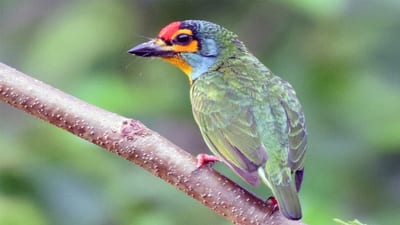
The Yellow-fronted Barbet (Psilopogon flavifrons, formerly Megalaima flavifrons) is an endemic bird found nowhere else on earth but Sri Lanka. Compact, colourful, and surprisingly vocal, it is the most frequently encountered barbet in the island's hill country and wet-zone forests — a dependable sighting for birders exploring forests from the lowlands up to about 2,000 metres.
How do you identify a Yellow-fronted Barbet?
The species is unmistakable once seen: a vivid yellow forehead and crown contrast sharply with a blue face and throat. The remaining upperparts are green, blending with the forest canopy. Adults measure around 22.5 cm in length — similar in size to a myna but noticeably stockier.
Compared with other Asian barbets, the Yellow-fronted Barbet has proportionally fewer rictal bristles at the corner of the mouth and a shorter bill that is wide at the base. Sexes are similar in plumage. Juveniles are duller than adults, gaining full colour as they mature.
Where does the Yellow-fronted Barbet live in Sri Lanka?
This barbet is primarily a species of the wet zone, thriving in the mid-hills and up-country forests where rainfall is reliable and fruiting trees are plentiful year-round. It ranges from the low-country wet zone up to about 2,000 m, and occurs sporadically in forests of the eastern dry-zone foothills.
Within the forest, Yellow-fronted Barbets tend to occupy the middle and upper layers of the canopy, rarely descending to ground level. They are regular participants in the famous mixed-species feeding flocks of the Sinharaja Forest Reserve, joining minivets, drongos, and other canopy species as they move through the trees in search of fruiting figs and other forest produce.
For visitors based in Colombo, the Labugama and Kalatuwawa forest reserves — both within roughly an hour of the city — offer reliable sightings without a long drive into the hills. The forests around Ella and the Horton Plains National Park buffer zone also provide good habitat at higher elevations.
What does the Yellow-fronted Barbet sound like?
Calls are the easiest way to detect this bird before you see it. The song typically opens with a rolling sequence that can be rendered as kow-o-wo-ow-ow-ow, before shifting into a rhythmic kuiar, kuiar, kuiar repeated many times. This calling phase is most active in the early morning and again briefly in the late afternoon; during much of the midday hours the birds tend to fall quiet.
Interestingly, Yellow-fronted Barbets go almost completely silent while feeding. It is not unusual to find several individuals together on a heavily fruiting tree, moving methodically from branch to branch without making a sound — easy to overlook unless you are scanning the canopy carefully.
What does the Yellow-fronted Barbet eat?
The diet is predominantly fruit — figs, berries, and other soft forest produce form the bulk of it. Like most barbets, however, the species is not exclusively frugivorous; insects are also taken, particularly during the breeding season when higher protein food is needed to raise chicks. At Sinharaja and other intact wet-zone forests, the bird's participation in mixed-species flocks suggests it opportunistically picks off insects disturbed by other foraging species.
When does the Yellow-fronted Barbet breed?
Breeding follows two distinct seasons each year: February to May and August to September. Both parents share excavation duties, carving a nest chamber into a dead or softwood tree. Entrance holes are typically positioned 3–10 metres above the ground, though some pairs nest higher. The entrance diameter is roughly 25 mm, leading to a deeper chamber that holds up to three pure white eggs. No nesting material lines the chamber — the eggs rest on bare wood chips left from excavation. Both parents incubate and share feeding responsibilities once the chicks hatch.
What is the conservation status of the Yellow-fronted Barbet?
As a Sri Lankan endemic, the Yellow-fronted Barbet's entire global population depends on the health of the island's forest cover. It is currently assessed as Least Concern by the IUCN, reflecting its relatively wide distribution across wet-zone and mid-elevation habitats. That said, ongoing deforestation and habitat fragmentation in the hill country and wet zone remain the primary long-term pressures on the species. Protecting contiguous forest patches — particularly in reserves such as Sinharaja and the Makandawa Rainforest — is critical for sustaining healthy barbet populations.
What is the best time of year to see Yellow-fronted Barbets?
Yellow-fronted Barbets are resident rather than migratory, so they can be observed year-round in suitable habitat. Activity levels peak in the early morning hours when calling is most frequent. The pre-breeding period from February through April is particularly rewarding: birds call persistently, pairs engage in territorial displays, and fruiting activity in wet-zone forests is often high. Visiting after significant rainfall, when the forest comes alive with activity, consistently produces the best sightings.
Tips for birdwatchers hoping to spot the Yellow-fronted Barbet
- Listen first. The distinctive rolling call carries far through forest — locate the bird by ear before scanning with binoculars.
- Check fruiting trees. A fig tree in fruit can attract multiple barbets simultaneously; scan slowly through the canopy rather than moving quickly along trails.
- Join a mixed-species flock. At Sinharaja in particular, following a moving flock almost guarantees an encounter.
- Start early. Arrive at the forest edge at dawn; calling activity drops sharply by mid-morning.
- Use forest reserves near Colombo. Labugama and Kalatuwawa are accessible half-day birding destinations that reliably host the species.