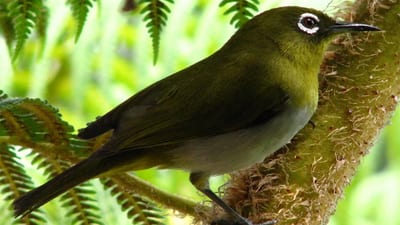
The Ceylon Scimitar Babbler (Pomatorhinus melanurus) is one of Sri Lanka's most recognisable forest birds, instantly distinguished by its long, sickle-shaped yellow bill and a remarkably coordinated duet call that echoes through humid woodland. As a species endemic to Sri Lanka, it is a reliable target for birders visiting the island's wet-zone forests and hill-country estates.
What does the Ceylon Scimitar Babbler look like?
Adults measure around 22 cm in length, and males and females are outwardly similar in plumage, as in most babblers. The most diagnostic feature is the long, decurved yellow bill, which gives the species its common name. The upperparts are typically warm brown, the underparts are white with rufous-brown flanks, and a prominent white supercilium runs above each eye. In the field, the combination of the curved bill and the habit of creeping along tree trunks and fallen logs makes identification straightforward even for less experienced birders.
Where can you find the Ceylon Scimitar Babbler in Sri Lanka?
The species occupies all suitable patches of humid, tall forest across the island, with one notable exception: it is largely absent from the dry northern peninsula. It also occurs in the dry lowlands and eastern hills, home of the race holdsworthi.
In the lowlands, the Sinharaja Forest Reserve — a UNESCO World Heritage Site — is perhaps the most reliable location, where the babbler is a regular participant in the mixed-species feeding flocks that move through the understorey. Other productive lowland sites include the Makandawa Rainforest corridor in Kegalle District. In the hill country, the bird is frequently encountered in tea and rubber estates that retain tall shade trees, particularly along river reservations and riparian strips where forest cover has been maintained. Horton Plains National Park, at higher elevations, also holds populations within its montane forest patches.
How does the Ceylon Scimitar Babbler behave and feed?
The babbler forages methodically, probing bark crevices, peeling loose bark, and rummaging through leaf litter at the base of trees. The curved bill is well adapted for extracting invertebrates — insects, larvae, and small invertebrates — from tight spaces that straight-billed birds cannot access. It regularly joins mixed-species flocks, which are a defining feature of Sri Lanka's wet-zone forests, and its presence in a foraging party often signals good forest quality.
The call is one of its most distinctive characteristics. The duet is so closely timed that the male's initial phrase and the female's near-immediate response are perceived as a single, fluid call. Experienced guides learn to distinguish the two voices within the overlapping sequence, but to a first-time listener it sounds like one bird singing alone.
When does the Ceylon Scimitar Babbler breed?
Breeding has been recorded from December to February and, in the south-west of the island, between May and July. The nest is a compact, cup-shaped structure built from mosses, dried leaves, and plant fibres, and is usually tucked into a bank, ledge, or tree cavity to provide protection from predators. Clutches typically consist of three to five plain white eggs.
What is the best time to visit Sri Lanka to spot this species?
The Ceylon Scimitar Babbler is a year-round resident, so there is no strict seasonal window for observation. However, the period from November to April generally offers the best birding conditions in the wet zone, as the southwest monsoon has receded and mornings are typically clear. The bird is most vocal and active in the early morning hours, roughly between 6 and 9 a.m., making a pre-breakfast forest walk the most productive approach. During the breeding season, calling intensity increases as pairs establish and maintain territories, making the duet easier to locate.
What is the conservation status of the Ceylon Scimitar Babbler?
As an endemic species, the Ceylon Scimitar Babbler's long-term survival is tied directly to the integrity of Sri Lanka's remaining wet-zone forests. It tolerates well-wooded estate landscapes, which provides some resilience, but continued fragmentation of lowland and mid-elevation forest remains a concern. The species is currently assessed as Least Concern by the IUCN, though endemic forest birds are always vulnerable to shifts in land use and canopy cover.
How do I find the Ceylon Scimitar Babbler on a guided tour?
The most efficient approach is to hire a specialist birding guide familiar with the call sequences of the wet-zone mixed flocks. At Sinharaja, local field guides based near the reserve entrance are highly experienced with endemic species and know the specific territories where the babbler is reliably active. An early start is essential — arriving at a forest trail by dawn significantly increases the chances of encountering a moving flock. Patience is rewarded: once a mixed flock is located, the babbler almost always appears within minutes.
- Best sites: Sinharaja Forest Reserve, Makandawa Rainforest, Horton Plains forest margins, Kitulgala riparian forest
- Best time of day: Dawn to mid-morning (roughly 6–10 a.m.)
- Best months: November to April for clearest conditions; December to February and May to July for breeding activity
- Key identification cues: Long decurved yellow bill, white supercilium, coordinated duet call
| Feature | Detail |
|---|---|
| Scientific name | Pomatorhinus melanurus |
| Family | Timaliidae (Old World babblers) |
| Length | Around 22 cm |
| Endemic status | Endemic to Sri Lanka |
| IUCN status | Least Concern |
| Habitat | Humid tall forest, riparian woodland, shaded estates |
| Breeding season | December–February; May–July in the south-west |
| Clutch size | 3–5 white eggs |