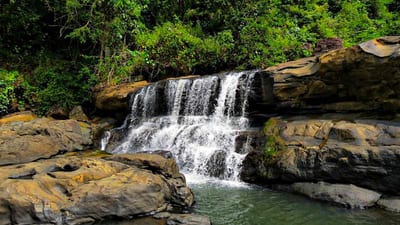
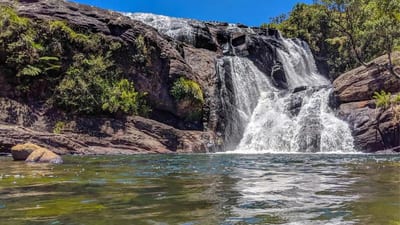
Laxapana Falls drops 413 feet (126 metres) through the misty highlands of the Nuwara Eliya district, making it the eighth-highest waterfall in Sri Lanka. Fed by the Maskeliya Oya — a major tributary of the Kelani River, the fourth-longest river in the country — the falls descends in a single dramatic curtain of white water before settling into a natural pool at its base. The surrounding hillsides are draped in tea estates, montane forest, and the dense greenery that defines Sri Lanka's central highlands.
Where exactly is Laxapana Falls?
The falls sits near the town of Hatton in the Nuwara Eliya district, roughly 140 kilometres east of Colombo. Hatton is a familiar stopover for travellers heading toward Nuwara Eliya or Adam's Peak, and Laxapana is a worthwhile detour from either route. The access road branches off close to the village of Norton Bridge, and from there a short walk leads to the main viewpoint above the cascade.
The surrounding area is part of the Maskeliya highlands, where the landscape alternates between hydroelectric infrastructure, tea cultivation, and pockets of cloud forest. The cloud forest habitats in this zone support a range of endemic bird species and highland flora that add a second layer of interest beyond the falls itself.
What makes Laxapana Falls historically significant?
Laxapana's importance goes well beyond scenery. The Maskeliya Oya that forms the falls also powers two hydroelectric stations nearby: the Old Laxapana Power Station, which is among the oldest hydroelectric installations in Sri Lanka, and the New Laxapana Power Station. Together they have supplied a meaningful share of the country's electricity generation for decades, making Laxapana a site of industrial heritage as well as natural beauty.
The combination of a working power infrastructure and an active tourist destination is unusual, and it gives Laxapana a character that purely scenic waterfalls lack. Visitors looking for context about the colonial-era engineering projects that shaped Sri Lanka's highlands will find this area particularly interesting.
When is the best time to visit Laxapana Falls?
The falls is at its most powerful during and just after the inter-monsoon periods — typically in April and October to November — when the Maskeliya Oya carries its highest volume of water. The cascade is visibly fuller and more forceful during these months, and the natural pool at the base is deeper.
The dry season between January and early March offers clearer skies and easier walking conditions, though the falls will be somewhat reduced in volume. Avoid visiting during heavy monsoon rainfall, when the access paths can become slippery and the mist around the falls reduces visibility considerably. Morning visits generally give the best light and the clearest air before afternoon clouds roll in from the south-west.
| Period | Conditions | Falls Volume |
|---|---|---|
| January – March | Drier, cooler, clear mornings | Moderate |
| April – May (inter-monsoon) | Showers, lush greenery | High |
| June – September (SW monsoon) | Heavy rain possible, mist frequent | Very high but access harder |
| October – November (inter-monsoon) | Showers, dramatic skies | High |
| December | Transitional, improving | Moderate to high |
How do I get to Laxapana Falls from Colombo?
The most direct route from Colombo is via the A7 highway through Avissawella and up into the highlands toward Hatton, a journey of roughly three to four hours by car depending on traffic. Alternatively, the scenic train from Colombo Fort to Hatton is a popular option that passes through Kandy and along some of the most spectacular rail scenery in the country; from Hatton, a tuk-tuk or taxi completes the journey to the falls.
If you are already based in Kandy or Nuwara Eliya, the falls is an easy half-day excursion. The road between Kandy and Hatton passes through the Ginigathena tea belt, and combining Laxapana with a stop at one of the working tea estates makes for a full day in the highlands. Travellers arriving from Ella can reach Hatton via Nuwara Eliya in around two hours.
What can I see and do near Laxapana Falls?
The immediate area around the falls rewards slow exploration rather than a quick photograph-and-leave approach. The natural pool at the base is a popular spot for cooling off, and the walking trails above the falls offer views across the Maskeliya reservoir and the surrounding highlands. Bird-watching in the adjacent forest patches can yield sightings of highland endemics including the Sri Lanka whistling thrush and various species of bulbul.
Within easy reach of Laxapana, visitors can explore:
- Adam's Peak (Sri Pada): Around 20 kilometres to the south, the sacred mountain draws pilgrims and hikers from December through May. The Hatton access route is one of the most popular starting points.
- Maskeliya Reservoir: A large man-made lake formed as part of the hydroelectric scheme, offering quiet scenery and views of the surrounding hills.
- Hatton town: A working hill-country town with a strong tea-industry character. The local market is a practical stop for provisions and a glimpse of everyday highland life.
- Bluefield Tea Gardens: One of the accessible working tea estates in the region where visitors can observe the plucking and processing of Ceylon Tea. A guided walk through the estate provides context for the plantation landscape that dominates so much of the view around Laxapana.
- Horton Plains National Park: Roughly 40 kilometres to the east, Horton Plains offers a completely different highland experience — an open plateau with World's End cliff, cloud forest, and excellent bird-watching.
What should I know before visiting Laxapana Falls?
The path to the falls is not a maintained tourist trail in the formal sense. Wear footwear with a firm grip, particularly after rain, and be cautious near the pool area where rocks can be slippery. The falls is not fenced or formally managed as a ticketed attraction, so there are no facilities such as toilet blocks or food stalls at the site itself; carry water and snacks from Hatton.
A reasonable level of fitness is helpful for the walk down to the base of the falls and back up. Children and older travellers should plan extra time and consider whether the path conditions on the day are manageable. Mobile network coverage in the immediate area can be intermittent, so download an offline map before leaving Hatton.
Laxapana is best visited as part of a broader highlands itinerary rather than as a standalone trip from Colombo, given the travel time involved. Pairing it with Adam's Peak, the Bogawantalawa valley, or a circuit through other highland waterfalls makes the journey considerably more rewarding.
Nearby places
13 places within about 25 km, nearest first.
- Castlereagh Reservoirunder 1 km
- Laxapana Estates4 km
- Zero Mile Post at Laxapana - Maskeliya - Norton Bridge4 km
- Dunkeld Estate6 km
- Delhousie6 km
- Nallathanniya City7 km
- Dick oya7 km
- Shannon Tea Estate7 km
- Aberdeen Falls7 km
- Sunken Town of Maskeliya8 km
- Kunudiya mountain8 km
- Baana Samanala Peak8 km
- Adam’s Peak8 km
Related reading
4 pages on closely related subjects.