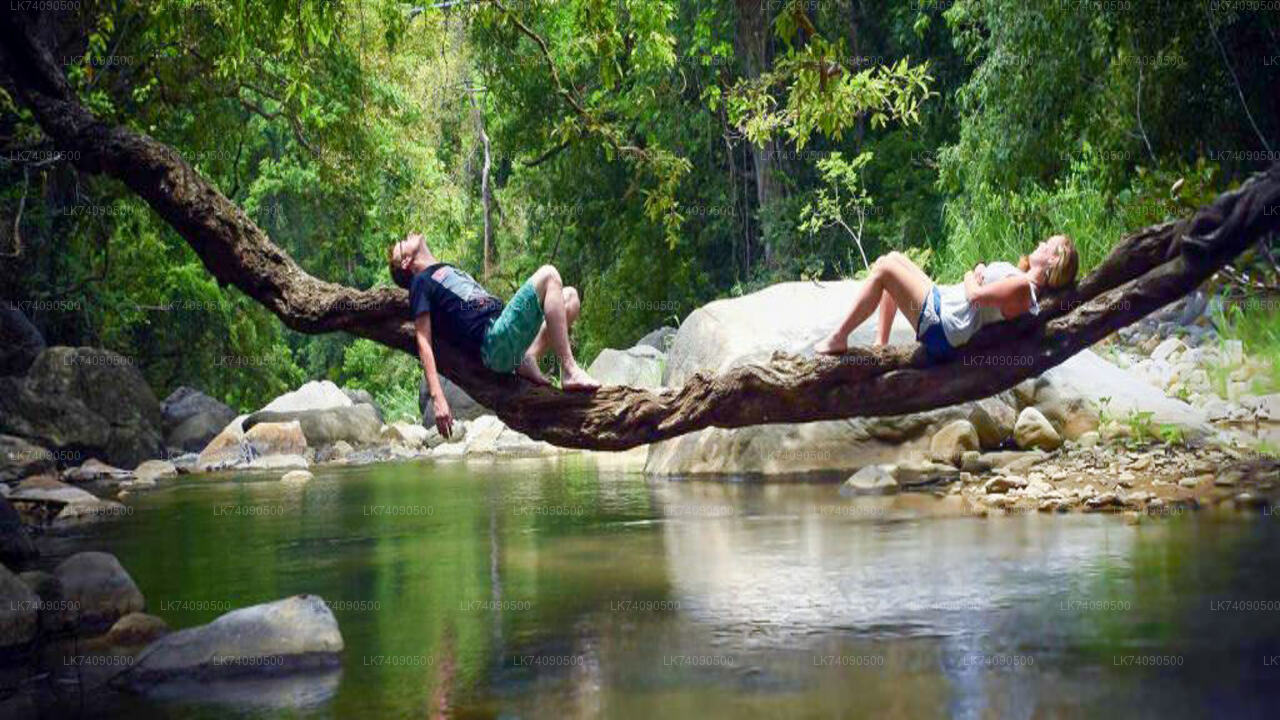
Kekuna Ella is one of southern Sri Lanka's quieter rewards — a compact waterfall tucked into the buffer zone of the Sinharaja Forest Reserve, close to the village of Lankagama in Galle District. Unlike the more heavily visited falls of the hill country, Kekuna Ella sees relatively few footprints, which makes the walk in feel genuinely exploratory and the arrival genuinely satisfying.
What is Kekuna Ella like?
The waterfall drops around 11 metres over a series of layered rock faces, fanning out slightly as it falls and collecting in a shallow natural pool at the base. The surrounding canopy closes in tightly, so the light that reaches the pool is filtered and cool even in the middle of the day. The mist thrown up by the cascade keeps the mosses and ferns around the banks vivid green year-round.
Because the site sits at the edge of one of Asia's best-preserved lowland rainforests, the biodiversity along the approach trail is unusually rich. Birders will recognise calls from endemic species, and the undergrowth regularly produces sightings of endemic butterflies and small lizards. The soundscape — water, wind through a high canopy, and intermittent birdcall — is the main attraction for many visitors as much as the waterfall itself.
How do I get to Kekuna Ella?
There are two practical approaches:
- From Lankagama: The most common starting point. The trail to the waterfall is roughly 2.5 km and passes through a mix of home gardens and forest edge before entering denser vegetation. Most fit walkers cover this in about an hour.
- From Deniyaya: Deniyaya town is the main gateway for Sinharaja and is better connected by road. From the forest edge it is approximately 2 km to the falls along marked trails. This route can be combined with a broader Sinharaja guided walk if arranged in advance through the Forest Department.
The nearest town with accommodation and food is Deniyaya. Private hire vehicles or tuk-tuks from Deniyaya can reach the Lankagama trailhead on paved roads, after which the path is on foot. There is no public transport that drops visitors at the trailhead itself.
What is the best time to visit Kekuna Ella?
Kekuna Ella flows most powerfully during and immediately after the south-west monsoon, which typically runs from May through July, and again after the inter-monsoon rains in October and November. Visiting at these times rewards you with a fuller cascade and lush surroundings, though trails become noticeably slippery underfoot.
The drier months from December through March are more comfortable for walking and photography, and the trails are safer for those without dedicated hiking footwear. The waterfall still flows but with a reduced volume. Sinharaja as a whole receives rain in most months, so any visit carries some chance of a shower — light, quick-drying clothing and a small pack cover are sensible year-round.
What should I bring and how difficult is the trek?
The terrain is rated moderate. The paths are uneven and root-crossed rather than steeply vertical, but the humidity and occasional mud make grip important. Closed-toe shoes with good ankle support or purpose-made trail sandals are strongly recommended — flip-flops are unsuitable.
- At least 1.5 litres of water per person
- Insect repellent (leeches are common after rain)
- A light waterproof layer
- Snacks, since there are no refreshment stalls on the trail
- A small first-aid kit or blister plasters
Children and older travellers can manage the route comfortably in dry conditions if they take their time. A local guide from Lankagama is worth arranging for first-time visitors — paths inside the forest can be unclear, and guides often double the wildlife sightings.
What else is nearby?
About 1.5 km upstream along the same waterway lies Patan Oya Falls, a secondary cascade that rewards those who continue beyond Kekuna Ella. The additional walk is relatively short and the trail stays close to the stream, making it an easy extension of the same outing.
The Sinharaja Forest Reserve itself — a UNESCO World Heritage Site and one of Sri Lanka's most important protected areas — begins effectively at the forest edge here. Guided walks inside the reserve cover different trail systems but share the same extraordinary biodiversity. If you are combining a Sinharaja visit with time in the Galle District or the southern coast, Kekuna Ella fits naturally as a half-day detour before or after the main forest walk.
How do I protect the environment at Kekuna Ella?
The area's appeal rests entirely on it remaining unpolluted and undisturbed. Carry all waste back out with you; there are no bins along the trail. Keep noise low near the waterfall, particularly if you arrive early when wildlife is most active. Avoid disturbing the pool bed — the natural pool is shallow and its substrate is fragile. Swimming in the pool is possible in dry conditions, but entering during high water is not advisable due to currents around the rocks.
The Sinharaja buffer zone is legally protected, and collecting plants, insects, or animals is prohibited. Stick to established paths to limit trail widening, which accelerates erosion in this high-rainfall environment.
Nearby places
11 places within about 25 km, nearest first.