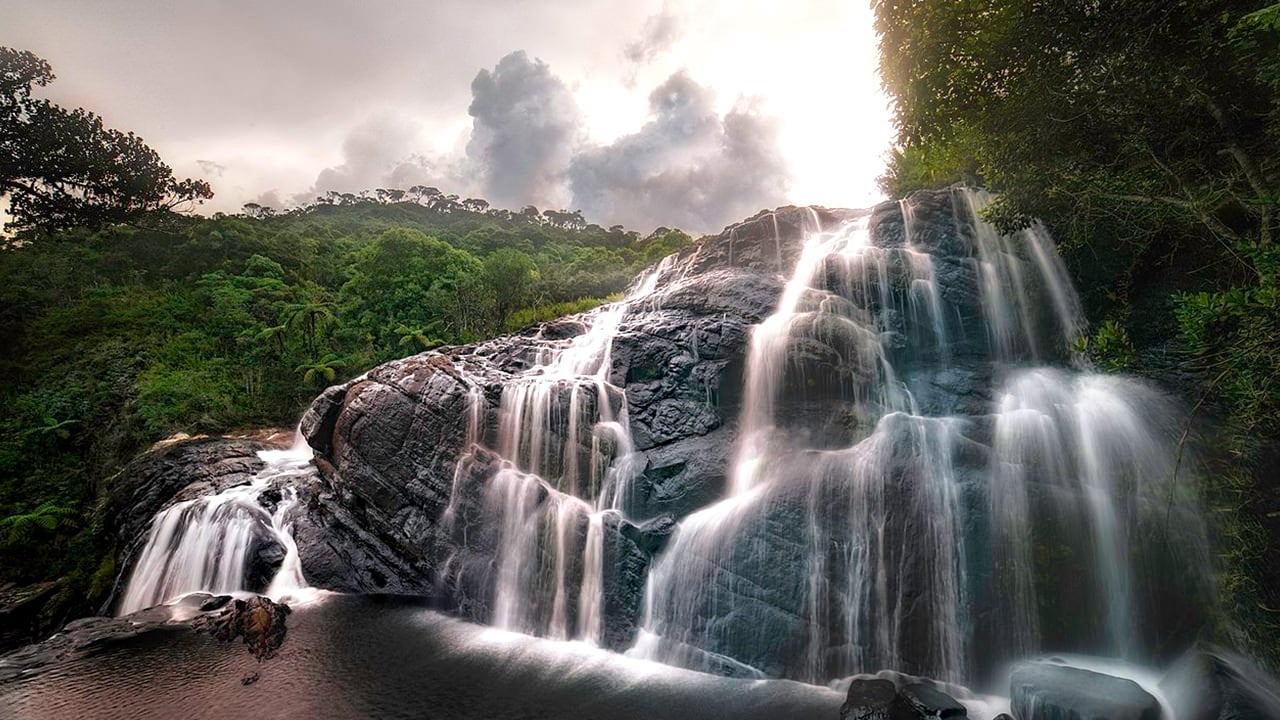

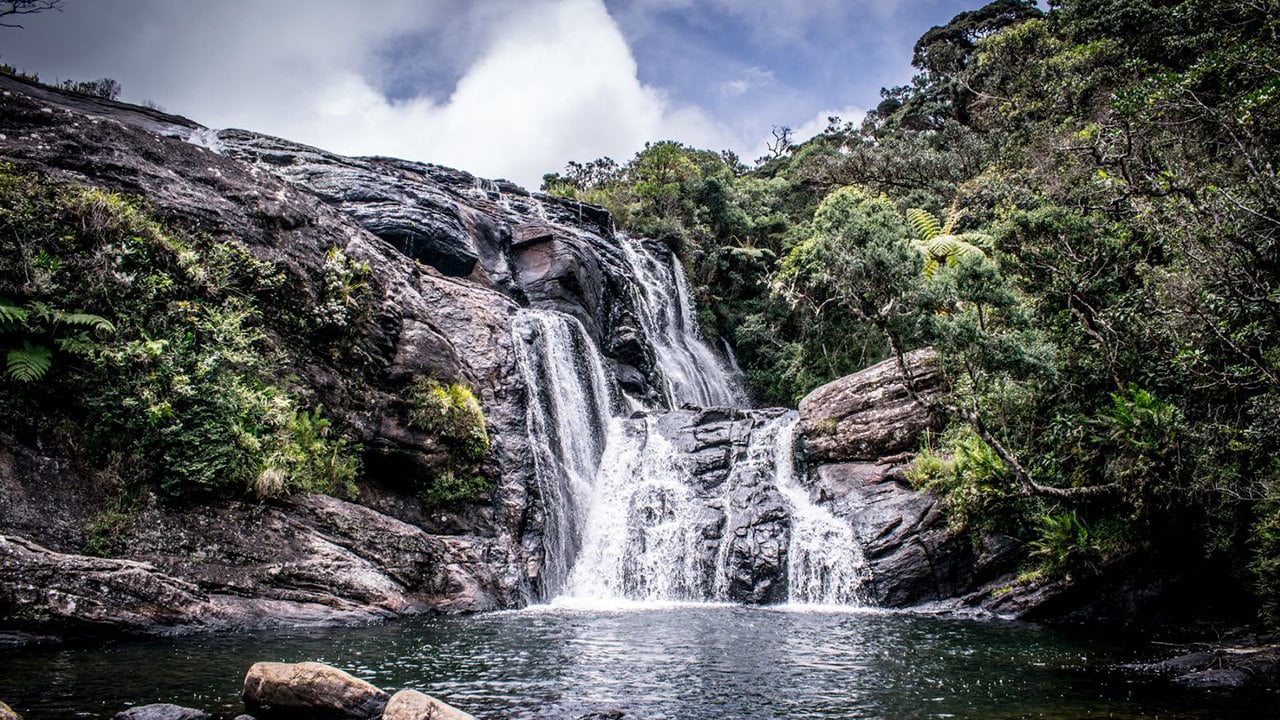
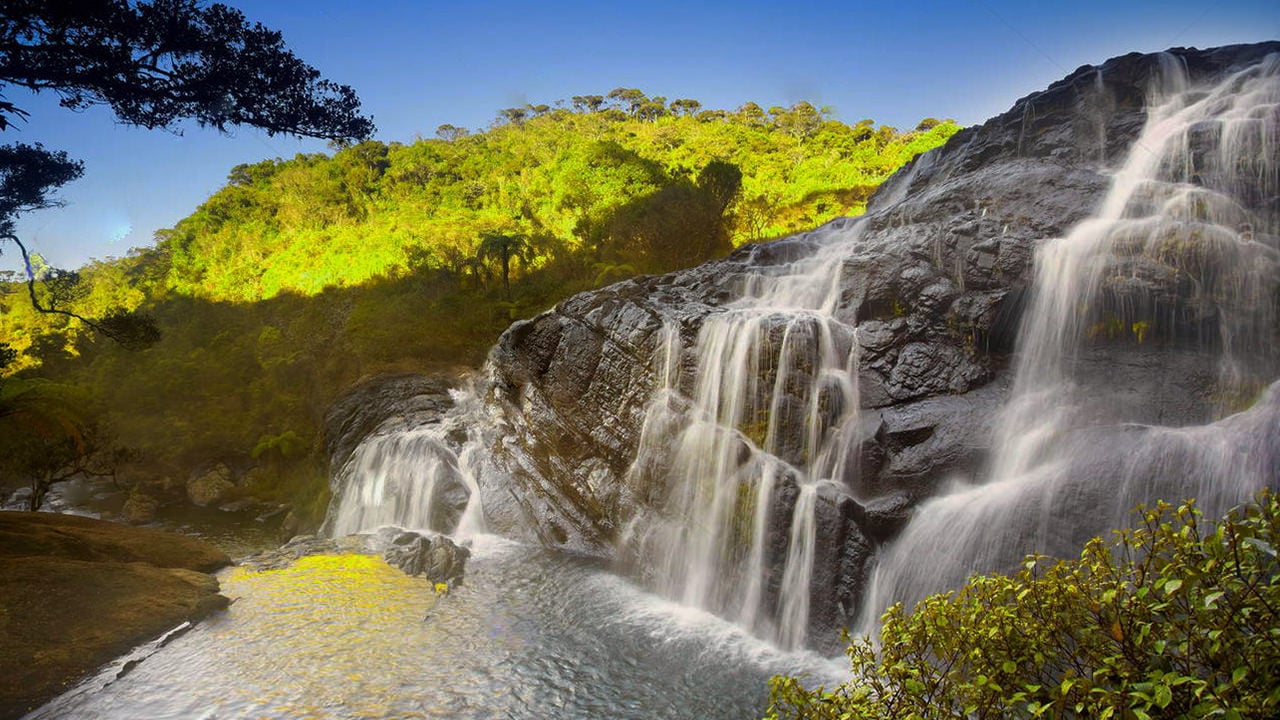

Baker's Falls is a waterfall set within the highland plateau of Horton Plains National Park, at an elevation of roughly 2,100 metres above sea level. The falls drop approximately 20 metres over a broad shelf of dark gneiss rock, splitting into several white streams before pooling in a boulder-lined basin below. The surrounding montane forest keeps the air cool and damp year-round, and the sound of the water carries well before the falls come into view on the trail.
The waterfall is named after Sir Samuel Baker, the British explorer who traversed the Central Highlands in the 1840s and later became well known for his explorations in Africa. Baker's Falls became a recognised landmark on the Horton Plains plateau well before the area was formally protected, and the name has remained ever since.
What is the trail to Baker's Falls like?
The standard hiking circuit inside Horton Plains National Park runs around nine kilometres and is typically completed in three to four hours at a relaxed pace. Baker's Falls sits roughly halfway along the loop, making it a natural rest stop between the park entrance and the famous viewpoint known as World's End. The path to the falls is a wide, well-maintained track through dense cloud forest, with exposed tree roots and occasional muddy sections — sturdy footwear is strongly advisable.
The final approach to the falls descends a short flight of stone steps to a viewing platform positioned directly in front of the cascade. Swimming in the pool is not permitted inside the national park, but the platform gives a clear, unobstructed view of the full drop.
What wildlife can I see along the way?
Horton Plains supports a range of endemic and highland-specialist species that are rarely encountered elsewhere in Sri Lanka. Along the trail to Baker's Falls you are likely to see:
- Sri Lanka sambar deer — large, shaggy deer that graze openly on the plateau grasslands, often in small groups.
- Purple-faced langur — the montane subspecies is endemic to this elevation and frequently spotted in the forest canopy near the falls.
- Sri Lanka leopard — present in the park but rarely seen; early-morning visitors have the best chance of sightings near the forest margins.
- Dull-blue flycatcher and Sri Lanka white-eye — among the highland bird species most commonly recorded near the waterfall.
- Rhododendron arboreum — the cloud forest along the trail turns red with these flowering trees between January and March.
When is the best time to visit Baker's Falls?
The park is open year-round, but the experience changes significantly with the seasons. The drier months from January through April generally offer the clearest skies and the most comfortable walking conditions, and the falls still run well from residual moisture in the highland soil. By May, the southwest monsoon begins to bring heavier rain to the plateau; mist can be thick by mid-morning, obscuring views at World's End though the falls remain impressive. The inter-monsoon period from September to November brings unpredictable showers but also lush, vivid green vegetation throughout the forest.
Regardless of season, arriving at the park gate as early as possible — typically around 6 a.m. when it opens — gives you the plateau largely to yourself and the best chance of clear conditions before cloud rolls in later in the morning.
How do I get to Horton Plains from Colombo or Ella?
The nearest town with accommodation is Nuwara Eliya, around 32 kilometres from the park entrance at Pattipola. From Colombo, the drive takes roughly five to six hours via the A7 highway through Kandy and Nuwara Eliya. From Ella, the journey is approximately one hour by road, making a day trip very practical. There is no reliable public transport to the park gate itself; most visitors arrange a private vehicle or a guided transfer to reach the entrance early enough to catch the best conditions.
What are the park entry fees and opening hours?
Horton Plains National Park is managed by the Department of Wildlife Conservation. Entry fees are set by the government and subject to periodic revision; visitors should confirm current rates at the gate or through their tour operator before the visit. The park typically opens at 6 a.m. and closes in the late afternoon. A conservation fee, vehicle fee, and tracker fee may all apply separately.
| Category | Note |
|---|---|
| Opening time | Typically 6:00 a.m. |
| Recommended arrival | As close to opening as possible |
| Circuit length | Around 9 km (full loop) |
| Average hiking time | 3–4 hours at a relaxed pace |
| Nearest town | Nuwara Eliya (~32 km) |
What should I bring on the hike?
The plateau sits above 2,000 metres and temperatures can feel markedly cooler than in the lowlands, particularly in the early morning. A light waterproof jacket is useful in any season. Because the trail passes through a protected national park, visitors are expected to carry out all waste; there are no food stalls or shops inside the park boundary, so bring water and snacks from Nuwara Eliya or the park entrance area. Plastic bags and single-use plastics are prohibited inside the park.
- Waterproof or water-resistant footwear with ankle support
- A light rain jacket or windproof layer
- At least 1.5 litres of water per person
- Sunscreen — UV levels are high at altitude even on overcast days
- Binoculars for wildlife and bird watching
Is Baker's Falls suitable for families with children?
The trail is broadly suitable for children who are comfortable walking for two to three hours on an uneven surface. The path does not involve any scrambling or exposed sections, and the falls viewing platform is safely fenced. That said, the cool temperatures and occasional rain mean younger children should be dressed in warm, waterproof layers. The full nine-kilometre loop to World's End and back is demanding for very young walkers; families sometimes hire a vehicle to drive to World's End first and walk back through Baker's Falls, reversing the standard circuit.
What else is near Baker's Falls?
World's End, the sheer escarpment with a near-vertical drop of around 870 metres, is the other major feature of the same hiking circuit and should not be missed on the same visit. Outside the park, the cloud forests of the Central Highlands extend to several other protected areas worth exploring. The Sinharaja Forest Reserve, Sri Lanka's only lowland rainforest UNESCO World Heritage Site, lies several hours to the southwest and offers a very different but equally rewarding forest experience.
Nearby places
11 places within about 25 km, nearest first.
- World's Endunder 1 km
- Horton Plainsunder 1 km
- Thotupola Kandaunder 1 km
- Horton Plains National Parkunder 1 km
- Cloud forestunder 1 km
- Windmills in Ambewela2 km
- Bakers Bend3 km
- Kirigalpotta3 km
- Ambewela Farm4 km
- Maskeliya City7 km
- Belihuloya City7 km
Related reading
6 pages on closely related subjects.